


News & Exhibitions
Latest Factory Updates, Industry Trends & Global Exhibition Information
Woodworking Solutions for Faster Changeovers in High-Mix Furniture Production
Faster changeovers begin with reducing the work required between the last acceptable part of one job and the first acceptable part of the next. A faster cutting or edging machine helps only when tooling, materials, programs, and inspection requirements are ready when production needs them. Otherwise, higher running speed leaves the main source of delay untouched.
Effective woodworking solutions for furniture manufacturing connect equipment selection with practical setup routines. In a factory producing different cabinet sizes, panel finishes, and edge details throughout the day, the objective is to make each transition predictable while protecting finish quality, part identification, and delivery commitments.
Measure the entire changeover before choosing equipment
A changeover does not end when an operator finishes adjusting the machine. It ends when the next job produces an acceptable part and can continue under stable conditions. Measuring only mechanical adjustment time hides delays caused by locating materials, correcting programs, checking edge appearance, or repeating trial pieces.
Observe representative transitions: a panel thickness change, an edge color change, a different drilling pattern, and a switch between standard and bevelled edges. Record what happens, who performs each task, and whether the machine must be stopped for that task.
This distinction prevents an expensive mistake: replacing a machine when the longest delays come from incomplete job information or missing components. Equipment investment becomes easier to justify once the actual constraint is visible.
Move preparation outside the machine stoppage
Many setup tasks can happen while the current job is still running. The next edge roll can be identified, the approved program retrieved, tooling inspected, and the next panel stack staged without interrupting production. Adjustments inside guarded areas, tool changes, and other tasks requiring isolation must remain within the machine’s prescribed safety procedure.
A practical preparation checklist should answer a few concrete questions:
- Are the correct panels available, with material, thickness, and surface finish identified?
- Are edge materials, tools, fixtures, and consumables ready for the next job?
- Does the production file match the current drawing revision?
- Are finished dimensions, edge assignments, and inspection requirements clear?
- Is there a labelled cart or defined location for the completed parts?
Preparation needs an owner. If everyone assumes someone else will bring the next edge roll or approve the drawing, the machine still waits. A short handover between material preparation and machine operation is often more useful than a longer checklist without clear responsibility.
Keep setup records close to the workstation. Record the tool identification, reference positions, relevant settings, and the material combination for which they worked. A saved setting is a starting point; tool wear, panel variation, and adhesive condition can still require adjustment.
Sequence jobs by what actually changes
Orders that look similar commercially may require very different machine setups. Two white cabinet panels may use different edge thicknesses, adhesives, or trimming profiles. Conversely, parts from separate orders may run efficiently together because their processing requirements match.
Build production families around the settings that cause meaningful disruption. At a panel saw or nesting machine, these may include board material, thickness, tooling, and hold-down requirements. At an edge bander, edge profile, band thickness, adhesive system, and panel thickness may matter more than overall panel dimensions.
Consider a schedule containing straight-edged shelves and cabinet components with a 45° edge detail. Repeatedly alternating between those processes can create unnecessary adjustments. Grouping compatible work can reduce transitions, provided parts remain traceable and the schedule still supports complete orders.
Long batches also have a cost. Producing every part of one finish together may leave assembly waiting for a few missing components from another family. Set batching limits around delivery priorities and downstream capacity. The useful batch is the one that reduces setup work without creating a larger queue elsewhere.
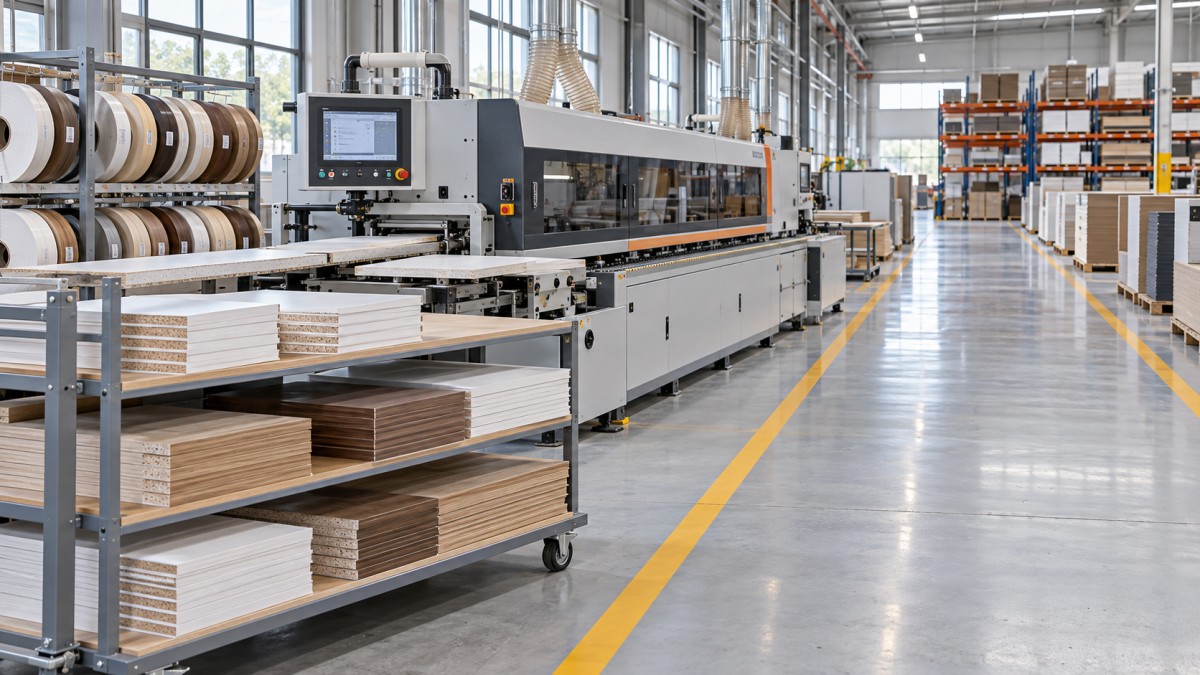
Choose machinery around the transitions your factory repeats
Machine specifications describe capacity, but they do not fully describe changeover effort. When comparing woodworking machinery, ask for a demonstration that moves between representative jobs. Watch the adjustments, trial pieces, operator actions, and recovery from an incorrect setting.
Useful features may include accessible adjustment points, clear position indicators, stored settings, repeatable tool references, and compatible toolholding systems. Their value depends on the application. Stored programs save little time if operators must still make several undocumented mechanical adjustments for each new panel type.
For CNC routing and drilling, examine the complete path from design file to accepted component. Compatible post-processing, reliable work offsets, suitable fixtures, and clear part orientation can matter as much as automatic tool changing. Small or narrow parts may require different workholding from full sheets, so a successful demonstration on large panels does not establish suitability for the whole product mix.
When a dedicated bevel edge machine makes sense
A dedicated process can be useful when a recurring edge detail repeatedly interrupts a general production route. The Beveling edge banding machine ZD450X is one example for 45° bevel edge processing of wood panels, MDF, and plywood, with automatic feeding, trimming, and polishing functions.
Its specified range includes panel thicknesses of 10–25 mm and edge band thicknesses of 0.4–1.5 mm. The stated minimum working length is 80 mm, and minimum working width is 70 mm. These limits provide an initial fit check; a production trial should also assess the combined dimensions, shape, surface finish, and edge detail of representative parts.
The changeover benefit would come from assigning suitable bevel work to a consistent route, reducing repeated reconfiguration elsewhere. That benefit depends on sufficient recurring demand, available floor space, and balanced capacity. Occasional bevelled components may not justify a separate station.
Installation also affects the decision. The listed machine dimensions are 5900 × 950 × 1700 mm, with a specified air pressure of 0.65 MPa. Layout planning must additionally provide feeding, outfeed, maintenance access, extraction connections, and safe material movement. A machine that fits physically can still create handling delays.
Standardize interfaces while preserving product flexibility
High product variety does not require every production detail to vary. Standard tool references, fixture mounting methods, program names, and material identification can support a wide range of furniture designs while making setup more consistent.
Tooling standardization works best when it reduces adjustment without compromising the cut. A shared tool family may simplify replacement and setup records, but different substrates and finishes can require different cutting geometries. Forcing one cutter to handle every material can increase chipping, wear, and rework.
Apply the same reasoning to edge materials. Reducing unnecessary variation in band thickness or profile can simplify processing when appearance and construction requirements permit it. Differences that serve a functional purpose should remain visible in the production instructions.
Keep tools, gauges, sample parts, and setup accessories in defined locations. A correct setup sheet cannot prevent delay if the required gauge is somewhere else in the workshop.
Protect the first acceptable part
Removing inspection from a changeover can make the recorded setup shorter while allowing defects to spread through the batch. A defined first-part check should focus on the characteristics affected by the transition.
After a panel thickness change, check the relevant machine positions and machining results. After an edge material change, inspect adhesion, trimming, surface damage, and appearance. After a CNC program change, check dimensions, hole positions, machining face, and orientation against the approved drawing.
Edge bonding deserves particular attention because a clean-looking edge does not establish bond quality. Adhesive application, panel condition, pressure, and temperature requirements must suit the material combination. Use an acceptance method appropriate to that combination rather than relying only on appearance.
Record successful settings alongside the inspection result. This creates a useful reference for repeat work and helps distinguish a setup problem from worn tooling, variable panels, or changed consumables. Operators should also know when an adjustment requires another check before production continues.
Keep faster machines from creating slower workflows
Reducing setup time at one station increases the rate at which work reaches the next. If edging improves but drilling or assembly cannot absorb the output, unfinished parts accumulate. Extra handling and searching can then consume the time saved.
Use a controlled buffer before the operation that limits output. Maintain enough ready work to keep that station productive, while limiting material elsewhere. The buffer should contain clearly identified, approved parts; a large pile of mixed components does not provide reliable production coverage.
Part identification should connect the physical component with its order, drawing revision, required edges, and next operation. Labels or barcodes can support this connection, but the underlying information must be correct. Scanning an outdated instruction simply moves an error faster.
Plan maintenance and support around production needs as well. Worn cutters, unstable air supply, clogged extraction, and contaminated adhesive equipment can turn repeatable setups into repeated troubleshooting. Critical spare parts and usable maintenance instructions help preserve improvements after commissioning.
For suppliers such as Qingdao Zhongding Machinery Co., Ltd., which provides woodworking machinery, technical support, spare parts, and after-sales service, the useful discussion extends beyond machine capacity. It should cover adjustment procedures, operator training, service access, and the components needed to sustain the intended production mix.
Validate the solution against a mixed production schedule
Before committing to a wider rollout, run representative transitions using the materials, edge details, and part sizes that create difficulty. Include a repeat job to test whether saved settings remain useful, plus a less familiar job to assess how clearly the setup process guides the operator.
Measure the interval from the last acceptable part of the previous job to stable, acceptable output from the next. Track trial material, rework, operator involvement, and downstream waiting alongside that interval. Comparing similar transitions helps prevent an easier product mix from being mistaken for a process improvement.
Acceptance criteria should cover setup duration, finished-part quality, handling, and required skills. A short demonstration performed by a specialist does not establish how reliably the routine will work across normal shifts.
Start with the recurring transition that causes the greatest disruption. Make its preparation repeatable, establish clear acceptance checks, and then decide which equipment capability would remove the remaining constraint. That sequence gives machinery investment a defined job to do—and gives the factory a practical way to judge whether it has succeeded.
Send Your Inquiry
We welcome your cooperation and we will develop with you.