


News & Exhibitions
Latest Factory Updates, Industry Trends & Global Exhibition Information
How Automated Woodworking Systems Track Parts from Cutting to Assembly
Automated woodworking systems track parts by linking each physical component to a unique digital record, then updating that record as the component moves through cutting, edge banding, drilling, inspection, and assembly. A barcode, two-dimensional code, or RFID tag provides the identifier. Production software supplies the machining instructions and destination, while readers, machine controls, and operator terminals report what has happened to the part.
That connection is reliable only when the system handles changes in sequence, rejected components, and replacement parts. A line that identifies panels correctly during an uninterrupted demonstration may still lose control when an operator removes a damaged piece or splits a stack. For technical evaluators comparing automated woodworking solutions, the useful question is whether the physical part and its production record remain aligned throughout these interruptions.
Part identity starts with the production data
Before a panel reaches the saw or nesting router, the production system needs a record that distinguishes it from every other component. A cabinet side panel may share dimensions with several others while requiring a different drilling pattern, edge treatment, finish, or assembly destination. Dimensions alone cannot provide dependable identification.
The record should connect the individual component to its order, assembly, material specification, machining requirements, and design revision. It also needs a defined route through production. Some panels proceed from cutting to edge banding and drilling; others require additional surface processing or inspection. The identifier acts as a lookup key, allowing each station to retrieve the relevant instructions without encoding the entire manufacturing record on a label.
Part type and physical instance deserve separate treatment. A part type describes the required component; an instance represents one manufactured attempt to produce it. If a damaged panel is recut, the system must distinguish the replacement from the original. Otherwise, a rejected panel that reappears downstream could be accepted alongside its replacement, creating duplicate inventory and a misleading assembly status.
Design changes require similar discipline. Once production starts, a revised drawing must not silently overwrite the instructions associated with components already manufactured. The system should retain the revision used for each part and establish whether existing pieces remain usable. Scanning an identifier is of limited value if it retrieves instructions that no longer describe the panel in front of the operator.
Choosing an identifier that survives the route
Printed barcodes and two-dimensional codes suit workflows where a reader can see the label at a predictable position. Human-readable text provides a useful recovery path when a scanner fails. Label placement must account for trimming, edge processing, drilling, stacking, and surface protection; a label that survives cutting may still disappear during a later operation.
RFID can identify tagged parts without direct optical visibility, but it introduces different engineering questions. Read zones must distinguish the intended panel from nearby workpieces, and tag performance needs evaluation around machine structures, stacked materials, and the actual handling arrangement. Reading several tags together does not automatically establish the order or position of the corresponding panels.
The choice therefore depends on the process. An accessible label may be sufficient for a manually loaded drilling station. A concealed identifier may help in another handling arrangement, provided the system can resolve which tagged component is entering the machine. In either case, the identifier carrier needs validation under the dust, abrasion, heat, pressure, and adhesive exposure it will actually encounter.
How the identity follows the panel between machines
At cutting, the software associates each resulting component with its production record. A nesting router may use labels applied to the sheet before machining, while a saw-based workflow may label components as they leave the cutting operation. Both approaches require a dependable association between the cut plan, the physical panel, and the correct label.
Pre-applied labels must correspond to the final nesting layout and remain attached to the intended pieces. Labels applied after cutting depend on controlled discharge and handling. If an operator rearranges similar panels before labeling, the system can assign valid identities to the wrong components. A successful barcode read would then confirm the label while leaving the underlying mistake undetected.
A useful tracking sequence follows the panel through these handoffs:
- Cutting: establish the physical part’s identity and record its release from the cutting operation.
- Edge banding: retrieve the required edge treatment, establish orientation, and record the relevant processing result.
- Drilling or routing: verify eligibility for the operation and load the appropriate machining program.
- Inspection or rework: record acceptance, a quality hold, or an authorized return to an earlier operation.
- Assembly staging: assign the component to its kit or assembly and check that all required parts are available.
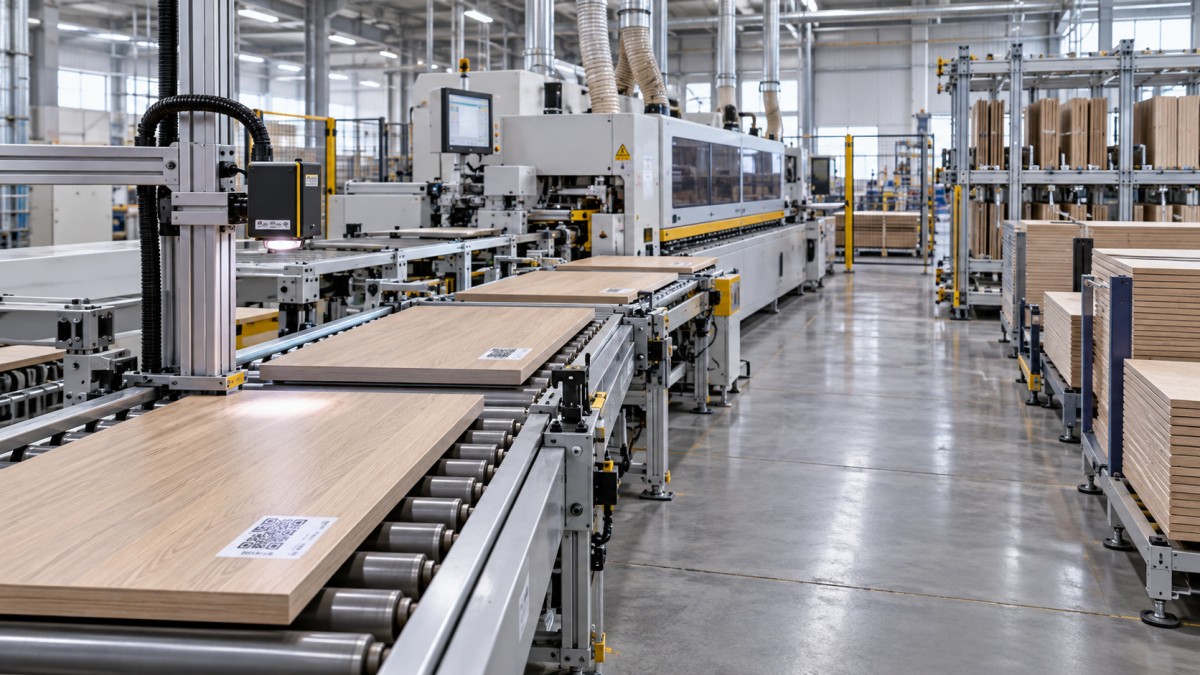
At each handoff, identification should lead to a decision. The station checks whether the part belongs there, whether prerequisite operations are complete, and which instructions apply. Reading a code and displaying an order number provides visibility, but controlling machine release requires additional logic.
Edge banding exposes an important limitation: identity does not establish orientation. A system may know which panel has arrived while remaining unable to tell which face is up or which edge leads into the machine. Depending on the equipment, orientation may be controlled by guides, handling devices, operator confirmation, or sensing. The record must describe the intended edges, and the physical process must present them correctly.
Position tracking can carry identity through an enclosed conveyor section after an entry scan. This works only while the relationship between parts and conveyor positions remains dependable. Removal, reinsertion, overtaking, or manual diversion can break that relationship. Where those events are possible, the design needs another identification point or an explicit procedure to restore the association.
Batch processing needs a different handoff
Some operations process several panels together, making individual entry-and-exit tracking less straightforward. Veneer pressing is one example. A Wood Veneer Hot Press Machine applies heat and hydraulic pressure to bond natural wood veneer to substrates such as MDF, plywood, or particle board. Its pressing function does not, by itself, establish component traceability.
For a multi-layer pressing operation, the surrounding workflow can associate each panel with a press load and loading position, then reconcile the parts during unloading. Label location and identification method need to suit the pressing conditions and finished surface. If identity is carried through a load map, the loading and unloading sequence must preserve that map. Any available cycle data should be connected to the correct load through a verified interface; automatic data exchange should never be assumed from the machine’s processing capability.
The software must distinguish a scan from a completed operation
A scan establishes that an identifier was read at a particular point. It does not prove that the machine processed the component successfully. Reliable tracking separates events such as arrival, instruction acceptance, cycle start, cycle completion, and quality release. These distinctions let downstream stations recognize the difference between a panel waiting beside a machine and one ready for assembly.
The production platform, machine interface, and controller must agree on what each status means. A controller’s “cycle complete” signal may confirm that a programmed sequence ended without confirming dimensional accuracy or finish quality. If inspection is required, its result needs a separate place in the workflow. Otherwise, the assembly system can report a complete kit containing components still awaiting acceptance.
Technical evaluation should examine several interfaces:
- Part-to-program matching: how the system selects the correct program and checks its revision before processing.
- Machine feedback: which events the equipment reports and how interrupted or aborted cycles are represented.
- Message handling: how delayed, repeated, or missing messages affect the part record.
- Connection loss: what work may continue locally and how records are reconciled when communication returns.
- Manual changes: who can override a route, replace an identifier, or release a held component, and what history is retained.
A stated communications protocol answers only part of the integration question. Even when equipment supports a common interface such as OPC UA, the available data fields, event meanings, and command permissions still need agreement. File-based program transfer may also be workable, but transferring a machining file does not automatically provide completion feedback or enforce the production route.
Repeated messages are a practical concern. If a machine sends a completion event again after reconnecting, the production system should recognize the duplicate and preserve one valid result. Events also need enough context to identify the part instance, operation, machine, and relevant sequence. A timestamp alone may leave ambiguity when messages arrive late.
Disconnected operation requires a defined policy. A station might continue with previously authorized instructions held locally, while another process may need to stop because the latest routing or quality status is unavailable. The appropriate choice depends on the consequences of using stale information. Evaluators should ask the supplier to demonstrate both the interruption and the subsequent reconciliation.
Assembly readiness depends on exceptions and kit completeness
Assembly is where tracking must answer a more useful question than “Where is this panel?” It must establish whether all required components for a specific assembly are present, accepted, and compatible with the applicable design revision. A trolley containing the expected number of panels can still be missing one component and carrying a duplicate of another.
A kit can have its own identifier, with individual parts scanned into it. The system then compares the actual contents against the assembly requirements and highlights missing, rejected, or incorrect components. If a panel is removed for repair, its kit membership or readiness status must change immediately enough to prevent premature release to assembly.
Exceptions deserve deliberate testing because they reveal whether the system understands production state. A useful acceptance demonstration should include an unreadable label, a panel presented at the wrong station, an interrupted machining cycle, a rejected component followed by a recut, and a network interruption. It should also include a part removed from a tracked conveyor or kit. Each event needs a visible recovery path that preserves the component’s history.
Relabeling is particularly sensitive. Operators need a way to recover identity without selecting a plausible record merely because the dimensions match. Recovery may rely on controlled location, cutting-plan information, other readable markings, or inspection against the production requirements. Where identity cannot be established confidently, holding or remaking the component can be more dependable than assigning an uncertain identity.
For mixed orders, frequent recuts, and several machining routes, individual part tracking can provide valuable control over assembly readiness. A simpler operation with stable batches may obtain adequate visibility through controlled batch handling and selected scanning points. The appropriate scope follows the places where identity can be lost and the decisions that depend on it.
Before accepting a proposed system, follow one component through its normal route, reject it, manufacture its replacement, and complete the assembly kit. The records should explain which physical instance was accepted, which operations it completed, and why the kit was released. That demonstration gives a technical evaluator concrete evidence that tracking can support production when the planned sequence changes.
Send Your Inquiry
We welcome your cooperation and we will develop with you.