


News & Exhibitions
Latest Factory Updates, Industry Trends & Global Exhibition Information
Which Woodworking Equipment Suits a Furniture Export Factory?
A furniture export factory needs more than machines that can cut and assemble wood. It needs equipment that can repeat the same result across long production runs, adapt to different buyer specifications, protect finish quality during transport, and remain practical to service when orders are already scheduled. That is why the answer to which woodworking equipment is suitable for a furniture export factory is usually a coordinated production line, not a single “best” machine.
The right setup depends on the furniture category, panel materials, order mix, finish requirements, and expected output. A factory producing flat-pack melamine cabinets has very different priorities from one making solid-wood dining tables or veneered bedroom furniture. However, most export-oriented factories benefit from reliable cutting, edge processing, drilling, machining, sanding, dust extraction, and inspection capabilities.
The equipment should be selected around the factory’s actual bottleneck. Buying a fast CNC machine will not solve late delivery if edging, sanding, hardware drilling, or packing remains slow and inconsistent. Production flow matters as much as individual machine capacity.
Start with the furniture and order model
Before comparing woodworking machines, define what the factory will make repeatedly. Export furniture commonly falls into a few production patterns:
- Panel furniture: cabinets, wardrobes, TV units, office desks, and ready-to-assemble furniture made from particleboard, MDF, plywood, or laminated panels.
- Solid-wood furniture: tables, chairs, beds, frames, doors, and decorative products requiring jointing, shaping, sanding, and finishing.
- Mixed-material furniture: furniture combining panels with solid wood, metal, glass, upholstery, or stone components.
- Customized contract furniture: hotel, apartment, retail, or project furniture produced in varying dimensions and smaller batches.
Panel furniture factories usually need accurate cutting, fast edge banding, drilling, and repeatable hardware positioning. Solid-wood operations need stronger preparation equipment, stable moulding or shaping capability, and a more developed sanding process. Factories serving multiple markets often need flexibility as well as speed, because buyer designs, hardware systems, packaging rules, and finish expectations can change between orders.
A common purchasing mistake is to choose equipment based only on a product catalog or a competitor’s factory layout. A machine can be technically capable but still unsuitable if it is too automated for the order volume, too limited for the panel sizes in use, or difficult to integrate with the factory’s current workflow.
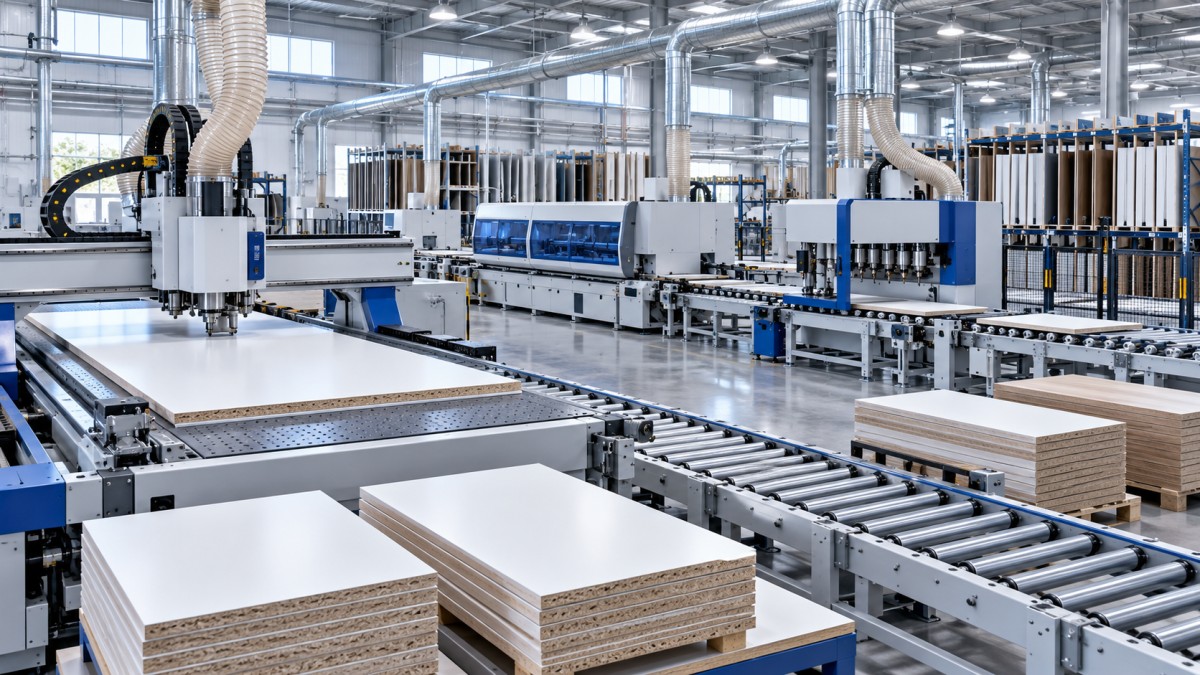
The core equipment for panel furniture export production
For panel furniture, material accuracy must carry through every stage. A small cutting error can become a visible gap at assembly; poor edge adhesion can create customer complaints after furniture reaches a humid or dry destination market. The essential equipment is therefore closely connected.
Panel saw or CNC nesting machine
A panel saw is a practical choice for factories with stable cutting lists, repeated cabinet dimensions, and a need for high-volume rectangular panel processing. Beam saws are commonly used where efficiency and consistent sizing are priorities. Sliding table saws can serve lower-volume production, sample work, and flexible cutting, but they depend more heavily on operator skill and material handling discipline.
A CNC nesting machine is often better for customized furniture, shaped components, and batch sizes that change frequently. It can cut, route, groove, and sometimes drill within one workflow, reducing panel movement between machines. It is not automatically the right replacement for a beam saw. If the factory mainly cuts standard rectangular cabinet parts in large volumes, a dedicated panel saw may provide a more direct and efficient process.
When choosing either option, examine usable cutting dimensions, material loading method, labeling needs, dust collection connection, and how cut parts will reach the next station. The machine’s quoted speed matters less than the complete cycle from raw board to sorted, identifiable component.
Automatic edge banding machine
For export panel furniture, an edge bander is often one of the most important quality-control machines in the line. It applies edge material to exposed board edges, but its value is not simply cosmetic. Proper edge processing protects the core material, improves durability, and makes the furniture look consistent from carton to final installation.
An automatic edge bander may include pre-milling, glue application, pressure rollers, end trimming, rough and fine trimming, scraping, and buffing. The right configuration depends on the material and expected finish. A factory producing basic utility furniture may not need every processing unit. A factory making painted, high-gloss, or premium laminated panels will usually need cleaner edge preparation and more controlled trimming.
Do not select an edge bander only by the number of units listed. Check whether it can handle the edge tape thicknesses used in your orders, whether glue temperature and application can be controlled consistently, and whether changeovers are realistic for the product mix. Poor maintenance, incorrect glue settings, and insufficient pre-milling can cause edge lifting, glue lines, chipping, or uneven corners.
CNC drilling and machining equipment
Furniture for export often uses knock-down connectors, hinges, drawer slides, and standardized hardware systems. Their hole positions must be accurate or assembly becomes difficult at the destination. A CNC drilling machine, point-to-point machining center, or drilling-and-routing center can improve consistency for cabinet sides, doors, shelves, and back panels.
This equipment is especially useful when the factory has many SKUs, frequent design revisions, or hardware patterns that vary by customer. It reduces manual marking and helps maintain repeatability, provided that production drawings and drilling programs are managed properly.
For simple, stable products, a multi-row drilling machine may remain a sensible and cost-effective solution. For varied export orders, CNC drilling offers greater flexibility. The deciding factor is not whether CNC is more advanced; it is whether the factory needs programmable changes often enough to justify it.
What solid-wood furniture factories need beyond cutting
Solid-wood furniture requires a different equipment balance because the raw material is less uniform than engineered board. Moisture movement, grain direction, knots, and material variation affect machining and finishing. The production line must prepare timber accurately before final shaping and assembly.
A typical solid-wood process may include a rip saw or crosscut saw for dimensioning stock, a jointer and thickness planer for producing straight and uniform boards, and a four-side moulder for repeated profiles or consistent section sizes. These machines are useful when the factory produces frames, legs, rails, mouldings, or other repetitive components.
A CNC machining center or CNC router becomes valuable when parts have curves, decorative profiles, holes, slots, or changing designs. It can improve repeatability for chair parts, table components, cabinet doors, and shaped panels. Yet it should not be used as a substitute for proper material preparation. Warped or poorly conditioned timber can still create inaccurate parts after CNC machining.
Solid-wood factories should also give serious attention to sanding. A wide-belt sander works well for flat components and panels, while profile sanders, edge sanders, or manual sanding stations may be needed for shaped parts. Sanding should be planned around the finish system. A surface that looks acceptable before coating may reveal scratches, glue marks, or uneven grain after stain, paint, or clear finish is applied.
Equipment that exporters often underestimate
The primary machines attract most of the attention, but supporting equipment often determines whether an export order is delivered with stable quality.
Dust collection deserves particular attention. Fine dust affects machine performance, creates rework during finishing, and can settle on adhesive or coated surfaces. It is not enough to install a collector somewhere in the workshop. The system must have suitable connection points, airflow balance, and cleaning routines for the machines actually in use.
Material handling is another overlooked area. A factory may invest in automated cutting but lose the gain when operators stack panels incorrectly, move parts too many times, or mix components from different orders. Labels, racks, roller tables, lifting devices, and clear batch identification can have as much impact on order accuracy as a new machine tool.
Choose automation to fit the workload
Automation is useful when it removes a repeatable constraint: repeated manual feeding, frequent measuring, heavy lifting, data entry, or operations that create too much variation between operators. It is less useful when the production plan is unstable, maintenance support is weak, or the factory has not yet standardized its drawings and material flow.
For a growing export factory, a sensible progression is often to automate the stages that create the most rework or delivery risk. This may mean upgrading from manual cutting to an optimized panel saw, from hand edging to automatic edge banding, or from manual drilling templates to CNC drilling. Fully integrated lines can be appropriate for stable, large-volume product families, but they require careful layout planning and dependable upstream material supply.
Machine utilization should be evaluated across the whole production schedule, not by peak demand from one order. A large machine that remains idle for long periods ties up capital and still requires operators, maintenance, floor space, and spare parts. Conversely, an undersized bottleneck machine can force overtime, create rushed quality checks, and delay container loading.
Questions to ask before placing a machinery order
A supplier should be able to discuss the production requirement in practical terms, not only provide a machine list. Prepare the following information before requesting a proposal:
- The main furniture categories and the materials used for each one.
- Largest and smallest panel or workpiece dimensions.
- Expected mix of standard orders, customized orders, and sample development.
- Required operations: cutting, grooving, routing, drilling, edging, sanding, assembly, or finishing.
- Current bottlenecks, recurring quality defects, and stages with excessive manual handling.
- Available workshop space, electrical capacity, compressed air, dust collection, and internal logistics routes.
- Whether operators need on-site training, remote technical support, installation guidance, or a planned spare-parts package.
These details help avoid a common mismatch: purchasing a machine that performs the intended operation but cannot work smoothly with the factory’s material sizes, utilities, staffing, or next production stage.
Service support is part of the equipment decision
For export furniture production, downtime can affect shipping schedules, customer acceptance, and production planning. A woodworking machine should therefore be evaluated as a long-term operating asset rather than a one-time purchase. Ask how technical problems will be diagnosed, how wear parts are identified, what documentation is supplied, and how operators will be trained to carry out routine adjustments.
Qingdao Zhongding Machinery Co., Ltd. supplies woodworking machinery and complete solutions for furniture manufacturing, workshops, and industrial production lines. With more than 20 years in the industry, the company focuses not only on machine performance but also on technical support, spare parts supply, and responsive after-sales service. For a factory building or upgrading an export line, this kind of support is most useful when it begins with a clear review of the production process rather than a generic equipment package.
Build the line around consistent output, not maximum machine count
The suitable woodworking equipment for a furniture export factory is the equipment that supports its actual products from raw material to packed shipment with controlled quality and manageable changeovers. For panel furniture, that commonly means accurate cutting, dependable edge banding, and precise drilling. For solid wood, it usually means strong material preparation, reliable shaping, and disciplined sanding. Both types of factories need effective dust extraction, handling, inspection, and service planning.
Begin with the product range and the current production constraint. Then choose machines that remove that constraint without creating a new one downstream. A balanced line with practical support systems will usually produce better export results than an impressive collection of standalone machines that do not work together.
Send Your Inquiry
We welcome your cooperation and we will develop with you.