


News & Exhibitions
Latest Factory Updates, Industry Trends & Global Exhibition Information
Is One Supplier Better for a Complete Woodworking Production Line?
Is one supplier better for a complete woodworking production line? Often, yes—but not automatically. For a furniture factory adding capacity, a cabinet shop moving from manual handling to connected equipment, or an exporter building a new panel-processing line, a single machinery partner can remove many of the coordination problems that appear between cutting, edge banding, drilling, sanding, assembly, and material handling.
The appeal is easy to understand. One supplier may provide a more consistent machine interface, a clearer layout plan, fewer arguments over responsibility, and a simpler path for commissioning and spare-parts support. Yet “one supplier” should not mean accepting a poorly matched machine simply because it comes from the same catalog. The better decision depends on the supplier’s ability to understand the product, production rhythm, labor situation, material mix, and future expansion plan—not merely its ability to quote a complete package.
In woodworking, the line is only as reliable as the handoff between its machines. A high-speed panel saw does not solve a bottleneck if parts then wait at the edge bander. An advanced CNC machining center can still sit idle when upstream labeling, sorting, or material flow is inconsistent. That is why the supplier decision deserves more attention than a simple comparison of individual machine prices.
A production line is a system, not a row of machines
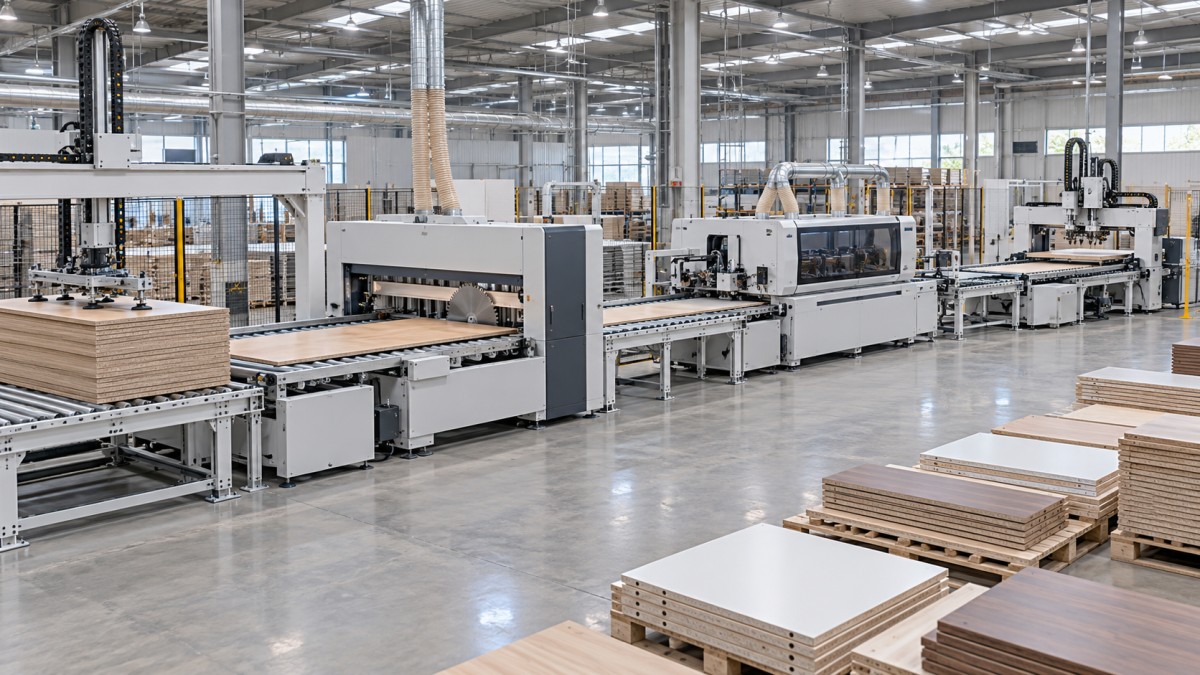
A complete woodworking production line may be relatively compact, such as a panel saw, edge bander, drilling machine, dust collection connection, and return conveyor for a cabinet workshop. It may also involve nesting, CNC routing, automatic loading and unloading, sorting, sanding, pressing, finishing, or packaging. The equipment list matters, but the connection logic matters more.
Take a typical panel furniture workflow. Boards need to be identified before cutting. Cut parts must be protected from confusion during stacking and transfer. Edge-banded components need to arrive at drilling or machining in the correct sequence. If the factory produces many customized orders, a small labeling error can cause more disruption than a temporary reduction in machine speed. In mass production, the greater concern may be whether feeding and discharge capacity can keep pace over a full shift.
A supplier responsible for the wider line has a practical reason to examine those links. If a machine cannot achieve the required throughput because material handling is too slow, the problem is visible to everyone. With separate suppliers, each party may reasonably focus on its own machine boundary. That can leave the factory manager trying to resolve the gaps.
Where a single-source approach usually makes sense
One supplier is often the stronger option when the project involves several interdependent machines and the buyer wants one technical team to take ownership of layout, interfaces, installation guidance, and startup support. This is particularly relevant for new facilities or workshops with limited in-house automation experience. It reduces the number of drawings, communication channels, and assumptions that need to be managed during the project.
There is also a maintenance advantage. Operators do not want to spend a production day deciding whether a fault belongs to the saw supplier, the conveyor supplier, the controls provider, or a third-party installer. A capable line supplier should be able to map the electrical, pneumatic, mechanical, and operating boundaries before shipment. That does not eliminate every service issue, but it makes responsibility easier to trace.
For overseas buyers, the value can be even more practical. Shipping schedules, container planning, documents, remote commissioning support, replacement parts, and operator training all need coordination. When equipment comes from several unrelated sources, small delays can become expensive because installation teams and site preparation are waiting for one missing component. A consolidated supply arrangement can reduce this exposure, provided the supplier has genuine export and project-management experience.
Qingdao Zhongding Machinery Co., Ltd. has worked in woodworking machinery for more than 20 years, supplying equipment and integrated solutions for furniture manufacturing, woodworking workshops, and industrial production environments. That kind of long-term involvement matters because complete-line work is rarely solved by selecting machines one by one. It requires an understanding of how production requirements translate into equipment configuration, floor space, operating access, maintenance access, and realistic sequencing.
The cost question is bigger than the quotation
Buyers sometimes assume that purchasing each machine from the lowest-priced specialist will always reduce capital cost. It can, especially when the line is simple or when the buyer has strong engineering resources. But the purchase price is only one part of the decision.
The less visible costs usually appear later: redesigning the layout after equipment arrives, adapting conveyors, modifying electrical connections, buying duplicate spare parts, retraining operators on different control logic, or losing time while suppliers debate an interface issue. A line that looks cheaper on paper can become difficult to run if its machines require different routines and no party has checked the production flow as a whole.
That said, a bundled proposal should never be accepted simply because it promises convenience. Ask for the equipment scope in detail. Does the proposal include internal transfer equipment, safety-related accessories where applicable, tooling requirements, dust extraction connection points, electrical requirements, commissioning boundaries, and operator training? Is installation support remote, on site, or handled by a local partner? These are commercial and technical questions, not fine print.
When multiple suppliers may be the better choice
There are valid reasons not to place every part of a woodworking line with one company. A factory may already have a preferred CNC brand, a standardized software environment, or an established local service provider. Some operations also rely on a highly specialized process where a particular machine maker has a clear technical advantage. In those cases, forcing everything into one package can create unnecessary compromise.
The key distinction is between a mixed-supplier line that is engineered and a mixed-supplier line that is merely assembled. The first has defined responsibilities, confirmed dimensions, agreed signal or handling requirements, and a person accountable for integration. The second depends on hopeful assumptions: “the conveyor should fit,” “the software should communicate,” or “the operator can work around it.” Those assumptions tend to become costly after delivery.
A buyer with a capable technical department can manage this complexity. A growing workshop without dedicated automation personnel should be more cautious. The more customized the product mix and the less forgiving the delivery schedule, the more valuable coordinated responsibility becomes.
Questions that reveal whether a supplier can really deliver a line
The best supplier conversations begin before the machine model is selected. A serious supplier will usually ask what materials are being processed, what products are made, how many variants are produced, how parts move through the workshop, and where the current delays occur. If the discussion starts and ends with machine price, the project may not be receiving the engineering attention it needs.
Before committing, buyers should ask for a proposed production flow rather than only a catalog quotation. The layout should show machine positions, loading and unloading direction, operator space, access for maintenance, and areas where panels or parts may accumulate. It should also identify the site requirements that must be prepared in advance, such as power supply, compressed air, floor condition, dust extraction, and material staging. Exact requirements vary by equipment configuration and should be confirmed against the final technical documentation.
It is equally important to discuss service before shipment. Which wearing parts should be kept on site? How are replacement parts identified? What information will the supplier need for remote troubleshooting? Are machine manuals and electrical drawings provided in a usable form? A low-cost machine becomes a poor investment if a minor component stops production and cannot be identified quickly.
For companies purchasing from abroad, communication quality is a useful early signal. Clear answers about scope, delivery preparation, machine configuration, and post-sale support are more meaningful than broad promises. Qingdao Zhongding Machinery’s focus on technical support, spare-parts supply, and responsive after-sales service reflects a practical reality of woodworking production: the relationship with the machinery supplier continues after the container is unloaded.
Do not buy capacity that the factory cannot feed
One of the most common planning mistakes is choosing equipment based on its maximum stated capability while overlooking the actual operating conditions. A machine may be technically fast, but output is governed by the slowest step: loading boards, changing tools, handling small parts, checking quality, moving work-in-process, or waiting for the next order file.
A sensible line design considers the products that generate most of the work, not only the most demanding sample piece or the best-case production rate. For example, a workshop making mostly standard cabinet components may prioritize steady flow and easy operation. A factory producing varied custom furniture may gain more from flexibility, clear part identification, and manageable changeovers. Neither approach is universally better.
Future growth should also be discussed honestly. It is reasonable to reserve space or connection points for later automation, but it is not always wise to pay for a complex system before orders, staffing, and material flow justify it. Good suppliers help customers distinguish between a line that is scalable and a line that is simply oversized.
The practical answer
So, is one supplier better for a complete woodworking production line? For many projects, particularly new or integrated lines, the answer is yes because one experienced partner can coordinate equipment selection, process flow, technical support, and after-sales responsibility. The benefit is not that every machine comes from the same place. The benefit is that someone has a clear view of the whole operation.
But a single-source solution is only as good as the supplier’s willingness to study the factory rather than push a standard bundle. Buyers should look for precise questions, transparent scope, realistic layout planning, and a support plan that remains useful after installation. When those elements are in place, a complete woodworking line can be easier to commission, easier to maintain, and far less frustrating to operate day after day.
Send Your Inquiry
We welcome your cooperation and we will develop with you.