


News & Exhibitions
Latest Factory Updates, Industry Trends & Global Exhibition Information
Building a Woodworking Production Line for Stable Output Across Multiple SKUs
Building a Woodworking Production Line for Stable Output Across Multiple SKUs
A woodworking factory rarely stands still. A furniture producer may run standard cabinet panels in the morning, smaller drawer components in the afternoon, and a customized retail fixture order before the week ends. The challenge is not simply to buy faster machines. It is to build a woodworking production line that keeps material flow, dimensional accuracy, and delivery reliability under control when product sizes, drilling patterns, edge materials, and order quantities change.
For decision-makers, this is where many investment plans become difficult. A line optimized only for one high-volume item can become restrictive when the product mix expands. At the same time, a highly flexible arrangement can create unnecessary complexity if it is not matched to actual production volume, workforce capability, and maintenance resources. Stable multi-SKU output comes from balancing capacity with changeover discipline, automation with recoverability, and machine specifications with the realities of the shop floor.
The right solution usually begins with the product family, not with a machine list. Before selecting panel saws, nesting CNC equipment, edge banders, drilling centers, conveyors, or sorting stations, a manufacturer needs a clear view of what actually moves through the factory.
Start with the SKU Mix, Not the Nameplate Capacity
“Multiple SKUs” can describe very different operating conditions. One factory may produce a limited range of cabinet modules with repeated dimensions. Another may manufacture made-to-order furniture where nearly every panel has a different length, width, edge treatment, or hole pattern. Both need flexibility, but not the same type of flexibility.
A practical planning exercise is to group products by processing route rather than by final product name. For example, several wardrobe panels, kitchen cabinet sides, and office storage components may all require cutting, two long-edge applications, drilling, and labeling. Their designs differ, but their production route is similar. By contrast, a drawer front with four-sided edge banding and a routing requirement may need a separate handling strategy.
This route-based view exposes where changeovers occur. In many plants, the real bottleneck is not cutting. It may be edge bander setup for different tape thicknesses or colors, a drilling station waiting for manual sorting, or an assembly area receiving incomplete panel sets. A machine with impressive throughput cannot stabilize the line if downstream operations repeatedly stop to identify, rework, or search for parts.
When reviewing the SKU mix, it is useful to document the following points for each major product family:
- panel material, thickness range, surface sensitivity, and expected board quality;
- part dimensions, including the smallest and largest pieces that must be handled safely;
- edge-banding requirements by side, tape type, glue process, and finishing expectation;
- drilling, grooving, routing, or hardware insertion operations;
- batch size, order frequency, priority rules, and expected design changes;
- identification needs, especially where visually similar panels may follow different routes.
These details do more than support equipment selection. They help determine whether the factory needs a connected line, a group of flexible standalone machines, or a phased configuration that can expand without forcing an early investment in automation that the operation cannot yet support.
Design Material Flow Around the Most Fragile Constraint
In panel furniture manufacturing, material flow is often described in a clean sequence: storage, cutting, edge banding, drilling, sorting, assembly, and packing. Actual production is less linear. Panels may require different edge sequences. Some parts must return for an additional operation. Others need to wait for a matching set before assembly. A workable layout accepts this reality instead of pretending every board follows one straight path.
The most fragile constraint is usually the process where a mistake is expensive or difficult to reverse. This could be a high-gloss panel that is vulnerable to scratching, a narrow component that is difficult to transport, or a drilling pattern that must align precisely with imported hardware. Protect that point first. Buffer zones, labeling, controlled return lanes, and clear inspection positions are often more valuable than adding a conveyor merely because it appears automated.
A well-planned woodworking production line should also avoid excessive backtracking. Every return trip increases handling, creates opportunities for mix-ups, and consumes floor space. Yet forcing an unnatural one-way flow can be equally inefficient when the SKU mix is broad. The better approach is to distinguish between frequent routes and exception routes. Frequent routes should be short and predictable; exceptions should have defined handling paths so they do not interrupt the main flow.
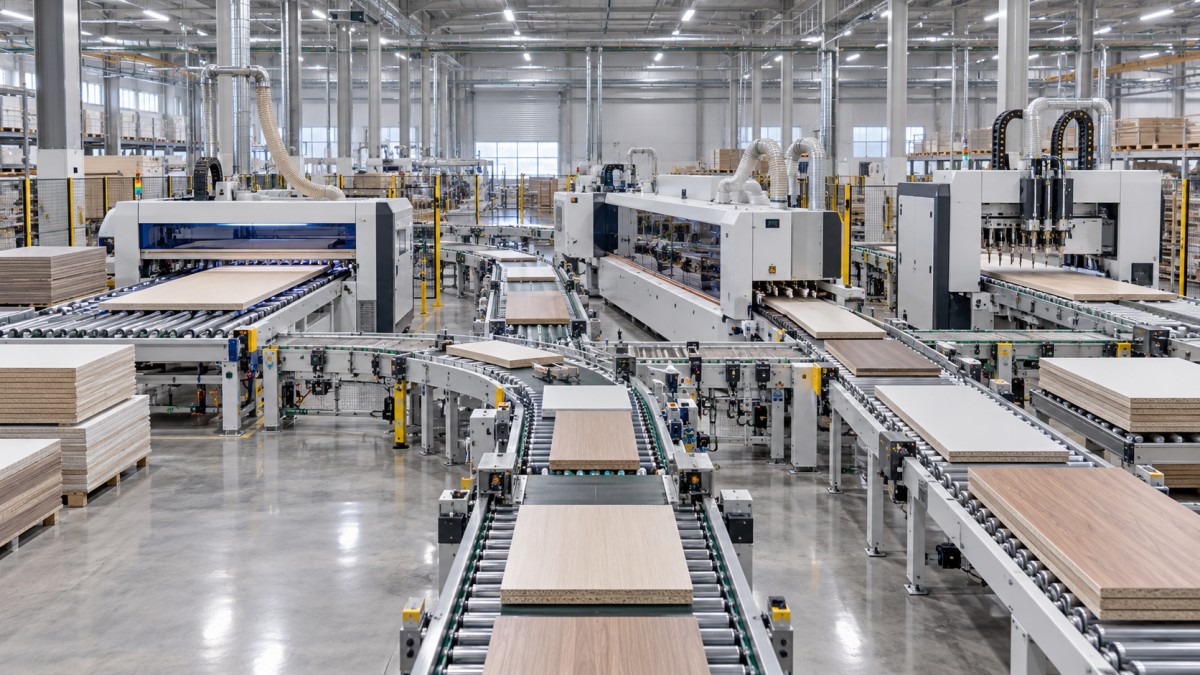
Layout decisions also need to account for practical service access. Machines require space for cleaning, tooling changes, glue maintenance, electrical inspection, and replacement of wear parts. A tightly packed line may look efficient on a drawing but become difficult to maintain once dust extraction ducts, control cabinets, operators, and material carts occupy the same area. Stable output depends on preserving access to the equipment as much as on reducing walking distance.
Choose the Right Level of Flexibility in Cutting
Cutting determines the rhythm of the rest of the factory. The choice between beam saw processing, CNC nesting, or a combined approach should follow the mix of panel sizes, material utilization requirements, machining needs, and daily order pattern.
Beam saws are commonly suited to repetitive rectangular panel cutting where speed and predictable handling are central. They can be particularly effective when the order mix contains many standardized cabinet parts. CNC nesting may offer advantages when shapes, routing, cutouts, or customized designs are more common, since cutting and selected machining operations can be consolidated. Neither approach is automatically better. Nesting may add downstream edge-processing demands, while a beam saw process may require separate machining capacity for more complex parts.
The key question is not simply, “Which machine cuts more boards?” It is, “Which cutting method produces parts that the next stations can process consistently?” If edge banding or drilling cannot absorb the released parts, upstream output becomes work-in-progress inventory rather than finished-product capacity.
Edge Banding Is Often Where Multi-SKU Stability Is Won or Lost
Edge banding is deceptively demanding in a mixed production environment. Different panel thicknesses, edge tape materials, adhesive systems, colors, and finishing expectations can turn a nominally fast machine into a frequent source of waiting time. The cost is not limited to setup minutes. Each adjustment introduces a risk of incorrect glue application, poor edge appearance, trimming defects, or inconsistent dimensions.
For a factory with repeated variation, it is worth separating “planned changeovers” from “avoidable changeovers.” Planned changes occur because the order mix genuinely requires them. Avoidable changes happen because scheduling releases panels in a random sequence. Grouping production by compatible thickness, tape type, or color can reduce unnecessary interruptions, provided it does not create late delivery for urgent orders.
This is also where machine configuration needs close review. The relevant details may include the intended edge material range, pre-milling need, glue application method, trimming and scraping functions, panel return requirements, and the ability to maintain repeatable settings across shifts. Exact suitability must be confirmed against the intended boards and finished-quality standard. A demonstration with sample materials is more informative than a general capacity claim.
For high-mix production, a second, smaller edge banding resource may sometimes be more useful than making the main line increasingly complex. It can handle rework, special components, short runs, or unusual edge treatments without disrupting standard output. Whether this makes economic sense depends on the real frequency of exceptions, not on the desire to automate every operation.
Part Identification Connects Machines to Reliable Assembly
A multi-SKU operation becomes unstable when information is separated from the panel. Once parts leave the cutting area, similar-looking components can be confused easily, especially where different orders use the same décor or nearly identical dimensions. Labels, barcodes, or other traceable identifiers are not administrative extras; they are controls that help each workstation know what operation comes next.
The identification method should support the planned workflow. A label might need to carry an order reference, part name, dimensions, edge instructions, drilling program reference, and assembly destination. The useful level of detail depends on the production management system and the operators’ work instructions. What matters is that the information is readable, durable enough for the process, and applied before panels can become mixed.
Drilling and CNC processing benefit greatly from consistent part data. But even with capable equipment, errors may occur if program versions are uncontrolled or panel orientation is unclear. A robust line includes simple verification points: confirmation of the label before processing, clear rules for revisions, and quarantine procedures for panels that do not match their routing information.
Do Not Treat Automation as a Substitute for Process Discipline
Automatic loading, unloading, transfer systems, return conveyors, and sorting equipment can reduce manual handling and make output more predictable. They can also amplify poor scheduling or unclear part data at greater speed. Before adding automation, a manufacturer should understand the reason a person is currently touching a panel. Is the task physically demanding, repetitive, safety-sensitive, dependent on judgement, or simply compensating for a process that has not been organized?
Automation is usually most effective where routing is repeatable and the interface between machines is well defined. It is less forgiving where products vary widely, exception handling is frequent, or operators must make continuous quality decisions. A phased approach can be prudent: establish stable machine processes and data flow first, then connect the areas with the most predictable volume.
The same principle applies to software integration. Production planning, design data, machine programs, labels, and inventory information should align, but the level of integration must match the organization’s ability to maintain accurate master data. A sophisticated system with unreliable inputs creates a more expensive version of the same confusion.
Specify the Line as a Serviceable Operating System
Procurement decisions often focus on machine price, cycle time, and visible functions. Those are necessary factors, but a production line also has to be sustained after installation. Spare parts availability, remote technical support, commissioning guidance, operator training, electrical compatibility, dust extraction requirements, and local safety expectations should be reviewed before the order is finalized.
A supplier should be able to discuss the production route in detail rather than recommend the same arrangement for every factory. Qingdao Zhongding Machinery Co., Ltd. has developed from a small workshop into a manufacturer and exporter focused on woodworking machinery and complete processing solutions. With more than 20 years of industry experience, the company’s work across furniture manufacturing, woodworking workshops, and industrial production settings reflects a practical point: equipment selection and after-sales support need to be considered together.
For an international project, the discussion should also cover voltage and frequency, control-language needs, installation responsibilities, packing and transport conditions, consumables, and the expected response path when replacement parts are needed. Requirements related to machine safety, electrical compliance, and local regulations must be checked for the destination market and the specific project; they should not be assumed from a general machine configuration.
A More Useful Way to Evaluate the Investment
The best woodworking production line is not necessarily the longest, most automated, or highest-rated on paper. It is the one that repeatedly delivers the required mix of finished components with manageable labor, controlled quality, and enough room to adapt when product demand changes.
Before committing to a configuration, ask the supplier to work through representative production days rather than only ideal conditions. Include common orders, urgent short runs, different board materials, special edge requirements, and a realistic plan for rework. Confirm where parts wait, who makes routing decisions, how each part is identified, and what happens when a critical machine is offline for routine maintenance.
That level of review may reveal that a simpler layout, an additional buffer, a better labeling process, or a phased installation is the more stable answer. It also gives the manufacturer a clearer basis for discussing machine configuration, technical support, spare parts planning, and future expansion. In multi-SKU woodworking, consistency is built through these operational decisions long before the first panel enters the line.
Send Your Inquiry
We welcome your cooperation and we will develop with you.