


News & Exhibitions
Latest Factory Updates, Industry Trends & Global Exhibition Information
How Panel Factories Can Evaluate Hot Press Performance Before Production Losses
How Panel Factories Can Evaluate Hot Press Performance Before Production Losses
For panel factories, a hot press rarely fails in a dramatic way at the beginning. More often, performance drifts: one zone heats more slowly, one platen loses parallelism under load, pressure builds less consistently near an edge, or the actual closing and dwell sequence begins to differ from the recipe shown on the HMI. The first signal may be a small increase in rework, an occasional blister, uneven bonding, thickness variation, or unexplained surface marks. By the time those signs become frequent enough to stop production, the factory may already have absorbed material loss, labor waste, delayed shipments, and avoidable safety exposure.
That is why hot press evaluation should be treated as a preventive control rather than a troubleshooting exercise. A hot press evaluation machine for panels factory can help turn hidden process variation into measurable evidence. The purpose is not merely to prove that a press can open and close. It is to establish whether heat, pressure, timing, movement, and protection functions remain stable under conditions close to real production.
For quality and safety teams, the most useful question is not “Is the press running?” It is “Can the press repeat the required process window across the full working area, over successive cycles, without creating unacceptable risk?” That question leads to a much more practical evaluation program.
Why finished-panel inspection is not enough
Finished-panel inspection remains necessary, but it is a late control point. Delamination, weak glue lines, thickness inconsistency, poor density distribution, and surface defects can originate from press behavior long before they become visible in a sampled board. When the defect is found after trimming, sanding, lamination, storage, or shipment preparation, its cost is no longer limited to the original panel.
Press-related defects are also easy to misdiagnose. Resin formulation, moisture content, furnish distribution, mat forming, caul plate condition, ambient temperature, and operator settings can all affect the result. A disciplined evaluation process does not assume that the press is always the cause. Instead, it separates machine capability from upstream material variation. If the press does not deliver consistent temperature and force, however, no amount of adjustment elsewhere will create a stable process.
This distinction matters when production pressure encourages teams to compensate informally. Increasing set temperature, adding dwell time, or raising nominal pressure may hide a developing mechanical or thermal problem for a short period. It can also increase energy use, alter panel properties, shorten component life, and make the original cause harder to trace.
What a meaningful hot press evaluation should measure
A useful evaluation combines machine data with independent verification. The press controller provides valuable information, but displayed setpoints should not automatically be treated as proof of actual platen conditions. Sensors, pressure transducers, valves, heating circuits, and controller scaling all require periodic verification within the factory’s maintenance and quality system.
The evaluation scope should reflect the panel type and process. Particleboard, MDF, plywood, laminated boards, and specialty composite panels can place different demands on pressing cycles. Yet several performance areas are relevant in nearly every factory:
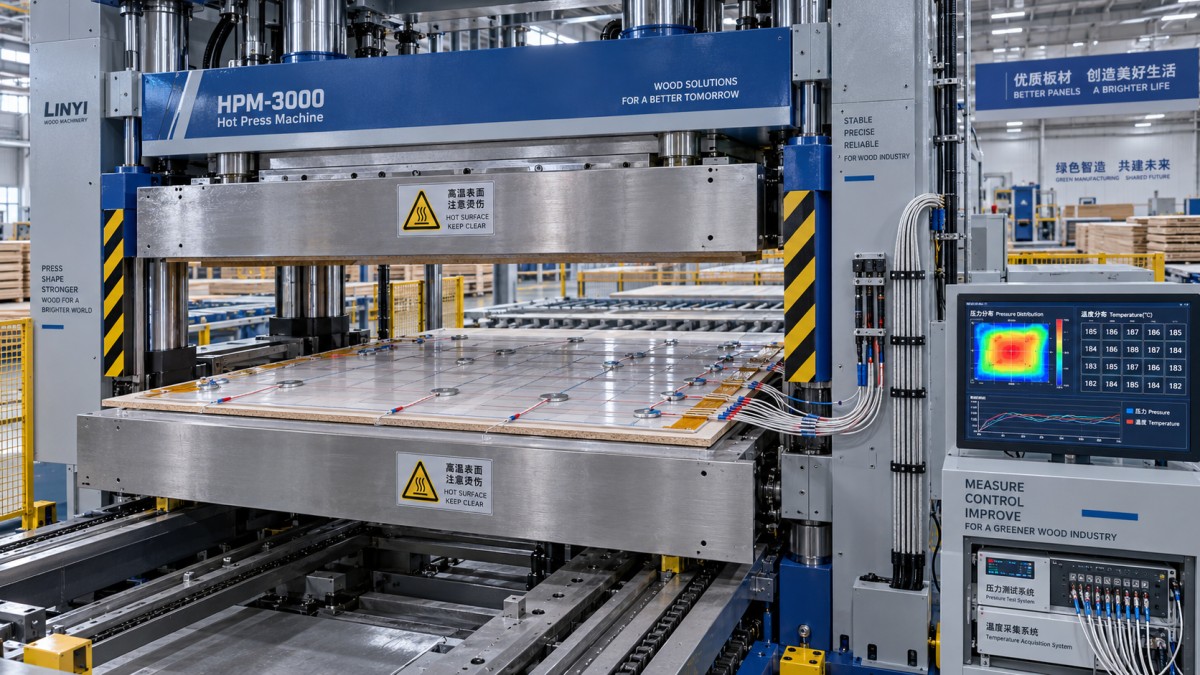
- Platen temperature uniformity: whether the effective pressing area reaches and maintains the intended thermal condition without problematic hot or cold zones.
- Pressure distribution: whether force is applied consistently across the working surface, particularly at corners, edges, and locations associated with repeat defects.
- Parallelism and deflection: whether upper and lower platens remain acceptably aligned through loading, closing, pressing, and opening.
- Cycle repeatability: whether closing speed, pressure build-up, dwell time, decompression, and opening behavior match the approved process sequence from cycle to cycle.
- Hydraulic stability: whether pressure holds as expected and whether leakage, pump instability, valve response, or accumulator behavior creates variation.
- Safeguarding performance: whether emergency stops, interlocks, guarding, light curtains or other protective devices fitted to the machine operate correctly under the site’s documented procedures.
These categories are connected. A pressure map that appears uneven may point to platen deflection, cylinder imbalance, mechanical wear, or an unsuitable test arrangement. A temperature issue may be caused by heater failure, circulation limitations, insulation deterioration, sensor placement, control tuning, or a mismatch between the monitored point and the actual contact surface. The test result starts the investigation; it should not be mistaken for a diagnosis by itself.
Build a baseline before comparing production data
The most valuable time to evaluate a press is when it is known to be operating correctly: after commissioning, following a major overhaul, after platen replacement, or immediately after a verified repair. That condition becomes the factory’s baseline. Without one, maintenance teams often compare current performance against memory, complaint records, or nominal machine specifications that may not reflect the actual production setup.
A baseline record should identify the panel product, adhesive system where relevant, target recipe, platen condition, test instruments used, sensor locations, ambient conditions where material-sensitive, and the sequence of test cycles. It should also distinguish between a no-load machine check and a loaded or simulated-load evaluation. A press may move smoothly without a mat or panel stack but behave differently when thermal expansion, hydraulic load, and real operating resistance are present.
Acceptance limits should not be copied blindly from another plant. They need to be linked to the panel specification, equipment design, adhesive and material process, customer requirements, applicable machine-safety obligations, and internal risk assessment. Where national or regional machinery rules apply, the factory should verify the current legal and technical requirements for its location rather than relying on generic advice. If a press has been modified, the change may also require a renewed review of guarding, controls, documentation, and safe operating procedures.
How to test temperature and pressure without creating misleading results
Temperature evaluation is commonly approached with multiple sensors positioned across the platen area or with a suitable thermal mapping method. The objective is not simply to capture the controller reading. It is to understand warm-up behavior, stabilization time, local variation, and temperature recovery over repeated cycles. Sensor attachment method, contact quality, sampling interval, and sensor calibration can all affect the result. A reading taken from an exposed surface may not represent the temperature transfer condition experienced by a panel.
Pressure distribution requires the same care. Pressure-sensitive film, sensor mats, load cells, or other instruments may be selected depending on press size, force range, required resolution, and the factory’s test method. The measuring device must be suitable for the expected temperature and compression conditions. It must also be protected from damage and positioned so that it does not introduce an artificial load pattern. A single central measurement can confirm that a press is generating force, but it cannot confirm uniform force across a large platen.
Repeated tests are more informative than a one-cycle snapshot. If a deviation appears only after several cycles, the cause may involve oil temperature, heating recovery, control response, mechanical expansion, or component fatigue. Recording the trend matters. A result that is technically inside an internal limit but drifting steadily from the baseline may justify planned maintenance before it becomes a production event.
Do not separate quality checks from safety checks
A press that produces acceptable panels can still present an unacceptable safety condition. Hot surfaces, high hydraulic force, closing platens, moving loading equipment, stored energy, and manual intervention during fault recovery all require attention. Performance testing can expose conditions that also affect safety: unexpected movement, irregular closing speed, delayed stop response, loss of pressure control, or the need for operators to intervene repeatedly near the danger zone.
Evaluation work itself must be planned safely. Lockout and isolation procedures, controlled test access, clear communication between maintenance and production personnel, and confirmation of guarding status are not administrative extras. They prevent a test intended to reduce risk from creating a new one. Any bypassing of protective functions for diagnostic purposes should be tightly controlled, authorized, and restored before normal operation resumes.
It is also wise to review operator reports alongside machine data. Operators often notice a changed sound, slower response, inconsistent closing behavior, or a new need to adjust settings before instruments reveal a clear fault. Their observations should be recorded in a way that maintenance teams can compare with cycle trends and inspection findings.
Choosing an evaluation approach that can be repeated
The best evaluation setup is not necessarily the most complex one. It is the one that provides reliable, traceable measurements and can be repeated after maintenance, recipe changes, extended shutdowns, or warning signs in production. For some factories, this means portable instruments used under a documented procedure. For others, it may involve dedicated monitoring and test equipment integrated into a broader preventive-maintenance plan.
When assessing a hot press evaluation machine for panels factory, decision-makers should ask practical questions: Can the instruments tolerate the press environment? Are their measurement ranges suitable for the actual machine? How are sensors calibrated or verified? Can the data be exported and compared with prior tests? Is the test layout suitable for the platen dimensions and panel products? Can technicians use the system without adding unacceptable risk or excessive downtime?
The answer may differ between a small woodworking workshop and a continuous industrial panel line. What should not differ is the need for a clear test method, documented results, and defined actions when results fall outside the factory’s approved limits.
Turning evaluation results into maintenance decisions
A test report has little value if it ends as a spreadsheet attachment. Results should lead to a decision: continue with normal monitoring, schedule corrective maintenance, reduce operating risk while parts are arranged, conduct a deeper root-cause review, or stop the machine if safety or product integrity cannot be assured. The action threshold should be agreed before a production crisis, not debated when output is already at risk.
Qingdao Zhongding Machinery Co., Ltd. has spent more than two decades working with woodworking machinery and production applications. That experience reinforces a practical point: equipment reliability depends not only on initial machine selection, but on how the machine is installed, monitored, serviced, and supported over its operating life. Access to technical guidance, spare parts planning, and responsive after-sales communication can make evaluation findings easier to convert into timely corrective work.
Before the next rise in rejects becomes a larger loss, factories should establish their press baseline, define a repeatable evaluation interval, and decide which deviations require escalation. The exact limits will depend on the press, panel construction, process recipe, and site requirements. But waiting for visible defects to confirm a problem is rarely the most economical or safest way to manage a hot press.
Send Your Inquiry
We welcome your cooperation and we will develop with you.