


News & Exhibitions
Latest Factory Updates, Industry Trends & Global Exhibition Information
What determines the throughput of panel furniture drilling equipment?
The throughput of panel furniture drilling equipment depends on more than drilling speed alone. For project managers planning a production line, the practical question is how many acceptable components a machine can deliver per shift.
Machine configuration, panel handling, tool changes, software integration, and maintenance all influence that result. Understanding these factors helps teams identify bottlenecks and compare equipment on realistic capacity.
This article examines the operational and technical variables that shape drilling throughput, then shows how to evaluate capacity, investment, and production risk before selecting equipment.
How should project managers calculate realistic drilling throughput?
Start with good panels produced per shift, not the fastest cycle displayed in a machine demonstration. A good panel meets drilling specifications and can move forward without rework.
For an initial estimate, calculate available production time after planned breaks and maintenance, then multiply it by the expected operating-time ratio and divide by average cycle time.
Express the result in consistent units: good panels per shift equals available seconds multiplied by the operating-time ratio, divided by average seconds per panel.
The operating-time ratio accounts for unplanned stoppages, changeovers, and other losses not already removed from available time. Avoid subtracting the same loss twice.
For example, a shift with 360 available minutes, a 75% operating-time ratio, and a 45-second average cycle yields an estimated 360 good panels.
That estimate assumes the cycle time and operating-time ratio already reflect quality losses, or that those losses are negligible. Otherwise, adjust the result using the expected first-pass yield.
If first-pass yield is 98% and has not already been included, the estimate becomes approximately 353 good panels per shift. Reworked panels require separate capacity allowance.
Use a weighted average cycle when several panel types are produced. A simple average can misrepresent capacity if complex components account for most of the production volume.
Which production requirements have the greatest effect on capacity?
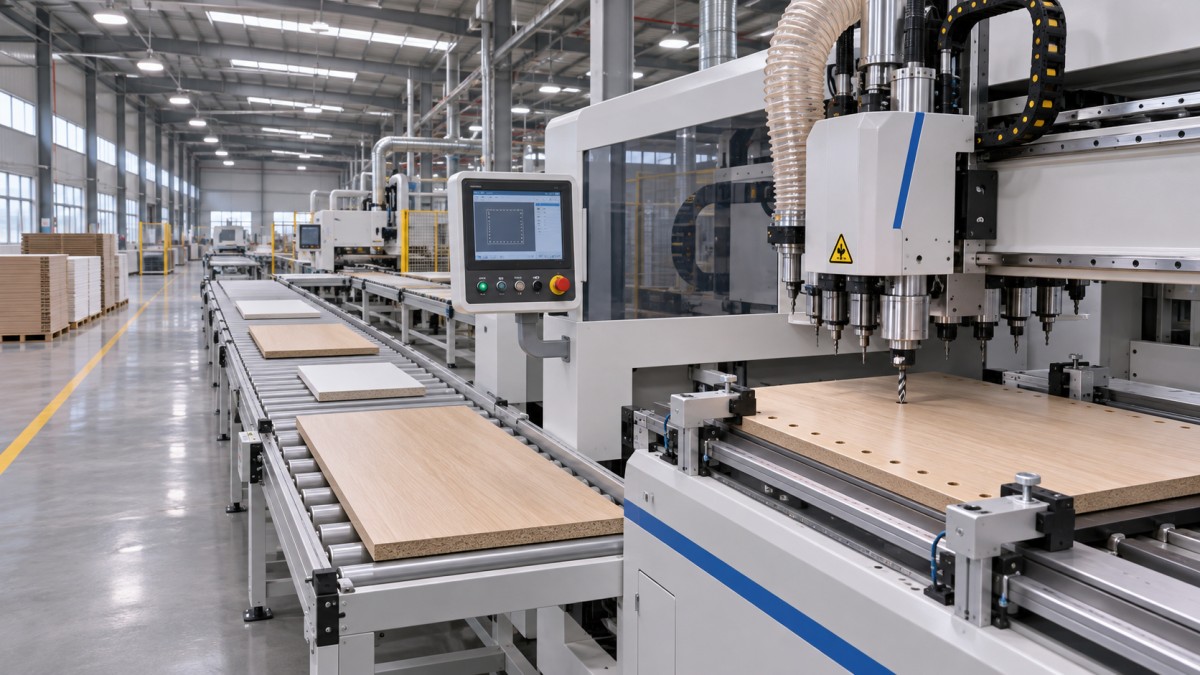
Panel size, hole count, drilling depth, edge operations, and machining faces determine the work required for each component. Two machines can perform differently on the same product mix.
A cabinet side with multiple connector holes and edge drilling usually requires more operations than a simple shelf. Throughput claims based on shelves should not be applied automatically to cabinet sides.
Material matters too. Particleboard, MDF, plywood, and coated panels can require different cutting conditions, tooling, and chip-control practices to maintain acceptable hole quality.
Small or narrow parts may need special clamping or handling arrangements. Oversized panels can require slower positioning, additional support, or a different machine layout.
Before requesting quotations, group components by dimensions, material, machining complexity, and expected volume. Include the proportion requiring each face, edge, or tool in the analysis.
For customized furniture, measure the frequency of design and batch changes. A machine optimized for long runs may lose its apparent advantage when jobs change repeatedly.
Ask suppliers to calculate capacity against this representative mix, including difficult parts and normal changeovers. A single best-case panel is insufficient for production planning.
How do machine configuration and drilling strategy affect output?
Drilling units, spindle arrangements, available tools, and supported machining faces determine how much work can be completed without repositioning or transferring a panel.
A multi-spindle drilling bank can reduce machining time when a recurring hole pattern matches its spindle spacing. Its benefit is smaller when patterns vary widely.
Independent spindles or additional tool positions may support a broader product mix, but their value depends on actual program requirements and the machine’s control strategy.
Confirm which operations can run simultaneously. A machine with several spindles does not necessarily drill every required hole at once, especially across different faces or depths.
Edge drilling, grooving, routing, and vertical drilling may require different tools or orientations. Each additional operation can increase cycle time or create another production step.
Automatic tool changing can reduce manual intervention for varied work, but the change itself takes time. Tool magazine capacity and tool life also affect unattended operation.
Clamping and positioning deserve equal attention. Reliable alignment reduces operator correction and rework, while repeated repositioning can erode the benefit of fast drilling.
Specify tolerance requirements alongside output targets. Faster cutting conditions are only useful when hole placement, diameter, and surface quality remain acceptable throughout the shift.
When does panel handling become the bottleneck?
In many lines, loading, unloading, alignment, and transfer consume as much time as machining. The relevant cycle includes these activities unless they overlap with drilling.
Observe whether the operator waits for the machine or the machine waits for the operator. This distinction helps determine whether additional automation will improve output.
For example, reducing drilling time from 30 to 20 seconds has limited value if manual handling still requires 40 seconds and cannot occur concurrently.
Vacuum loading, conveyors, return systems, and automatic unloading can reduce handling time, but their benefit depends on panel dimensions, weight, orientation, and production sequence.
Check whether handling equipment can process the smallest, largest, and heaviest parts in the planned mix. Exceptions requiring manual handling must be included in the capacity estimate.
Upstream cutting and edge banding must also supply correctly identified panels at the required rate. Downstream assembly must remove finished parts without blocking the drilling station.
Buffers can absorb short disruptions between processes, but they require space and disciplined identification. A buffer cannot permanently compensate for an undersized upstream or downstream operation.
Map the entire flow before purchasing equipment. The effective line output is constrained by the slowest sustained process, not necessarily by the drilling machine itself.
Can software and job preparation prevent lost production time?
Software affects throughput before the first panel reaches the machine. Accurate programs, clear job identification, and reliable data transfer reduce delays at the production station.
Check whether the machine can import the formats produced by existing design and manufacturing systems. Confirm how drilling coordinates, panel orientation, and material information are transferred.
Barcode or label identification can speed program selection and reduce operator errors when labels remain readable and the correct program is linked to each part.
For high-mix production, compare programming time, job release procedures, and exception handling as carefully as spindle speed. Frequent manual corrections can consume substantial engineering capacity.
Run sample jobs through the complete workflow, from design file to finished component. Include revisions, mirrored parts, and panels with similar dimensions but different hole patterns.
Clarify who maintains tool libraries, validates programs, and resolves data errors. Software integration has continuing operational requirements as well as an initial implementation cost.
How should downtime and quality losses be included?
Tool wear, chip buildup, sensor faults, and inconsistent panel positioning can gradually reduce output. Planned checks are generally easier to manage than unexpected line interruptions.
Track tool life by material and operation where practical. Replace or service tools before wear causes unacceptable holes, excessive cutting forces, or repeated stoppages.
Dust extraction and compressed air must match the equipment supplier’s requirements. Insufficient extraction or unstable air supply can affect reliability, cleanliness, and clamping performance.
Record downtime by cause and duration, including programming corrections, material shortages, setup, and machine faults. Separate planned stops from unplanned losses for consistent reporting.
Measure first-pass yield as well as total output. A line producing more panels with frequent drilling errors may create extra inspection, rework, and assembly delays.
During commissioning, establish a baseline for cycle time, availability, and quality. Review the data after operators become familiar with the equipment and the normal product mix.
How can teams compare machines and justify automation?
Request a documented trial using representative materials, panel sizes, and drilling patterns. Suppliers should state staffing, tool configuration, handling arrangements, and whether changeovers are included.
Compare sustained good panels per shift rather than peak hourly output. Where a full-shift trial is impractical, combine measured cycles with clearly stated downtime assumptions.
Ask for separate results for common panels and demanding exceptions. This exposes whether an attractive average depends on excluding parts that will regularly enter production.
Calculate the total investment, including the machine, handling equipment, installation, software integration, extraction, training, spare tooling, and any required building or utility changes.
Then estimate annual benefits from incremental good output, labor changes, reduced rework, and avoided outsourcing. Count additional output only when demand or avoided costs make it valuable.
A simple payback estimate divides the additional investment by annual net benefit. Deduct additional operating expenses and account for maintenance, consumables, and software costs.
For example, an automation upgrade costing $120,000 with an estimated $40,000 annual net benefit has a simple payback of three years, before financing and tax effects.
Test that estimate against lower demand, slower ramp-up, higher downtime, and operator coverage. Also assess service response, spare-parts availability, and the cost of a prolonged failure.
Where furniture projects include both drilled panels and solid-wood decorative components, assess those processes separately. A lathe does not replace panel drilling or increase drilling capacity directly.
For example, the CA-1530 CNC Wood Lathe is intended for turning solid-wood parts such as furniture legs and columns, with a stated standard maximum machining length of 1,500 mm.
Qingdao Zhongding Machinery supplies woodworking machinery and support; project teams should confirm the configuration, utilities, service arrangements, and acceptance criteria for each proposed machine.
Conclusion: Plan around sustained good output
The throughput of panel furniture drilling equipment is determined by the interaction of machining, handling, software, staffing, maintenance, and the actual component mix.
Build the business case around representative cycle measurements and good panels per shift. Validate the surrounding line before paying for additional machine speed or automation.
The strongest choice is the configuration that meets required demand reliably, maintains quality, and leaves enough operational flexibility for the product changes your project expects.
Send Your Inquiry
We welcome your cooperation and we will develop with you.