


News & Exhibitions
Latest Factory Updates, Industry Trends & Global Exhibition Information
Integrating a furniture drilling solution into an existing production line
Integrating a furniture manufacturing drilling solution into an existing production line requires more than selecting the right machine.
Project managers must consider equipment compatibility, available floor space, material flow, production targets, and installation schedules to minimize disruption.
With over 20 years of woodworking machinery experience, Qingdao Zhongding Machinery helps manufacturers assess these factors and plan practical integrations that support drilling precision, efficient throughput, and long-term operational reliability.
The strongest integration projects start with a measurable production constraint. Define the required output and accuracy, then verify whether the existing line can feed, support, and accept the proposed equipment.
Before approving a purchase, establish the installation window, total project cost, acceptance criteria, and responsibility for each interface. These decisions often matter as much as the drilling machine itself.
Where Will the New Drilling Equipment Deliver the Most Value?
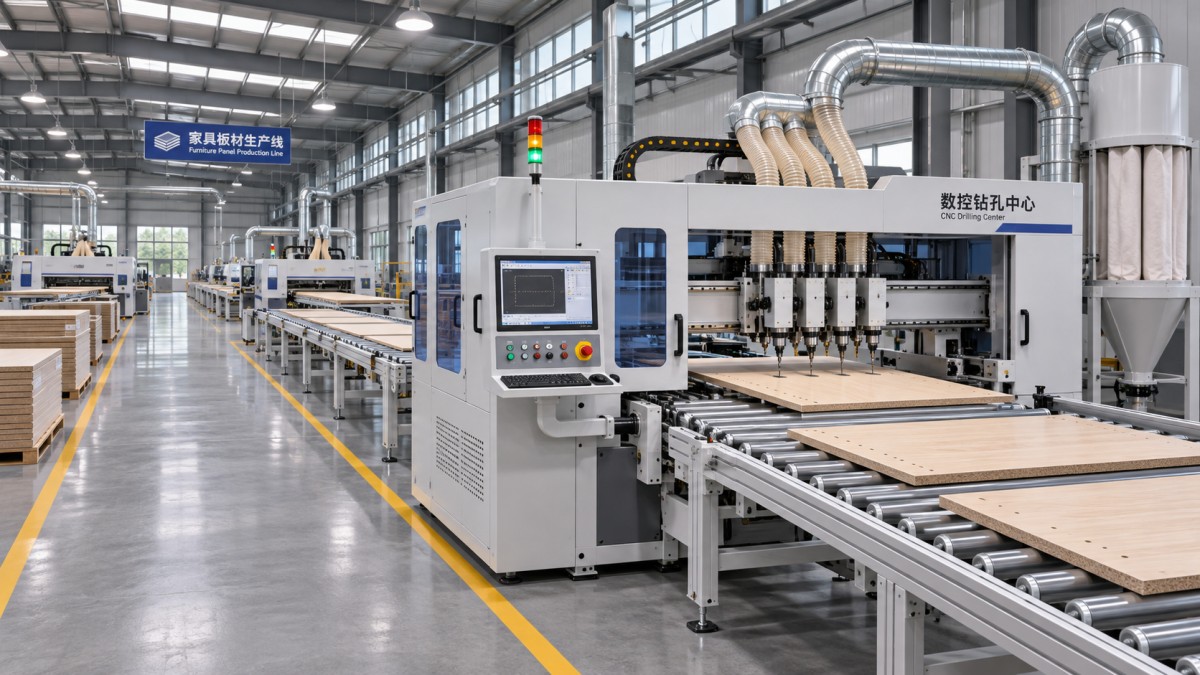
Map the current production route from panel cutting and edging through drilling, assembly, and packing. Record where panels wait, where operators intervene, and where defects first appear.
Measure actual throughput over representative shifts, including product changes and stoppages. Nameplate machine speeds alone cannot reveal whether drilling is the bottleneck or simply exposes a constraint elsewhere.
For example, faster drilling will have limited effect if an upstream edgebander cannot supply enough panels or downstream assembly cannot absorb the additional output.
Separate recurring losses into categories such as setup time, loading delays, incorrect hole patterns, rework, and equipment downtime. Assign each category an estimated cost and improvement target.
A standalone or offline drilling cell may suit variable orders and limited floor space. An inline system is more compelling when panel flow is consistent and interfaces justify automation.
Document the decision in a short project brief: products covered, target output, quality requirements, available investment, implementation deadline, and constraints that cannot be changed.
How Much Capacity Does the Production Line Actually Need?
Start with the required good panels per shift, not the advertised maximum speed. Include breaks, planned maintenance, expected downtime, and the product mix in the calculation.
For an illustrative target of 400 accepted panels in an eight-hour shift, assume six productive hours after allowances. The line must average approximately 67 good panels per productive hour.
That figure is a planning baseline, not a machine cycle-time specification. The supplier must also account for loading, positioning, drilling complexity, unloading, and product changes.
Ask for cycle-time estimates using representative panel drawings, hole counts, materials, and batch sizes. Include the slowest common part and a demanding part with multiple drilling faces.
Check whether the proposed process requires panels to be rotated or repositioned. These steps can add handling time and introduce errors even when the drilling cycle itself is fast.
Specify capacity in accepted output over a defined period. A useful acceptance measure might be good panels per hour during a witnessed run, with the agreed product mix and staffing.
Which Compatibility Checks Should Happen Before Purchase?
Compile the panel dimensions, thickness range, materials, edge conditions, hole diameters, drilling depths, and positional tolerances required across the current product family.
Check both the smallest and largest parts against the machine's workholding and transfer arrangements. Also review narrow, warped, or flexible panels that may need special support.
Confirm which faces and edges require drilling, whether holes pass through the panel, and how the machine references each part. Inconsistent reference edges can create assembly problems.
Review available drawings and production files with the supplier. Confirm supported formats, coordinate conventions, program transfer methods, revision controls, and who will convert existing drilling patterns.
Do not assume that two machines can exchange data because both use CNC controls. Request a demonstration using actual production files and verify the resulting hole positions.
For automated transfer, define conveyor height, panel orientation, spacing, handoff speed, and the method used to identify each part. Agree on signals for ready, running, blocked, and fault states.
Assign ownership for electrical connections, control integration, mechanical modifications, and safety interfaces. An interface register prevents gaps between the machine supplier, system integrator, and plant team.
How Should Floor Space and Material Flow Be Planned?
A footprint drawing should show more than the machine outline. Include infeed and outfeed zones, operator access, maintenance clearance, tooling storage, dust extraction, and emergency escape routes.
Trace the longest panel through every transfer and rotation. Check turning space, doorways, columns, overhead obstructions, and access for forklifts or lifting equipment during installation.
Compare alternative layouts against the current movement of people and materials. A compact machine can still increase labor if operators must repeatedly carry or restack panels.
Consider a small buffer where upstream and downstream cycle times vary. Size it using observed interruptions and available space, rather than treating inventory as a substitute for resolving bottlenecks.
Confirm the capacity and connection requirements for electrical power, compressed air, and dust extraction with the selected equipment supplier. Existing services may require upgrades or relocation.
Review how finished panels leave the drilling station. Clear identification and controlled stacking help prevent mixed orders, damaged surfaces, and misplaced components before assembly.
Could Upstream Panel Quality Affect Drilling Results?
Drilling accuracy depends partly on the material arriving at the station. Inconsistent panel dimensions, poor edge quality, surface defects, or weak bonding can undermine otherwise capable equipment.
Where a project also includes panel lamination, review pressing quality separately from the drilling investment. An upstream press can affect panel consistency, but it does not perform drilling.
The Hot Press Machine range is intended for pressing and laminating materials used in furniture production, including veneer, plywood, MDF, and decorative panels.
Listed configurations include one to four working layers, 1,200 kN total pressure, and electric heating with conduction oil. Confirm model-specific specifications and suitability before including one in a project.
For existing presses, inspect bonding quality and panel flatness before attributing every drilling defect to the new station. Agree on incoming material criteria for acceptance testing.
What Does the Project Cost Beyond the Machine?
Build a total installed cost estimate that includes the equipment, freight, unloading, foundations if needed, utilities, extraction, conveyors, controls, tooling, training, and commissioning.
Add allowances for production downtime, temporary handling, program preparation, spare parts, and contractor work. Identify which costs are firm quotations and which remain assumptions.
Estimate annual benefits from defensible changes: reduced labor hours, lower rework, fewer outsourced operations, or additional contribution from production that can actually be sold.
Avoid counting theoretical capacity as revenue unless downstream operations and customer demand can use it. Also avoid counting the same labor saving in multiple benefit categories.
As an illustration, an installed investment of $150,000 with verified annual net savings of $50,000 has a simple payback of three years, excluding financing, tax, and residual value.
Test that estimate against lower utilization, longer changeovers, consumable costs, and delayed ramp-up. Present a range to management, with the assumptions that most affect the result.
Set a contingency appropriate to the maturity of the layout and interface design. Unresolved building work or control integration deserves more scrutiny than a fully surveyed installation.
How Can Installation Disruption Be Controlled?
Build the schedule backward from the required production date. Include design approval, manufacturing, shipping, site preparation, installation, testing, operator training, and a realistic ramp-up period.
Identify the critical dependencies for each milestone. For example, machine delivery is not sufficient if electrical work, extraction connections, or the agreed production programs are incomplete.
Complete a site survey before releasing the final layout. Confirm actual measurements and service locations on the shop floor, rather than relying solely on older building drawings.
Plan a shutdown window around the operations that genuinely require it. Where feasible, complete utility preparation and program development while the existing line continues running.
Protect customer deliveries with a temporary production plan. Depending on the factory, this may involve building approved stock, shifting work to another cell, or using a qualified subcontractor.
Define a rollback decision before commissioning begins: who can authorize it, what conditions trigger it, and how the previous process will be restored if startup takes longer.
Keep one owner for the integrated schedule and hold regular reviews with production, maintenance, quality, safety, and suppliers. Record open issues with deadlines and named owners.
What Should Be Tested Before the Line Is Accepted?
Agree on acceptance criteria before ordering, including part quality, sustainable output, safety functions, program handling, documentation, and the conditions under which tests will be performed.
Where practical, conduct a factory acceptance test using representative drawings and materials. Confirm that successful supplier-site results will be repeated during site acceptance under agreed conditions.
Inspect hole locations, diameters, depths, and surface quality against approved drawings. Define the measurement method, sample size, instruments, and permitted tolerances before testing.
Run a representative mix of parts for a defined period at the planned staffing level. Record good output, stoppages, changeovers, defects, and the reasons for interruptions.
Test abnormal conditions as well as normal production. These may include a missing panel, blocked outfeed, program selection error, emergency stop, and safe recovery after interruption.
Have qualified personnel validate the complete installation against applicable local machinery and workplace safety requirements. Supplier documentation alone does not establish compliance for the integrated line.
Separate minor punch-list items from issues that prevent acceptance. Document correction deadlines, retest procedures, and payment milestones in the purchase agreement.
How Can the Team Sustain Performance After Startup?
Train operators on loading, program selection, routine checks, and fault reporting. Maintenance staff also need instruction on preventive maintenance, troubleshooting, and safe isolation procedures.
Establish ownership of drilling programs and revisions. A controlled approval process reduces the risk of an outdated pattern reaching production after a furniture design changes.
Agree on a practical spare-parts list based on the installed configuration and supplier recommendations. Confirm lead times, support contacts, warranty terms, and the escalation process.
Track accepted output, first-pass quality, downtime, and changeover time during ramp-up. Compare results with the baseline and investigate recurring losses before declaring the project complete.
Schedule a review after operators have worked with the system across normal product variations. Small adjustments to fixtures, programs, or material flow may improve performance without major investment.
Conclusion: Make the Integration Decision on Line Performance
A furniture manufacturing drilling solution is most valuable when it resolves a measured constraint and fits the factory's actual products, interfaces, staffing, and delivery commitments.
Project managers should approve the investment only after capacity assumptions, total costs, installation responsibilities, and acceptance tests are clear. The result is a decision grounded in production outcomes.
Qingdao Zhongding Machinery can discuss equipment and broader woodworking requirements with project teams. Provide representative drawings, production targets, and layout constraints to support a more useful technical assessment.
Send Your Inquiry
We welcome your cooperation and we will develop with you.