


News & Exhibitions
Latest Factory Updates, Industry Trends & Global Exhibition Information
Steam-Heated Hot Wood Presses: Sizing Steam Supply for Consistent Production
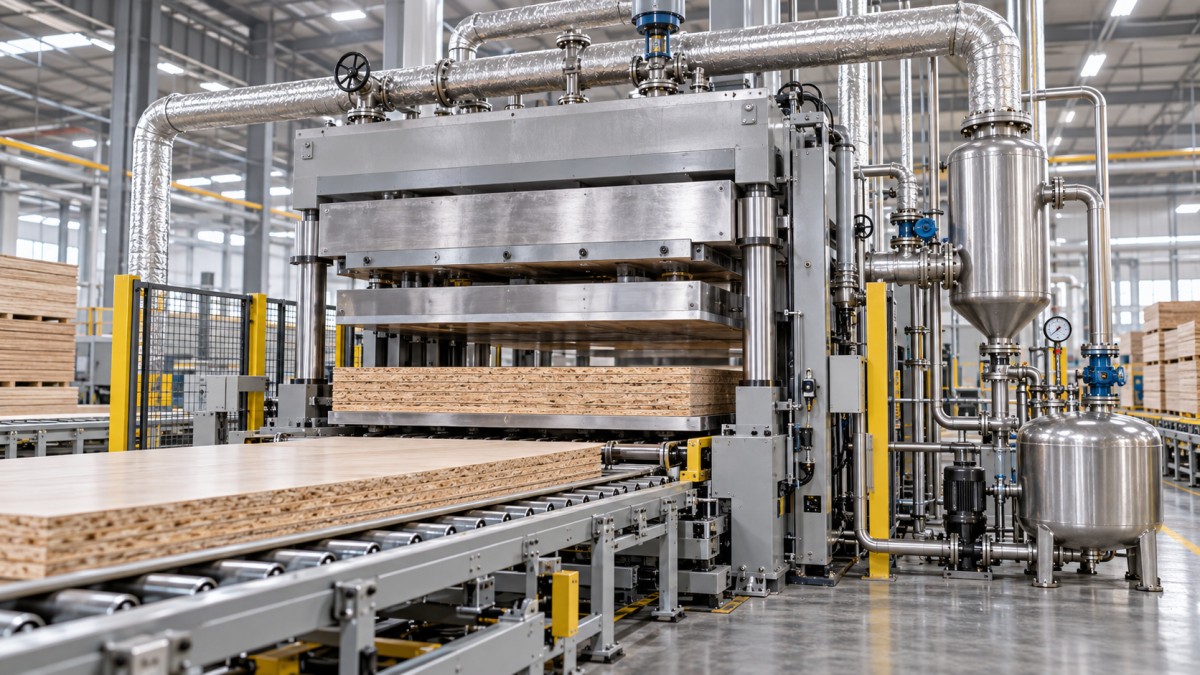
When a panel line misses its planned output, the press is often blamed first. Yet in many projects, the real constraint sits upstream: the steam system cannot deliver enough stable heat when the press needs it most. A hot wood press with steam heating may look fully specified on paper, but inconsistent steam pressure, undersized piping, poor condensate removal, or an unrealistic heat-up assumption can turn a promising production schedule into a daily source of delays.
For project managers, steam sizing is not simply a utility calculation. It is a production decision. The available steam capacity influences platen warm-up, press cycle repeatability, adhesive curing conditions, shift-start readiness, and the number of panels that can be processed during peak demand. A properly planned system gives the press a stable thermal foundation; an undersized one forces operators to compensate with longer cycles, lower temperatures, or frequent waiting.
This guide outlines how to size the steam supply for a hot wood press with steam heating, what engineering inputs matter most, and where projects commonly lose capacity before the machine has even started production.
Start with the production requirement, not the boiler nameplate
A common planning mistake is to begin with a boiler’s rated evaporation capacity and assume that it will be sufficient for the press. The rated figure matters, but it does not describe how much steam is truly available at the press inlet during a busy production window.
Steam demand is shaped by the operating pattern of the entire factory. If a veneer dryer, sanding line, glue kitchen, building heating circuit, or another press calls for steam at the same time, the hot press may see a pressure drop precisely during heat-up or recovery. The relevant question is therefore not “How large is the boiler?” but rather:
- How much steam is available at the required pressure after other users are considered?
- What is the press’s peak demand during cold start and during normal cycling?
- How quickly must the platens recover temperature after each pressing cycle?
- Can the steam distribution network deliver that volume without excessive pressure loss?
- Will condensate leave the platen circuit fast enough to preserve heat transfer?
These questions move the discussion from nominal equipment capacity to actual production capability. They are especially important in furniture-panel facilities, plywood operations, laminating plants, and workshops that plan to add a press to an existing steam network rather than build a dedicated utility system.
Understand the three steam loads behind a heated press
The steam load of a press is not constant. A realistic calculation separates the duty into three different conditions, each with its own impact on plant design.
1. Initial platen heat-up
At shift start, after maintenance, or after a prolonged stop, the press platens must be raised from ambient temperature to the operating setpoint. This is generally the highest short-term heat requirement. Heavy platens have considerable thermal mass, and a project team should define the acceptable heat-up time rather than treating it as an afterthought.
If the production plan requires the press to be ready within a limited start-up window, the boiler, piping, control valves, and steam separator must all support that rate of heat input. A system that eventually reaches temperature but takes too long to do so may still reduce the effective output of the first shift.
2. Heat maintenance and standing losses
Once the platens are at temperature, the system must replace heat lost through insulation, press structure, exposed surfaces, connecting pipes, and intermittent opening of the press. This maintenance load is lower than the initial warm-up demand, but it is continuous. In a poorly insulated installation, standing losses may be large enough to create unnecessary fuel consumption and uneven temperature behavior near the edges of the platen.
3. Cycle recovery during pressing
Every pressing cycle removes heat from the platens. Cold or cooler boards, veneers, glue layers, fixtures, caul plates, and ambient air entering the open press all affect the temperature recovery requirement. The heat needed per cycle may appear modest in isolation, but rapid cycle times create repeated peaks. For a high-throughput line, average demand alone is not enough; the steam circuit must respond to those repeating loads without allowing platen temperature to drift.
A useful planning principle is simple: size for the most demanding credible operating condition, then confirm that average operation remains economical. Designing only around average steam consumption often produces a press that performs adequately in a quiet test run but struggles at full production rhythm.
A practical framework for estimating steam demand
Detailed thermal calculations should be completed with the press manufacturer, boiler supplier, and utility engineer. Still, project leaders benefit from understanding the structure of the calculation, because it makes specification reviews more meaningful.
The total required heat can be expressed as:
Total heat load = platen heat-up load + material heating load + heat losses + system allowance
For initial heat-up, the basic relationship is:
Heat required = mass of heated components × specific heat × temperature rise
The heated components may include upper and lower platens, internal heating channels, steel plates, moving beams, and any attached tooling that absorbs significant heat. Divide this required energy by the target heat-up time to determine the required heat rate.
For each pressing cycle, estimate the energy absorbed by the wood-based material and its moisture content. The calculation should consider board dimensions, thickness, density, incoming temperature, required core temperature, and the number of openings per hour. Moisture is important: heating water within the board requires much more energy than heating dry wood fiber alone, and evaporation or vapor movement may influence the process as well.
To convert heat demand into steam consumption, use the usable heat released as steam condenses at the selected working pressure. In simplified terms:
Steam flow = required heat rate ÷ usable latent heat of the supplied steam
Because latent heat changes with pressure, the calculation must use steam-table values appropriate to the actual pressure at the press inlet, not merely the boiler outlet. The final design should also include a reasonable engineering margin for start-up variation, line losses, future operating changes, and measurement uncertainty. Margin is not a substitute for correct sizing, however. A large arbitrary factor can hide poor assumptions about material temperature, piping condition, or simultaneous loads.
Pressure selection is a temperature decision
In a hot wood press with steam heating, steam pressure and platen temperature are directly linked. Saturated steam transfers heat efficiently while condensing, and its saturation temperature rises as pressure increases. The selected working pressure must therefore be high enough to support the desired platen temperature with an adequate driving temperature difference.
It is tempting to choose the highest available pressure, but that is not automatically the best answer. Higher pressure may increase the available temperature, yet it can also demand stronger components, more careful pressure reduction, and tighter control. The right target is the pressure that allows stable platen operation at the process setpoint while matching the equipment’s rated design conditions.
Pressure stability matters as much as pressure level. If the supply pressure falls during a cycle, the condensing temperature in the platen channels falls with it. The result can be slower heating, uneven cure conditions, and differences between early and late panels in a production run. For applications involving laminating, veneer pressing, door-core assembly, or moisture-sensitive adhesives, these variations can show up later as weak bonds, surface defects, or rejected panels.
Do not overlook the pipe between the boiler and the press
An adequately sized boiler cannot compensate for an undersized steam main. Long pipe runs, excessive elbows, restrictive valves, poorly selected pressure-reducing stations, and shared branches all create pressure loss. If the press is located at the far end of a facility, the distribution network deserves the same attention as the press itself.
Steam lines should be sized around the expected flow rate, allowable pressure drop, steam velocity, pipe length, and future expansion requirement. High velocity can carry water droplets and create noise, erosion, and unstable control. Low velocity is not always desirable either, especially where piping is poorly pitched and condensate can collect. Correct pipe routing, drainage points, insulation, and supports are practical details with a direct effect on thermal performance.
The project specification should clearly identify whether steam demand is calculated at the boiler outlet, at the pressure-reducing station, or at the machine connection. These are not interchangeable reference points. A responsible design confirms the pressure available at the press under peak load.
Condensate removal protects temperature uniformity
Steam heats a platen effectively because it condenses and releases latent heat. Once that condensate forms, it must be removed. If water remains in the platen channels or coils, it occupies heat-transfer area, slows steam entry, and can create cold zones. In severe cases, accumulated condensate contributes to water hammer, a sharp mechanical shock that can damage valves, joints, traps, and piping.
For project teams, condensate management should be treated as part of the press heating design, not an accessory package. Key items include properly selected steam traps, strainers, check valves where required, drip legs, air vents, and correctly pitched return lines. Trap selection must match the pressure differential, condensate load, control behavior, and return arrangement. A trap that works under one stable condition may perform poorly when the press cycles frequently or when the pressure changes across a regulating valve.
Return-line backpressure also deserves review. If condensate is lifted to an elevated return main or discharged into a pressurized recovery system, the available differential pressure across the trap may be reduced. This can cause flooding even when the trap itself is correctly sized on a catalog sheet.
Specify temperature uniformity as a production requirement
Project documents often state a nominal platen temperature but say little about uniformity. That leaves room for misunderstanding. A press may reach the target temperature at one sensor location while still showing meaningful variation across the platen surface. For panel production, that variation affects glue cure, moisture movement, surface finish, and cycle consistency.
Ask the press supplier how platen channels are arranged, where temperature sensors are located, how many control zones are used, and how uniformity is checked during commissioning. Larger platens, thicker steel sections, complex multi-opening presses, and high-speed applications may require more deliberate zoning and control than a small workshop press.
Uniformity is also influenced by what happens outside the platen: uneven loading, oversized panel gaps, cold caul plates, damaged insulation, and unstable steam pressure can all distort the thermal picture. The best design combines well-engineered platen circulation with disciplined operating conditions.
Build a demand profile before approving the utility package
A single consumption number is rarely enough for project approval. Instead, request a time-based demand profile that shows expected steam use during cold start, normal pressing, short stoppages, and simultaneous operation with other thermal equipment. This profile helps engineers evaluate whether a boiler, accumulator, pressure-reducing station, or distribution upgrade is needed.
For example, a facility may have enough average boiler capacity over an eight-hour shift but insufficient reserve for the first 30 minutes, when the press, dryer, and building services all call for heat. In such cases, operational sequencing, an insulated steam accumulator, or a revised start-up schedule may be more effective than simply increasing boiler size.
It is wise to review at least these operating scenarios:
- Cold start after an overnight shutdown;
- Maximum planned press cycle rate;
- Operation with the largest or coldest incoming panels;
- Concurrent demand from existing steam users;
- Restart after a brief line interruption;
- Future capacity expansion or a second press installation.
Common shortcuts that create expensive commissioning problems
Some issues recur across woodworking projects. One is using generic steam consumption values from a different press size or process. Press area, platen mass, opening configuration, material type, and production rhythm can change demand substantially. Another is assuming that steam pressure at the boiler will remain unchanged at the press connection.
Teams also sometimes select a control valve based only on line size. A valve must be sized for controllability across the expected load range; an oversized valve may hunt, while an undersized one limits recovery. Finally, insulation is occasionally treated as a minor finishing item. Insulating steam mains, valves where practical, and exposed press-related components reduces heat loss, improves safety, and supports more predictable temperature control.
Turn the calculation into a workable procurement specification
Before placing an order, align the press supplier and utility contractor around a shared data sheet. It should include platen dimensions, number of daylight openings, operating temperature range, target heat-up time, expected cycle time, board types and incoming conditions, required steam pressure at the machine, estimated peak and average steam consumption, condensate return arrangement, and electrical/control interfaces.
Qingdao Zhongding Machinery Co., Ltd. works with woodworking customers who need more than a machine outline; they need a press solution that fits the realities of their workshop or production line. With over two decades of experience in woodworking machinery, the company can support the technical dialogue between project teams and equipment selection, helping clarify the operating conditions that influence long-term reliability.
The goal is not to install the largest possible steam system. It is to create a balanced one: enough capacity for reliable start-up and cycle recovery, stable pressure at the press, clean condensate removal, and room for sensible growth. When those elements are defined early, a steam-heated press becomes easier to commission, easier to operate, and far more likely to deliver consistent panel quality throughout the working day.
Send Your Inquiry
We welcome your cooperation and we will develop with you.