


News & Exhibitions
Latest Factory Updates, Industry Trends & Global Exhibition Information
Hot Wood Press Forming for Curved Furniture Parts: Tooling and Cycle Planning
Selecting a hot wood press for curved furniture parts is not simply a question of choosing a machine with enough tonnage and heated platens. In real furniture production, a curved shell, armrest, seat back, or molded panel is the result of a tightly connected system: veneer construction, mold geometry, adhesive response, heat transfer, pressure distribution, loading method, and release timing all influence the final component.
For a technical evaluator, the difficult part is rarely identifying the desired curve on a drawing. The real challenge is proving that the curve can be repeated thousands of times without edge cracking, springback, glue-starved areas, surface marking, or an unpredictable press queue. A well-planned hot pressing cell turns a visually demanding furniture component into a controlled manufacturing process.
This guide focuses on tooling decisions and cycle planning for hot-pressed curved wood components, with practical considerations for furniture factories, contract manufacturers, and workshops moving toward repeatable industrial production.
Begin with the finished part, not the press specification
Curved furniture parts are often evaluated from the machine outward: platen size, heating temperature, cylinder layout, and pressure rating. That approach can miss the variables that actually define feasibility. It is more reliable to start with the finished component and work backward through the process.
Before selecting a press configuration, clarify what the part must do after pressing. Is it a decorative curved veneer panel applied over a substrate? A multi-layer plywood shell that carries seating loads? A bent armrest with a tight visible radius? Or a three-dimensional molded component with compound curvature? These parts may all be called “curved wood,” but they impose very different demands on tooling and cycle control.
- Part geometry: minimum bending radius, overall depth, concave and convex areas, flange details, and whether the curve is single-axis or compound.
- Layup design: number of veneer plies, grain orientation, veneer thickness, core material, and decorative face construction.
- Surface standard: whether the part will be upholstered, painted, lacquered, or retained as an exposed natural-veneer surface.
- Structural requirement: load-bearing performance, dimensional tolerance, and allowable springback after conditioning.
- Production pattern: prototype batches, frequent model changes, or dedicated long-run production.
A press that suits flat door panels may not produce a stable molded chair shell. Conversely, an elaborate multi-cavity system can be uneconomical when furniture designs change frequently. The correct application solution balances part repeatability with the cost and flexibility of the tooling.
Tooling is the real shape-control system
In hot forming, the press supplies force and heat, but the mold determines the part. Even a robust hot press cannot compensate for poor mold alignment, uneven contact surfaces, or a form that ignores the behavior of the material being bent.
The most common tooling arrangement uses matched male and female forms. The workpiece is placed between the two tool halves, and pressure consolidates the veneer stack into the required geometry. This arrangement is especially useful for chair shells, curved seat elements, arched components, and laminated plywood forms where both inner and outer surfaces require control.
For simpler components, a shaped caul plate or a flexible pressure medium may be sufficient. However, each alternative has limits. A flexible pad can improve contact across shallow curves, yet it may not hold a sharp edge or a deep profile as precisely as a rigid matched mold. Vacuum-based systems can be useful for veneer laminating and selected low-pressure applications, but their pressure profile differs significantly from a hydraulic hot press.
Allowance for springback should be designed into the mold
Wood-based laminations naturally attempt to recover part of their original shape after the press opens. This springback is influenced by veneer species, moisture level, adhesive type, radius, ply arrangement, pressing temperature, and cooling time. It should not be treated as a small final-stage correction.
For reliable results, the mold geometry normally needs compensation based on production trials. The required allowance is not universal; a shape that holds well in thin birch veneer may recover differently when made from thicker hardwood veneers or a different glue system. Technical teams should therefore validate tooling with the actual production layup rather than a visually similar substitute material.
Tooling also needs practical features that are easy to overlook during early design review: positive locating points for the veneer pack, stops that prevent the layup from shifting during closing, clearance for glue squeeze-out, and a release strategy that protects delicate face veneers. If these details are absent, operators often compensate by hand, and the process becomes dependent on individual skill.
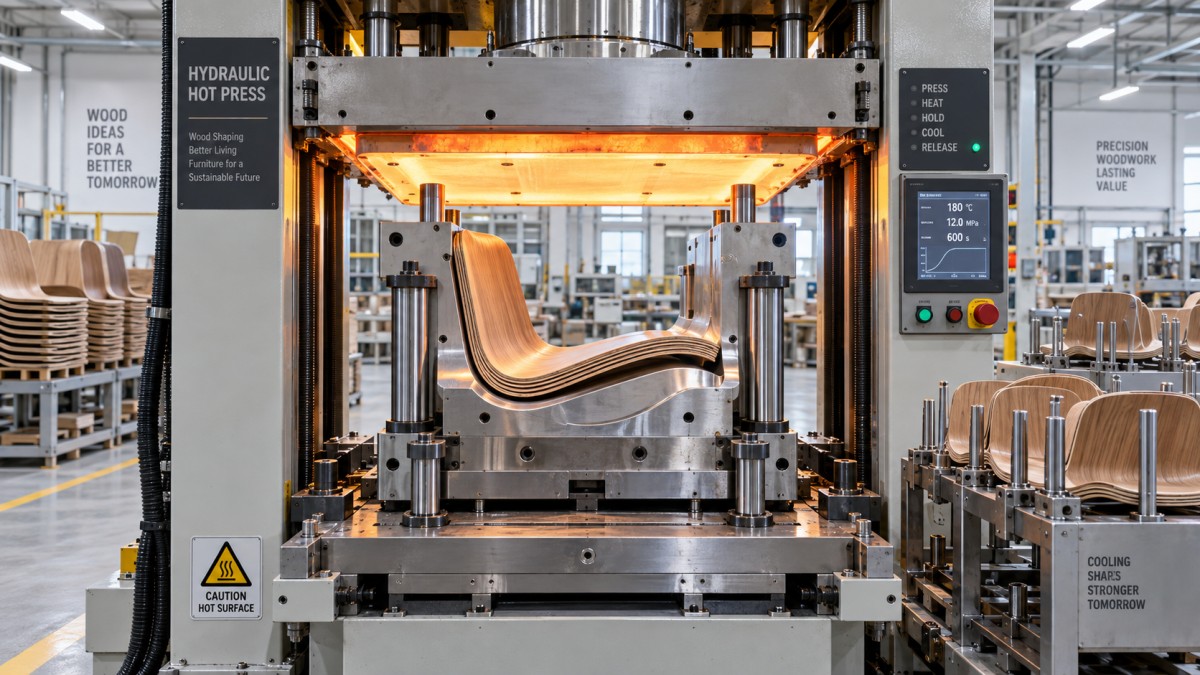
Match mold materials to temperature, pressure, and expected output
Molds for curved furniture pressing may be made from metal, engineered wood-based materials, composite constructions, or combinations of these. The best selection depends on required accuracy, press temperature, cycle frequency, and product life.
Metal tooling generally offers strong dimensional stability and good durability in high-volume operation. It is well suited to repeated heating cycles and precise matched surfaces, although it requires higher initial investment and careful thermal design. If the mold is expected to absorb heat rapidly from the platen, its mass can lengthen warm-up behavior at the beginning of a shift; this should be included in production planning.
Engineered wood or composite molds can be practical for development, small batches, and less demanding curves. They are comparatively easier to modify when a new furniture model is introduced. Their limitations become clearer when the process involves higher temperatures, prolonged dwell periods, heavy pressures, or continuous operation. Dimensional changes caused by moisture, heat exposure, and surface wear can gradually appear in the finished part.
A hybrid approach is often valuable: a rigid structural base, wear-resistant contact surfaces, and replaceable locating or edge inserts. This reduces the cost of maintaining the full tool while protecting the features most likely to affect alignment and visible quality.
Pressure must be distributed, not merely increased
When a curved part shows weak bonding or an inconsistent profile, increasing press pressure is a common reaction. It is not always the right one. Excessive pressure may force adhesive out of the bond line, crush a soft core, leave platen or caul marks, or create veneer stress that later becomes visible as checking or cracking.
The goal is adequate and uniform consolidation across the entire laminate. Deep concave forms, sharp transitions, and edges are frequent risk areas because the veneer pack can bridge rather than conform fully to the mold. Pressure mapping films, trial panels, and carefully observed glue-line inspection are useful ways to verify contact. For complex shapes, the tooling may need compliant layers in selected zones, but these should be controlled rather than added casually. Too much compliance can reduce dimensional repeatability.
Press frame rigidity and platen parallelism matter here as much as nominal tonnage. A large press with poor parallelism can produce more variation than a smaller but well-maintained machine matched to the tool. For this reason, a technical review of a hot wood press for curved furniture parts should include how the press maintains stable closing movement and pressure across the full mold footprint.
Heat has to reach the glue line at the right moment
Hot pressing accelerates adhesive curing, but platen temperature is not the same as glue-line temperature. Heat must pass through the platen, mold or caul, veneer layers, adhesive, and often insulating air gaps caused by imperfect contact. The surface may feel hot while the center of a thick layup remains below the adhesive’s preferred curing range.
This distinction is especially important for multi-ply shells and components with heavy tooling. If the press opens based only on a timer developed for a thinner sample, the part may appear acceptable at unloading but relax, delaminate, or distort later in the process.
Adhesive selection and press settings must be developed together. Factors to review include:
- open assembly time before the layup enters the press;
- spread rate and glue viscosity;
- moisture introduced by the adhesive system;
- required curing temperature at the bond line;
- acceptable dwell time before over-curing, discoloration, or veneer damage occurs;
- post-press handling requirements before trimming, sanding, or machining.
Production teams should avoid treating published adhesive data as a finished press recipe. Supplier guidance is a starting point, while the final cycle must reflect the actual veneer species, thickness, tool mass, and environmental conditions in the factory.
Build the cycle around stable work, not the fastest possible press opening
A productive press cycle is more than closing, heating, and opening. It begins when operators prepare the veneer pack and ends only when the formed part is stable enough for the next downstream operation. If the press cycle is shortened but the component must rest longer before trimming, the apparent gain may simply move congestion to another station.
A useful cycle plan separates the process into measurable stages: material preparation, adhesive application, layup positioning, mold loading, press closing, pressure build-up, thermal dwell, controlled opening, unloading, cooling or conditioning, and final inspection. Recording these stages makes bottlenecks visible. In many factories, loading accuracy and post-press handling create more lost capacity than the actual heated dwell.
Multi-opening presses or multiple molds can improve output when the adhesive’s open time permits several layups to be prepared safely. Yet more cavities do not automatically mean better productivity. The loading sequence must be balanced so that one delayed layup does not cure prematurely before pressing. For high-mix furniture production, quick-change mold arrangements and standardized locating systems may offer more value than maximum cavity count.
Do not ignore cooling and stress relaxation
Opening a mold immediately after adhesive cure may save seconds, but it can compromise shape retention. A curved laminate leaves the press with internal stress and residual heat. Some parts benefit from remaining in the mold briefly under reduced pressure or from being transferred to a cooling fixture that preserves geometry while the structure stabilizes.
This is particularly relevant when the part has a tight radius, a large unsupported span, or an exposed decorative veneer that must remain flawless. Conditioning time should be based on actual measurement of springback and downstream defect rates, not on the assumption that a cured glue line alone guarantees a stable form.
A practical validation route before committing to production tooling
Before approving a full production cell, run structured trials with production-representative materials. Use the intended veneer grade, adhesive, surface treatment sequence, and expected moisture condition. Prototype results made with fresh, hand-selected veneer can be misleading if normal incoming material shows wider variation.
Evaluate more than visual appearance. Check curvature against the drawing after release, after cooling, and after a defined conditioning period. Inspect bond lines at edges and in high-stress regions. Review whether glue squeeze-out can be cleaned without damaging the face. Confirm that operators can load the mold consistently and safely. Finally, assess whether the part reaches machining, upholstery, or finishing in a condition that supports the planned takt time.
Qingdao Zhongding Machinery Co., Ltd. approaches woodworking machinery selection with this broader production view. With more than two decades of experience serving furniture manufacturing and woodworking operations, the focus is not limited to supplying a press. Press configuration, tooling compatibility, operating stability, spare-parts planning, and responsive technical support all affect whether a curved-part process remains dependable after installation.
What technical evaluators should ask before selecting the system
The strongest machine proposal is one that answers process questions clearly. Ask how platen dimensions relate to the actual mold envelope, how pressure is controlled across the working area, what heating arrangement is suitable for the adhesive and tool construction, and how the press accommodates mold changes. Request clarity on safety interlocks, access for loading, maintenance points, and the availability of support for commissioning and future service.
Also ask for the information needed to engineer the cycle rather than just operate the machine: recommended process monitoring points, mold mounting requirements, limits on tool weight, and practical guidance for achieving stable platen temperature. A press should become a predictable part of the line, not a machine that requires constant adjustment from experienced operators.
For curved furniture production, consistency is the real measure of success. When tooling geometry, pressure distribution, thermal transfer, adhesive behavior, and cycle timing are developed as one system, a hot press can produce components that hold their intended form and move smoothly into finishing and assembly. That is the standard a hot wood press for curved furniture parts should be evaluated against: not only whether it can make one acceptable sample, but whether it can support reliable furniture manufacturing day after day.
Send Your Inquiry
We welcome your cooperation and we will develop with you.