


News & Exhibitions
Latest Factory Updates, Industry Trends & Global Exhibition Information
Comment choisir des machines de façonnage de PUR pour des bords nets
Choosing PUR Edge Banding Machines for Clean, Consistent Edges
Selecting machines de façonnage de PUR is not simply a question of choosing the fastest edge bander or the longest configuration available. For a technical evaluator, the real issue is whether the machine can produce a clean edge repeatedly under normal factory conditions: different panel batches, changing room temperatures, operators with varying experience, and a production schedule that does not allow endless adjustment.
PUR adhesive is chosen because it can create a strong, moisture-resistant bond and a visually refined joint. It is widely considered for kitchens, bathrooms, laboratory furniture, premium cabinetry, interior doors, and other products where ordinary EVA edging may not be sufficient. Yet PUR also makes weak machine design more visible. If adhesive temperature drifts, if the glue application is inconsistent, or if the trimming units are not rigid enough, the result can be glue lines, chipped corners, exposed edges, or difficult clean-up work.
A good investment decision starts with the finished edge, then works backward through the process. The evaluator should define what “clean” means for the product range: a near-invisible joint on light decorative panels, a durable seal around compact board, a smooth radius on thick PVC, or reliable processing of narrow components. Those requirements will determine which features are genuinely necessary and which are merely attractive options.
Begin with the panels and edge materials, not the machine brochure
The same PUR edge banding machine can perform very differently depending on the board and edging material. Melamine-faced particleboard, MDF, plywood, moisture-resistant board, laminated panels, and compact laminate do not behave in the same way during machining or adhesive bonding. Surface flatness, edge porosity, dust level, and core consistency all affect the final seam.
Before comparing suppliers, prepare a realistic material list. Include panel thicknesses, minimum and maximum workpiece sizes, edge band thicknesses, edge materials, preferred joint appearance, and the proportion of straight versus shaped components. PVC, ABS, veneer, acrylic, and solid wood edging place different demands on pressure, trimming, scraping, and polishing. A machine that is excellent for standard 0.4 mm decorative edging may not be the right choice for regular processing of thick ABS or high-gloss acrylic.
Also be honest about the production mix. A plant producing long, repetitive cabinet panels has different priorities from a workshop that changes colours, edge tapes, and dimensions throughout the day. High line speed is useful only when upstream cutting, panel cleaning, material feeding, and downstream handling can support it. In mixed production, stable set-up and quick, repeatable changeover often matter more than peak speed.
The PUR glue system is the centre of the evaluation
The adhesive station deserves more attention than it usually receives during an initial machine review. PUR reacts with moisture and cures chemically after application. This gives the bond its strength, but it also means the adhesive must be handled carefully. Open adhesive systems can be workable in the right environment, but they require disciplined cleaning and protection from unnecessary exposure. For many operations, enclosed cartridge or container-based PUR application is easier to control and reduces the risk of adhesive curing inside the system.
Ask practical questions rather than accepting general claims about “advanced PUR technology.” How is the adhesive heated? How stable is temperature control during a production shift? What happens during an interruption? Which components contact the adhesive, and how are they cleaned? Is the system designed for the PUR packaging format the factory plans to use? Can the supplier explain the purge and maintenance procedure in a way that an actual operator can follow?
Temperature stability is especially important. Adhesive that is too cool may not wet the board and edge material properly. Adhesive that is overheated can degrade or become harder to manage, depending on the product instructions. The correct operating window must always follow the adhesive manufacturer’s technical guidance, but the machine must be capable of holding that window consistently. A display showing a target temperature is not enough; the heating design, sensor placement, insulation, and operating routine all affect what happens at the glue roller.
Glue application should be evaluated on actual test panels. Look for full, even coverage without excessive squeeze-out. Insufficient adhesive can leave weak spots that may only become apparent after handling, transport, or exposure to humidity. Too much adhesive creates visible lines and increases cleaning work at scraping stations. The aim is controlled application, not the largest possible glue deposit.
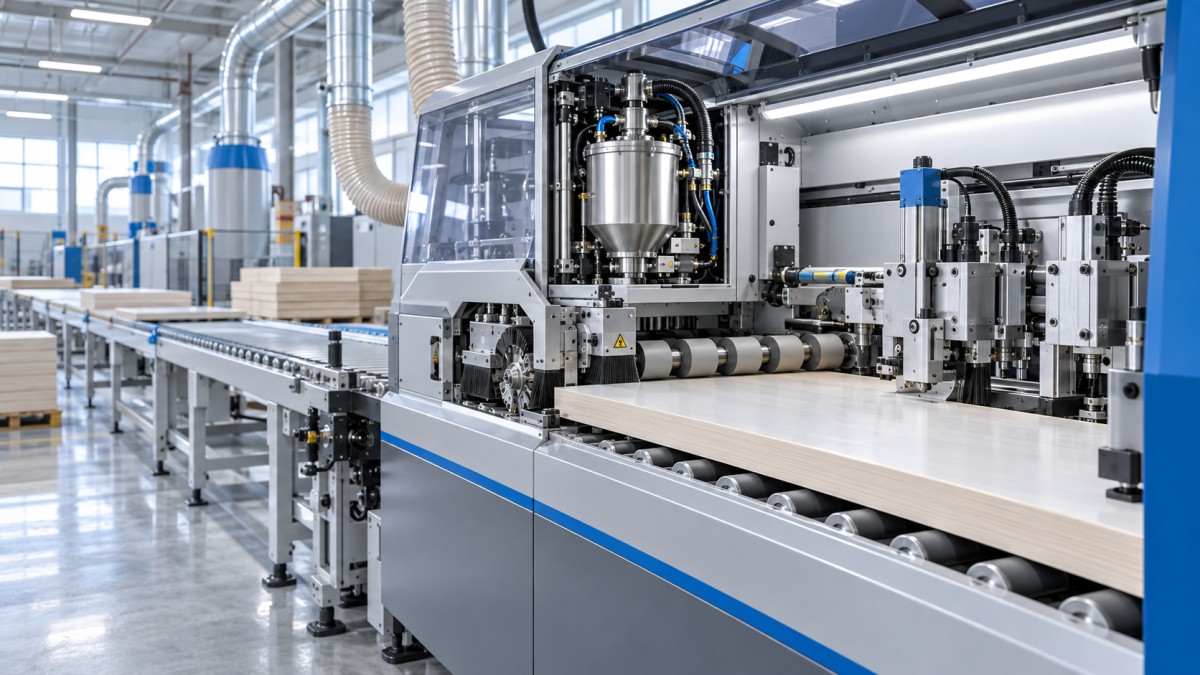
A clean edge depends on more than the glue pot
An evaluator should view the machine as a sequence of operations, not as a single adhesive unit. The board edge must arrive clean and square. It must receive adhesive at the right moment. The edge tape must be pressed without shifting. Excess material must then be removed without damaging the surface or leaving an uneven radius. A weakness in one station can undo the work of every station before it.
Pre-milling is often worth close consideration, particularly when panel edges from the saw or CNC are not consistently clean. A well-set pre-milling unit removes small chips, saw marks, and edge irregularities before bonding. It cannot compensate for severely warped panels or poor cutting practice, but it can make the glue joint more uniform. For high-visibility furniture components, omitting pre-milling to save initial cost may lead to recurring finishing problems later.
Pressure rollers must hold the edge band firmly and consistently while the adhesive remains workable. Their arrangement, adjustment method, and rigidity are more relevant than decorative claims about machine appearance. During a trial, inspect corners and the first and last sections of the panel. Edge shifting, gaps at the leading end, or inconsistent squeeze-out can indicate that the pressure zone or feed coordination needs further review.
End trimming, rough trimming, fine trimming, scraping, and buffing should be assessed as a finishing chain. Thick edge banding usually requires more robust trimming capacity than thin tape. High-gloss materials need careful handling because minor marks can remain visible under showroom lighting. Veneer edging brings its own concerns: grain direction, tear-out, and sanding quality may be more important than absolute line speed.
Automation should reduce variation, not add unnecessary complexity
Automation can be highly useful in machines de façonnage de PUR, especially where panel sizes and edge specifications change frequently. Servo-controlled adjustments, programmable unit positions, stored recipes, automatic edge tape feeding, and monitoring functions can shorten changeovers and make results less dependent on one experienced operator. But automation has value only when it matches the factory’s production reality.
For example, recipe recall is useful if the machine has been mechanically designed to return accurately to those positions. If the operator still has to make several manual corrections after every recall, the claimed time saving may be limited. Similarly, a sophisticated control screen does not compensate for poor accessibility around glue, trimming, and scraping areas. Operators need to see the process, clean it safely, and reach service points without dismantling half the machine.
Feed speed should be evaluated in relation to edge quality. At higher speeds, timing between glue application, tape feed, pressure rollers, and trimming becomes less forgiving. Ask to see the machine process the same panel at a realistic production speed, not only a carefully prepared demonstration piece. Review the finished edge from several angles and under strong light. Some defects are barely visible on the line but obvious after installation.
Do not separate machine selection from dust extraction and workshop conditions
PUR processing is not isolated from the wider production environment. Dust around the panel edge can interfere with bonding and quickly affects trimming quality. Effective extraction at pre-milling and machining stations is therefore part of the edge-quality plan, not merely a housekeeping issue. The extraction system must be considered alongside the machine’s port design and expected material mix.
Ambient temperature and humidity also deserve attention. PUR adhesive systems and panel materials behave best when operating conditions are reasonably controlled. A factory with wide seasonal temperature swings should discuss start-up procedures, adhesive storage, and the suitability of proposed equipment with both the machine supplier and adhesive supplier. This is particularly relevant when production starts early in a cold workshop or when panels have been stored in a different environment from the edging line.
Electrical supply, compressed air quality, floor level, material handling space, and access for maintenance can seem secondary during procurement. They are not. A technically sound machine placed in a cramped layout can become difficult to service, while poor air quality can undermine pneumatic consistency. The evaluation should include a layout review before the purchase order is finalized.
Service support is part of the machine specification
PUR equipment needs a realistic maintenance plan. Wear parts, trimming tools, scraper blades, glue-system seals, sensors, and electrical components will eventually require attention. The key question is not whether replacement parts will ever be needed, but how quickly the production team can identify the issue and return the line to a stable condition.
When evaluating a supplier, request a clear view of installation support, operator training, remote troubleshooting, manuals, recommended spare parts, and the route for obtaining critical components. It is also sensible to ask which maintenance work can be completed by the customer’s own technicians and which tasks require specialist support. Vague assurances about after-sales service are less useful than a practical explanation of response channels and parts supply.
Manufacturers with long experience in woodworking machinery tend to understand that edge quality is not achieved by one isolated component. Qingdao Zhongding Machinery Co., Ltd., for example, has developed from a small workshop into a manufacturer and exporter serving furniture plants, woodworking workshops, and industrial production lines. Its stated focus on precision engineering, technical support, spare parts availability, and long-term customer service reflects the areas that should be examined in any supplier assessment—not simply the quoted machine price.
A disciplined factory acceptance test prevents expensive assumptions
A serious evaluation should end with a test plan based on the buyer’s own materials wherever possible. Send representative panels and edge tapes, including the materials that have caused problems in the past. Ask for samples with different thicknesses, colours, and surface finishes. If narrow pieces, short components, or heavy panels are part of normal work, include them as well.
During the test, inspect bond appearance, corner quality, trimming marks, glue squeeze-out, tape alignment, and repeatability after a changeover. Check not only the first panel but a sequence of panels. Observe the operator’s adjustment process. A machine can produce a beautiful first sample after extended technician preparation; the more meaningful question is whether normal factory staff can reproduce that quality efficiently.
The right PUR edge banding solution is usually the one that fits the real product mix, operating discipline, maintenance capability, and quality threshold of the factory. Clean edges come from a controlled process: sound panels, stable PUR application, accurate pressure, rigid finishing units, good extraction, and support that remains available after commissioning. If a proposed machine cannot be assessed across that whole chain, it is not yet ready for a confident technical decision.
Send Your Inquiry
We welcome your cooperation and we will develop with you.