


News & Exhibitions
Latest Factory Updates, Industry Trends & Global Exhibition Information
How platen temperature affects wood board hot press bond quality
Platen Temperature Is a Bonding Variable, Not Just a Heat Setting
In a wood board hot press machine, platen temperature directly influences whether an adhesive reaches the cure condition needed to form a durable bond. It also affects how heat travels through veneer, particleboard, MDF, plywood layups, overlays, and other board assemblies. A press can display the selected platen temperature accurately while the bond line inside the panel is still too cold, too hot, or too uneven for reliable production.
For quality and safety teams, the practical question is not simply, “What platen temperature should be used?” The more useful question is: “Does the actual temperature history at the adhesive line match the resin system, board construction, moisture condition, press time, and target quality standard?”
When platen temperature is too low, resin may not cure sufficiently before the press opens. The immediate result can be low internal bond strength, edge lifting, core delamination, or failures that only appear after machining, conditioning, transport, or exposure to humidity. When the platen is too hot, the production line may appear faster, but the process can create a different set of defects: premature skin curing, adhesive starvation at the interface, veneer checking, surface discoloration, steam-related blows, excessive formaldehyde release during pressing where relevant, and increased burn risk around the press area.
A stable platen temperature is therefore necessary, but it is not sufficient. Bond quality depends on the combination of temperature, time, pressure, heat transfer, and material condition.
Why the Displayed Temperature Can Mislead a Quality Check
The press platen is the heat source, not the bond line itself. Heat must pass from the platen into the outer board layers and then move toward the center of the assembly. The speed and uniformity of that transfer vary with board thickness, density profile, moisture content, veneer species, surface finish, adhesive spread, caul plates, release sheets, and the contact quality between the panel and platen.
For a thin veneer lamination, the adhesive line may approach curing temperature relatively quickly. For a thicker multilayer assembly or a dense panel with a cooler core, the internal bond line can lag substantially behind the platen. Raising the platen setpoint may shorten the heating stage, but it does not automatically solve poor heat transfer. In some cases it widens the temperature difference between the board faces and the center, making surface defects more likely before the core has reached an adequate cure condition.
This distinction matters when investigating apparently inconsistent failures. If one panel passes a short-term peel or shear check while another delaminates later, the cause may not be adhesive batch variation. It may be an uneven thermal profile caused by local platen temperature variation, nonuniform board moisture, cold loading conditions, poor platen contact, or a press cycle that was developed around nominal settings rather than actual panel temperature.
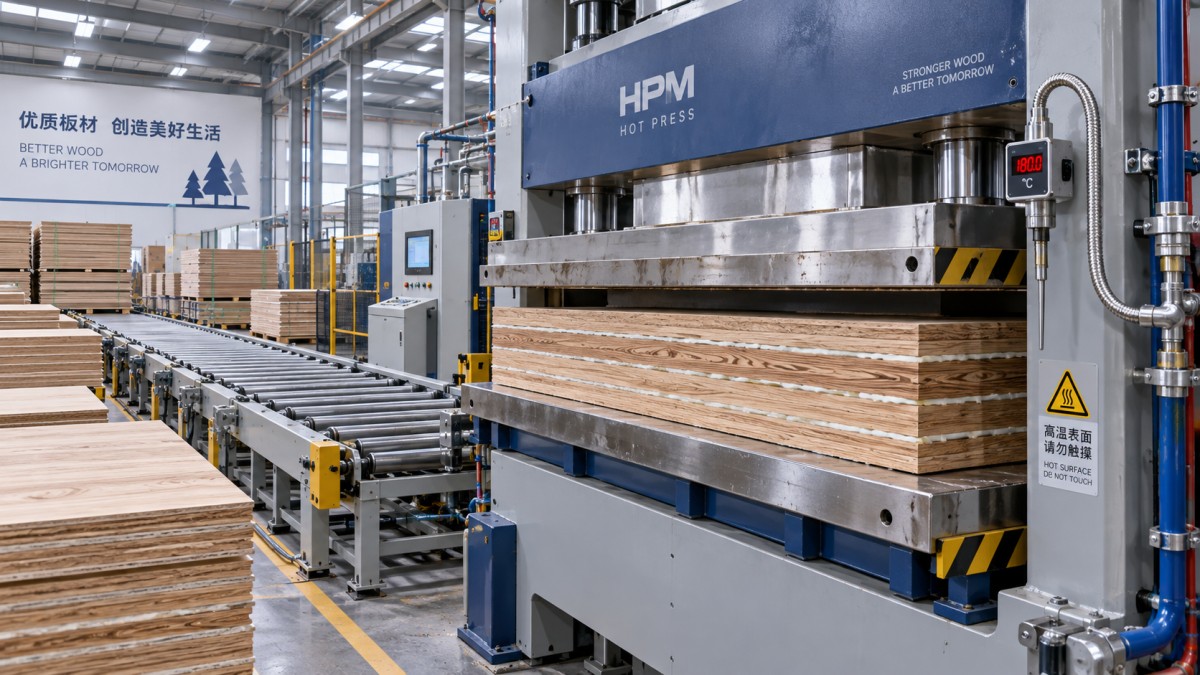
A wood board hot press machine should therefore be evaluated as a controlled thermal system. The setpoint, sensor reading, oil or steam temperature, platen surface temperature, and bond-line temperature are related, but they are not interchangeable measurements.
Too Cold: The Failure Mode Is Often Under-Cure, but the Evidence May Be Delayed
Low platen temperature slows resin activation and curing. The risk is obvious for thermosetting adhesive systems that require heat to develop their designed strength, but it can also affect bonding systems that depend on heat for viscosity reduction, moisture movement, film formation, or crosslinking. A panel may leave the press looking acceptable because pressure temporarily holds the layers together. The defect may emerge after trimming, sanding, drilling, CNC machining, packaging, or changes in ambient humidity.
Common quality signals associated with insufficient thermal input include:
- Open joints or lifted veneer near panel edges.
- Low internal bond results or irregular failure surfaces during destructive testing.
- Delamination after conditioning or moisture exposure.
- Weak adhesion concentrated in the panel center or in thicker sections.
- Higher reject rates after secondary processing rather than immediately after pressing.
- Large variation between panels produced in the same nominal cycle.
Under-cure should not be diagnosed from platen temperature alone. Low adhesive spread, poor glue transfer, expired or improperly mixed resin, inadequate pressure, and excessive open assembly time can produce similar symptoms. However, temperature deserves early attention because it interacts with every one of these variables. A resin with limited workable time may already have lost flow before the panel receives enough heat; a colder board may require a longer closed-press period even when the platen setting has not changed.
Quality control should also avoid relying only on the average temperature of a platen. Averages can hide cold zones near edges, corners, inlet and outlet areas, or regions affected by internal channel design. A board produced across a cooler zone may have a predictable weakness pattern that gets mistaken for random adhesive failure.
Too Hot: Faster Cure Can Produce a Weaker Assembly
Increasing platen temperature is often treated as the simplest way to reduce press time. That approach can work only within the curing window of the adhesive and the thermal tolerance of the board assembly. Beyond that window, heat can improve surface-side cure while damaging the conditions needed for bond formation deeper in the panel.
One frequent issue is premature curing at or near the panel surface. If resin gels before it has spread adequately into the intended interface, the resulting bond can be brittle, discontinuous, or poorly anchored to the substrate. This is particularly relevant where the material stack has variable porosity, uneven sanding, local density differences, or a coating layer that restricts absorption.
Excessive temperature can also drive moisture rapidly into vapor. Wood-based boards contain moisture, and adhesives may introduce additional water. During pressing, vapor pressure develops within the panel. If heat rises too quickly, pressure is released too abruptly, or the board construction restricts vapor escape, the panel can blister, crack internally, or separate when the press opens. These events create both quality losses and safety concerns because a sudden release can eject hot vapor, fragments, or hot material toward nearby personnel.
Other signs that the process may be thermally aggressive include surface darkening, veneer checking, excessive compression near the faces, print-through from press components, strong odor during pressing, and a narrower process window between acceptable panels and visible rejects. These symptoms should trigger a review of the whole temperature-time-pressure profile rather than a simple adjustment of the platen setpoint.
Temperature Uniformity Often Matters More Than a Higher Setpoint
For repeatable bond quality, a uniform platen surface can be more valuable than a higher nominal operating temperature. If one zone runs hot and another runs cold, operators may increase the overall setpoint to protect the cold zone. The hot zone then becomes more prone to over-cure, surface defects, or vapor-related damage. The result is a process that can only be made acceptable by accepting variation.
Temperature nonuniformity can arise from fouled heat-transfer circuits, poor thermal-fluid circulation, scale, control valve issues, damaged heating elements, uneven insulation, sensor drift, platen wear, or inadequate warm-up. It can also be introduced by loading practice. Cold panels, wet boards, uneven stacks, damaged caul plates, and debris on the platen surface all alter local heat transfer.
A useful control approach separates three checks:
These checks should be linked. A temperature map without bond testing does not prove process capability. Bond testing without temperature verification can identify a defect without revealing whether the press is the source. Together, they allow quality personnel to distinguish equipment variation from material variation.
The Press Recipe Must Be Matched to the Adhesive and Board Construction
There is no universally correct platen temperature for wood board pressing. Adhesive chemistry determines the required cure behavior, while board construction determines how long heat takes to reach the relevant bond line. A setting suitable for a thin decorative veneer may be unsuitable for a thick plywood layup, a high-density substrate, or a panel with moisture-sensitive surface layers.
When reviewing a press recipe, quality teams should establish the conditions around the setting rather than record only one temperature value:
- Adhesive type, mix ratio, viscosity condition, and stated cure requirements.
- Board thickness, layer count, density, surface preparation, and incoming temperature.
- Moisture range of each component, not only the nominal moisture target.
- Adhesive spread consistency and whether glue is transferred evenly at the interface.
- Pressure level, pressure ramp, dwell time, decompression sequence, and press opening practice.
- Platen temperature at multiple locations and its recovery behavior between cycles.
- Post-press conditioning time before bond testing, machining, stacking, or packaging.
This framework prevents a common mistake: treating a failed bond as evidence that “the temperature was wrong” without identifying whether the temperature was too low, uneven, applied for too short a period, or mismatched to the material stack. It also prevents the opposite mistake of solving every defect by adding heat. A hotter platen may hide one symptom while increasing another defect mechanism.
Use Bond Tests as Process Controls, Not Just Final Inspection
Destructive bond testing is most useful when it is designed to reveal thermal variation. Sampling only one board from the middle of a production run may miss problems tied to start-up, platen recovery, outer press zones, material changes, or shift-to-shift adjustments.
Sampling plans should include panels from different platen positions and, where the product allows, specimens from board edges and central areas. The failure appearance matters alongside the measured result. A failure that occurs mainly within the wood substrate can indicate a different condition from a clean adhesive-line separation. Repeated weakness in the center of a thick assembly points toward heat penetration or press-time questions; repeated weakness near one side of the press points more strongly toward local temperature, pressure, or loading consistency.
Inspection records become more useful when they connect test results to the actual process state: press number, cycle time, setpoint, measured surface temperature, material lot, board moisture, adhesive preparation time, and operator adjustments. This is not administrative detail. It allows a quality manager to see whether defects track with thermal performance or with another source of variation.
Safety Controls Belong in the Temperature-Control Plan
Platen temperature affects personnel risk as well as bond quality. Hot surfaces, heated caul plates, leaking thermal fluid, steam release, board blowouts, and hot-panel handling all require controls that remain effective during normal production and during faults. A press operating closer to the upper limit of its recipe may have less tolerance for a stuck control valve, sensor error, delayed unloading, or an unexpected interruption in the cycle.
Safety management should verify that temperature sensors are maintained and calibrated according to the facility's control system, over-temperature alarms are functional, guards and interlocks remain effective, and operators have a defined response for abnormal odor, smoke, vapor release, surface scorching, or unusual press noise. Lockout procedures are especially important before maintenance on heated platens, thermal-fluid circuits, hydraulic systems, or press mechanisms.
Boards should not be treated as harmless immediately after unloading. A panel with trapped heat or internal vapor pressure can behave differently from a stable, conditioned board. Handling routes, stacking practice, and inspection timing should account for that condition, particularly after recipe changes or when moisture levels have shifted.
What a Defensible Temperature-Control Decision Looks Like
A sound pressing decision does not begin with the highest temperature the machine can reach or the shortest cycle shown in a theoretical recipe. It begins with the adhesive cure requirements and confirms that the selected cycle delivers adequate, sufficiently uniform heat to the bond line without damaging the board.
For quality control, the practical target is a documented operating window: platen temperatures verified across the working area, an established press-time relationship for the specific board build, defined moisture and adhesive preparation limits, and bond tests that can detect drift before it becomes a shipment issue. For safety managers, the same window should include abnormal-condition responses and maintenance checks that protect workers from thermal, pressure, and mechanical hazards.
When bond quality becomes inconsistent, raising platen temperature should be treated as a hypothesis to test, not an automatic correction. The strongest process decisions come from confirming where heat is actually reaching, how evenly it is delivered, and whether the adhesive line receives the cure conditions the product was designed to achieve.
Send Your Inquiry
We welcome your cooperation and we will develop with you.