


News & Exhibitions
Latest Factory Updates, Industry Trends & Global Exhibition Information
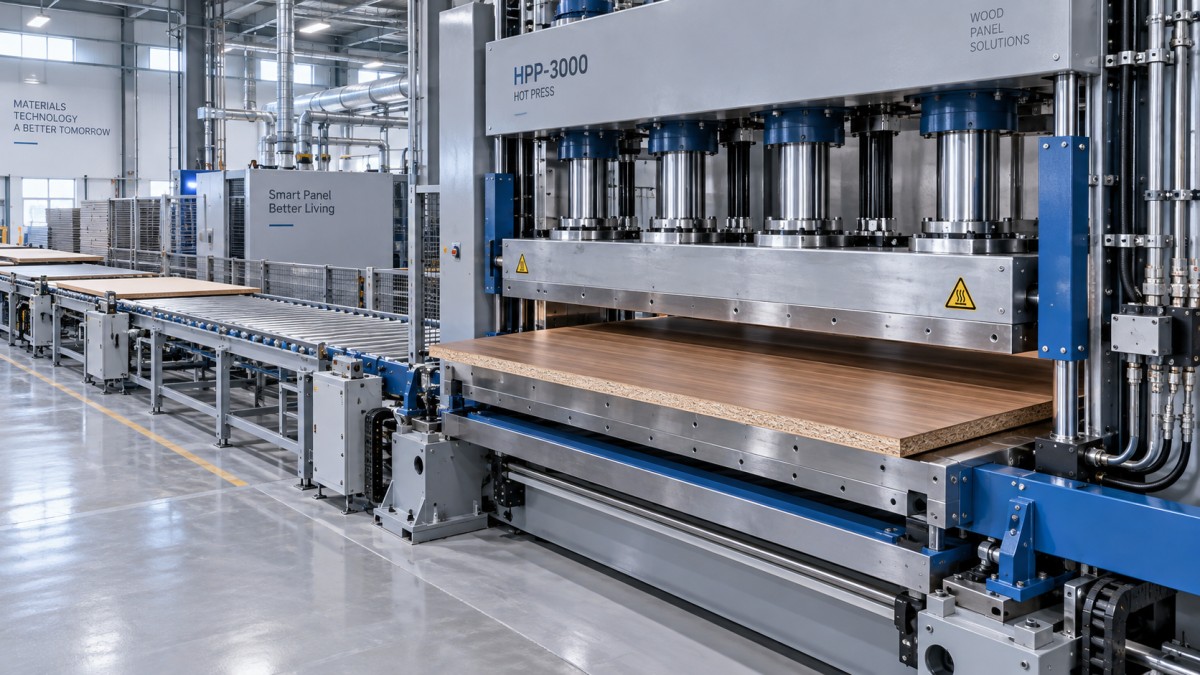
When a hot press for furniture board industry needs higher pressure
A furniture-board press needs higher pressure only when the existing pressure is demonstrably insufficient at the glue line or across the full panel area. A higher tonnage rating is not automatically a quality upgrade. In many production situations, weak bonding, raised edges, uneven veneer contact, or inconsistent thickness may look like pressure problems but are actually caused by poor platen parallelism, incorrect adhesive spread, unsuitable moisture content, or excessive panel loading.
The practical question is not “How much more pressure can the press generate?” It is “What pressure reaches the material uniformly during the required pressing cycle?” For technical evaluation, the correct decision starts with the board construction, panel dimensions, adhesive system, and expected output. Increasing pressure is justified when those factors show that the current machine cannot provide stable, even compression without extending cycle time or creating defects.
Start by separating pressure shortage from process instability
A hot press for furniture board industry applications may handle plywood, particleboard-faced panels, MDF laminating work, veneer pressing, door skins, decorative overlays, or laminated furniture components. These jobs do not respond to pressure in the same way. A press that performs well on small plywood panels may become inadequate when moved to large-format boards, denser substrates, thicker constructions, or materials requiring full-surface contact.
Before specifying a higher-pressure press, review the symptoms at the finished-board level. True pressure-related issues often appear as incomplete contact between layers, localized delamination, poor consolidation near panel edges, visible gaps around curved or uneven surfaces, or variable bond quality between positions in the same load. Defects that occur randomly from one batch to another, rather than repeatedly in the same board area, more often point to adhesive preparation, material conditioning, loading practice, or temperature control.
Pressure should be treated as one part of a controlled pressing window. That window also includes platen temperature, dwell time, closing speed, adhesive open time, board moisture, stack construction, and pressure distribution. Raising pressure while leaving the rest of the process unchanged can hide a problem temporarily or create a new one, such as glue-starved joints, crushed substrate surfaces, excessive resin squeeze-out, or platen deflection.
Calculate from effective pressing area, not machine tonnage alone
Press suppliers commonly state capacity in total tonnage, while production requirements are more meaningfully expressed as pressure over the working area. The same total force produces very different results on a small panel and on a large panel. A press that appears powerful on paper may deliver inadequate unit pressure once the platen is fully loaded.
The basic relationship is:
Required press force = target surface pressure × loaded panel area
The loaded area should represent the actual area under pressure, including the full panel footprint or the combined footprint of multiple parts being pressed at one time. It should not be based only on nominal platen dimensions. A large platen operating with small centrally located components has a different force requirement from the same platen carrying a full-size furniture board.
In technical review, also account for a realistic operating margin. The press should not need to run at its maximum hydraulic capability for every cycle. A margin supports consistent control, allows for variations in material thickness and load arrangement, and reduces dependence on peak-pressure operation. The size of that margin depends on the application, but the principle is straightforward: required force should be available under normal production conditions, not only under ideal test conditions.
A useful evaluation compares the required unit pressure at maximum loaded area with the pressure the machine can sustain across that area. This avoids selecting a larger press simply because a total-tonnage figure sounds more suitable.
When higher pressure is genuinely needed
There are several conditions in which additional pressing capacity is usually justified. The first is a planned increase in panel size while maintaining the same board construction and production standard. More area requires more total force. The second is a change from relatively forgiving panel assemblies to constructions that demand tighter, more uniform contact, such as certain veneer or laminate applications where local gaps are unacceptable.
A third condition is the need to maintain a controlled cycle while production volume rises. Sometimes the existing press can produce acceptable panels only by extending dwell time, reducing the loaded area, or avoiding the most demanding materials. In that situation, added capacity may be part of a credible production solution, provided thermal performance and adhesive curing behavior also support the shorter or fuller cycle.
Higher pressure can also be appropriate where measured platen deflection or uneven loading shows that the working surface does not maintain adequate contact at the outer zones of a full load. However, a larger hydraulic force alone does not correct a platen that is poorly supported, misaligned, or insufficiently rigid. The press structure and platen design must be evaluated with the pressure rating.
Conditions where more pressure may make the board worse
Pressure is often overused as a response to bonding defects. Adhesive systems need enough pressure to bring surfaces together and maintain contact while curing, but they also need a suitable bond-line condition. Excessive force may force adhesive out of the interface, particularly where spread quantity is already low or surfaces are very smooth. The resulting joint can appear tightly compressed immediately after pressing but have limited bond integrity.
Low-density particleboard and some lightweight core materials require particular caution. High pressure can leave visible compression marks, reduce thickness, damage edges, or create uneven density through the panel. Decorative surfaces may also show telegraphing, texture transfer, or gloss variation when the pressure-temperature combination is too aggressive.
Moisture-related defects should not be solved by increasing force. Boards with unsuitable moisture content can produce steam-related blistering, poor heat transfer, dimensional movement, or inconsistent curing. More pressure may alter the appearance of the defect without correcting the underlying material condition. Likewise, a cold platen zone or inaccurate temperature measurement cannot be compensated for reliably by higher hydraulic pressure.
Check pressure distribution before changing the press specification
A press does not perform as a single point of force. It must apply force evenly over a broad heated surface, repeatedly, during normal loading patterns. Uneven distribution is one of the most important reasons that a nominally adequate press gives inconsistent results.
Begin with platen parallelism. During closing, the upper and lower platens should meet in a controlled, parallel manner. Misalignment can create high-pressure contact on one side while leaving another side under-compressed. Look for recurring defects near the same corners, along one edge, or at a consistent location in multi-opening presses. These patterns are more informative than a general report of poor bonding.
Next, inspect the condition of the platens and any intermediate caul plates. Warping, surface damage, accumulated contamination, or uneven thermal behavior can affect contact. Caul plates must be flat, appropriate for the temperature range, and correctly handled; a distorted plate can introduce pressure variation even when the primary press structure is sound.
Load symmetry also matters. An uneven arrangement can cause the press to work under an off-center condition. This is especially relevant when different-sized components are pressed together or when only part of a large platen is loaded. Review actual operator loading patterns rather than assuming that all cycles use centered, full-size panels.
Practical evidence to collect
- Finished-board defects mapped by location, side, and panel orientation.
- Actual maximum loaded area and loading layouts used during normal shifts.
- Pressure readings during closing, holding, and release phases.
- Platen temperature consistency across the working surface.
- Thickness measurements before and after pressing, especially for low-density boards.
- Adhesive spread condition, open time, and visible squeeze-out pattern.
- Maintenance history related to hydraulic cylinders, seals, guides, platens, and leveling systems.
This evidence helps distinguish a capacity problem from a machine-condition or process-control problem. It also gives equipment designers enough information to recommend a press configuration based on the real application rather than a single tonnage request.
Pressure must match adhesive behavior and heat transfer
In hot pressing, the adhesive does not cure simply because force is applied. Heat must reach the bond line, and the adhesive must remain within its workable range long enough for the assembly to consolidate. A faster closing rate may be beneficial for productivity in some processes, but it can also displace adhesive or trap air if the material stack is not prepared correctly.
Review whether the existing press reaches the intended platen temperature and holds it consistently throughout the cycle. Temperature variation across a platen can create apparent pressure defects because one region cures differently from another. Pressing time should then be assessed together with core thickness, thermal conductivity of the materials, and the adhesive manufacturer’s processing guidance.
Pressure ramps may be more useful than a simple maximum-pressure target. Some assemblies benefit from controlled initial contact followed by full pressing force, while others require prompt consolidation to prevent surface movement. The correct profile depends on material construction. A machine with suitable pressure capacity but limited control over closing, holding, and decompression may not deliver repeatable board quality.
Choose the press architecture around the hardest normal production condition
The correct specification is usually based on the most demanding board that will be produced routinely, not on an occasional small component and not on a theoretical maximum that will never be loaded. Define the panel dimensions, substrate types, thickness range, layer configuration, press cycle, and quality criteria before selecting capacity.
For large furniture panels, platen rigidity and support arrangement become as important as total force. The design should resist deflection across the full working width. Cylinder layout, frame stiffness, guide accuracy, and hydraulic control all affect whether nominal pressure becomes usable pressure at the panel surface. Multi-opening presses add another consideration: every daylight should close consistently, and the load must be balanced through the stack.
Opening height deserves separate attention. A high-pressure machine with insufficient daylight may limit practical loading, caul plate use, or future product variation. Conversely, excessive opening height can affect cycle efficiency and machine dimensions. The required opening should be defined from the full production stack, including board thickness, tooling, caul plates, and safe handling clearance.
A disciplined decision path for an upgrade
- Define the maximum normal panel size and all planned board constructions.
- Set the required unit pressure for each construction using adhesive, substrate, and surface requirements.
- Calculate the corresponding total force at the largest loaded area.
- Review current defects by location to identify distribution, thermal, adhesive, or material-related causes.
- Confirm platen flatness, parallelism, frame condition, and actual hydraulic performance before attributing defects to low tonnage.
- Check whether the desired production rate changes dwell time, heating demand, or loading practice.
- Specify a force margin and control features that support repeatable operation without constant maximum-pressure use.
A higher-capacity hot press is justified when this review shows that unit pressure falls below the process requirement at the real working area, or when the current equipment cannot maintain even contact and required cycle conditions within its normal operating range. When the evidence instead points to uneven heating, poor alignment, unsuitable adhesive settings, moisture variation, or damaged platens, those issues should be corrected first. Buying more tonnage without resolving them can increase operating load while leaving the original board-quality problem in place.
Send Your Inquiry
We welcome your cooperation and we will develop with you.