


News & Exhibitions
Latest Factory Updates, Industry Trends & Global Exhibition Information
What determines the cycle time of a furniture board hot press?
For project managers and engineering leaders, furniture board hot press cycle time is a production-planning variable, not merely a machine specification or operator setting.
It determines how many panels a line can deliver per shift, how much energy each board consumes, and whether downstream processes receive material consistently.
The practical answer is that cycle time results from heat transfer, adhesive curing, board condition, press mechanics, material handling, and quality requirements working together.
A faster setting is not automatically a better setting. If pressing ends before the core temperature or adhesive bond reaches target conditions, defects create expensive rework.
Therefore, the goal is to establish the shortest validated cycle that meets board strength, surface quality, flatness, emissions, and production reliability requirements.
Which Technical Variables Have the Greatest Effect on Cycle Time?
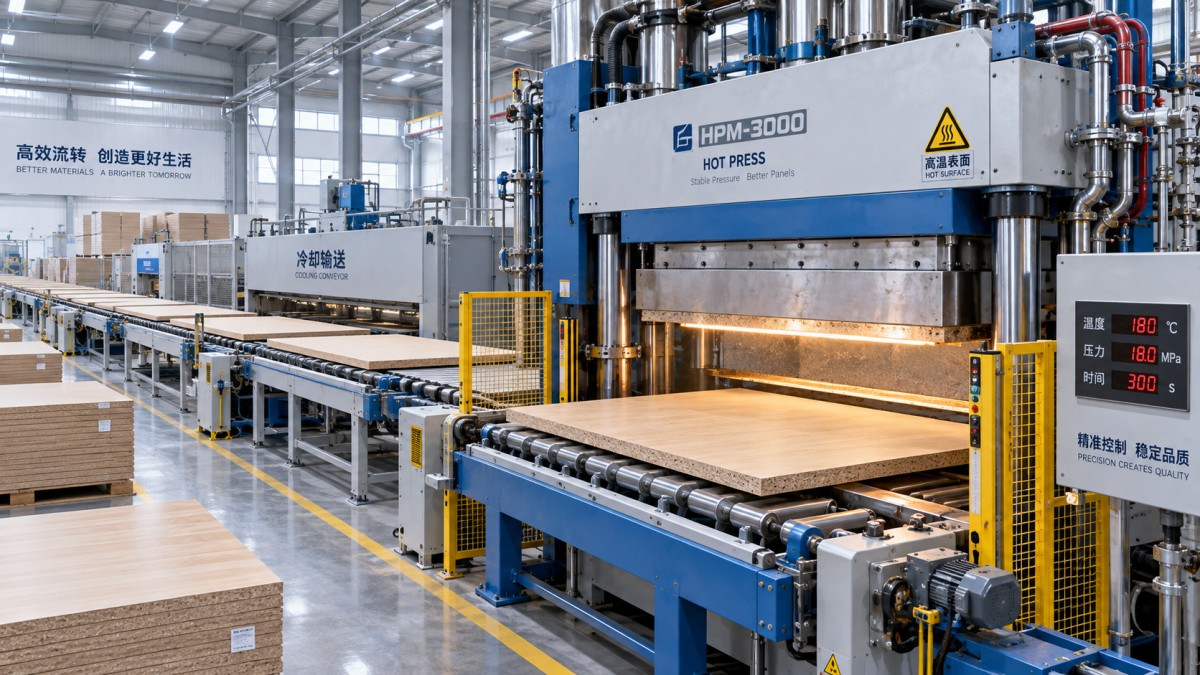
The most influential variables are board thickness, density, initial moisture content, adhesive formulation, pressing temperature, required pressure, and the time needed for loading and unloading.
These variables cannot be optimized independently. A change in adhesive chemistry may allow shorter pressing, but it can also require tighter moisture control or higher platen temperatures.
For a furniture board hot press, the effective cycle begins when the incoming board reaches the loading position and ends when a finished board clears safely.
That definition includes loading, platen closing, pressure build-up, heat penetration, adhesive curing, pressure release, opening, unloading, and any necessary transfer or stacking movements.
Board Thickness and Core Heating Time
Thickness usually has the clearest relationship with cycle time because heat must travel from the hot platen surfaces toward the center of the board.
Thin laminated panels may reach the required internal temperature quickly, while thicker particleboard, MDF, plywood, or composite panels require substantially longer heating periods.
Project teams should avoid calculating press output from thickness alone. Board density, veneer layers, decorative surfaces, and core composition all affect thermal conductivity and heating behavior.
A dense board can resist heat penetration more than a lower-density board of identical thickness. This may extend curing time even when platen temperature remains unchanged.
When product specifications include a broad thickness range, the press schedule should be based on validated recipes rather than one universal timing rule.
Moisture Content and Steam Generation
Moisture content strongly affects both heat transfer and product quality. Controlled moisture can help internal heat movement, but excessive moisture can create steam-related defects.
During pressing, water within the board converts to vapor as temperatures rise. That vapor may accelerate center heating, especially in wood-based composite panels.
However, too much moisture increases the risk of blistering, delamination, surface bubbling, edge cracking, and unstable thickness after the panel leaves the press.
Inconsistent moisture is often more damaging than moderately high moisture. Variable incoming boards force operators to add safety time, reducing predictable press capacity.
For project managers, moisture measurement and conditioning capacity should be treated as part of the hot-press investment, not as an upstream issue outside the project scope.
Adhesive Type and Cure Profile
Adhesive selection defines the minimum combination of temperature, pressure, and time needed to create a durable bond across the furniture board structure.
Urea-formaldehyde adhesives are common in many wood-panel applications because of cost and curing speed, but their performance depends on formulation and process control.
Melamine-urea-formaldehyde, phenolic, polyurethane, and other adhesive systems can require different thermal profiles, open times, pressure levels, and post-press handling conditions.
Accelerators may reduce required pressing time, but they should be evaluated against storage stability, glue spread consistency, emissions requirements, bond durability, and supplier availability.
A short laboratory cure time should never be used directly as a production setting. Full-scale boards have different heat transfer, loading, and pressure-distribution conditions.
Platen Temperature and Heat Transfer
Higher platen temperatures can reduce the heat-up portion of a cycle, but temperature increases are constrained by surface quality, overlay materials, adhesive behavior, and energy demand.
If the platen is too cool, the board core may not reach curing temperature quickly enough. If it is too hot, surfaces may discolor, scorch, or cure unevenly.
Temperature uniformity across each platen matters as much as the nominal setpoint. Cold zones can create weak bonding areas and force longer overall cycles.
Engineers should verify actual platen temperatures at multiple locations, especially after warm-up, during peak production, and following maintenance of heating circuits or thermal-oil systems.
Good insulation, stable heating controls, clean platen surfaces, and adequate thermal-oil circulation can improve consistency without simply raising the specified operating temperature.
How Do Pressure, Closing Speed, and Press Construction Affect Output?
Pressure does not cure adhesive by itself, but it creates contact between layers, distributes resin, consolidates the board, and prevents voids during the critical heating stage.
The correct pressure depends on board construction, veneer or laminate material, glue spread, target density, surface finish, and required thickness tolerance after pressing.
Excessive pressure can squeeze adhesive from the bond line, crush a low-density core, mark delicate surfaces, or increase hydraulic energy consumption without improving strength.
Insufficient pressure can leave unbonded areas, poor veneer contact, visible bubbles, and thickness variation. These defects can become apparent only after machining or finishing.
Closing and Pressure Build-Up Time
Fast platen movement improves throughput only when board alignment, loading safety, and pressure control remain reliable. Mechanical speed should support, not destabilize, the full process.
Modern hydraulic systems may use rapid closing until the platen approaches the board, then transition to controlled pressing as contact is established and pressure rises.
This sequence can reduce non-productive time while limiting impact damage. It requires responsive valves, correct hydraulic sizing, reliable sensors, and a well-maintained control system.
Slow pressure build-up may be caused by undersized pumps, internal hydraulic leakage, poor valve response, inadequate accumulator capacity, or incorrect programmed transitions between stages.
Before purchasing a larger press, teams should determine whether lost capacity is actually caused by curing time or by avoidable mechanical delays between completed cycles.
Platen Size, Daylight, and Parallel Processing
A larger platen can increase output per stroke, but only if loading, material preparation, unloading, and downstream handling can support the larger batch size.
Multi-daylight presses process several boards simultaneously, increasing capacity per cycle. They may be attractive where product dimensions, recipes, and handling systems remain relatively stable.
However, multi-daylight configurations can complicate loading and unloading, recipe changes, maintenance access, and fault recovery. Their value depends on the product mix and automation level.
For high-mix furniture production, shorter cycles with flexible single-daylight or automated press arrangements may outperform large batch systems that create frequent waiting periods.
The right configuration should be evaluated using hourly good-board output, not only theoretical press strokes. Changeovers, rejects, waiting time, and maintenance must be included.
Why Loading, Unloading, and Material Flow Often Limit Capacity
Many furniture board hot press projects focus on platen pressure and heating power, then discover that loading and unloading activities consume a large share of cycle time.
Manual loading can be appropriate for low-volume or variable production, but it often introduces inconsistent positioning, safety delays, operator fatigue, and idle press time.
Automatic loading systems, vacuum lifters, roller conveyors, shuttle tables, and stacking equipment can reduce handling time while improving alignment and protecting finished surfaces.
Automation should be selected according to panel size, weight, production volume, recipe variety, available floor space, and the reliability of upstream board preparation.
A fast press paired with slow feeding equipment simply moves the bottleneck. The complete line must be balanced from glue application through conditioning, pressing, cooling, trimming, and storage.
Recipe Changes and Production Scheduling
Cycle time also includes the operational cost of changing products. Different board sizes, thicknesses, decorative layers, adhesive systems, and pressures require recipe transitions.
Frequent changeovers reduce effective capacity because operators must confirm settings, adjust guides, replace release materials, inspect surfaces, and stabilize the first production boards.
Project managers can improve output by grouping compatible orders into campaigns. This reduces adjustment frequency while preserving reasonable delivery lead times for customers.
Production scheduling should consider curing similarity, not only panel dimensions. Grouping boards with compatible thermal and pressure recipes can reduce variation and simplify quality control.
Digital recipe management supports this approach by storing validated parameters, preventing unauthorized changes, recording production history, and making repeat orders easier to reproduce accurately.
Cooling, Conditioning, and Downstream Constraints
The press may release a board quickly, but the board may still require cooling or conditioning before trimming, sanding, machining, packaging, or surface finishing.
Releasing hot panels too aggressively can contribute to springback, warping, internal stress, surface damage, or handling marks, particularly with sensitive decorative materials.
Cooling racks, conveyors, separators, and buffer zones should be sized for the actual press output. Insufficient buffer capacity can stop the press despite a short pressing cycle.
Engineers should map every minute from raw-board entry to downstream acceptance. This reveals whether a proposed cycle-time reduction creates a new bottleneck elsewhere.
How Should Project Managers Calculate Realistic Press Capacity?
Theoretical capacity is calculated from boards per cycle, cycles per hour, planned operating hours, and the number of available production days. It is useful but incomplete.
Realistic capacity must subtract planned maintenance, warm-up, recipe changes, material shortages, quality inspections, operator breaks, minor stoppages, and rejected boards requiring replacement.
A practical calculation begins with average validated cycle time rather than the fastest recorded cycle. Then apply a realistic availability factor based on operating history or project assumptions.
For example, a press completing four boards every six minutes has a theoretical output of forty boards per hour before accounting for any downtime or rejected panels.
If the line achieves eighty percent availability and ninety-five percent first-pass quality, expected good output becomes materially lower than the theoretical maximum used in brochures.
Measure the Cycle in Separate Elements
Breaking cycle time into elements makes improvement work more effective. Track loading, closing, pressure build-up, heating and curing, opening, unloading, and transfer separately.
When the curing period dominates, investigate board moisture, adhesive formulation, temperature uniformity, and heat-transfer conditions. Do not focus first on conveyor acceleration.
When loading and unloading dominate, assess automation, fixture design, operator motion, stack arrangement, panel alignment, and synchronization with upstream and downstream equipment.
When cycle variation dominates, examine incoming material consistency, sensor accuracy, hydraulic stability, operator practices, maintenance condition, and the discipline of recipe control.
A data historian or simple production dashboard can show average cycle time, maximum cycle time, downtime causes, temperature trends, and first-pass quality by product recipe.
Use Quality Data to Set the Lower Limit
The lower limit for cycle time is established by verified quality, not by machine speed. Boards must meet bond strength, thickness, appearance, flatness, and durability standards.
Run controlled trials that reduce cycle time in defined increments. Test samples after conditioning rather than relying exclusively on immediate visual inspection at the press exit.
Relevant tests may include internal bond strength, peel resistance, thickness recovery, surface appearance, moisture distribution, formaldehyde emissions, and machining performance where applicable.
Document the approved process window, including acceptable board moisture range, platen temperature, pressure stages, target cycle time, and corrective actions for deviations.
This approach gives operations staff clear limits and gives project leadership confidence that capacity gains do not rely on unstable or unverified settings.
What Equipment Features Help Reduce Cycle Time Without Raising Risk?
The best furniture board hot press configuration combines adequate heating capacity, consistent pressure control, accurate sensors, efficient handling, and controls that preserve validated process recipes.
Uniform platen construction and dependable heating circuits are essential. A high nominal temperature is less useful than stable, repeatable temperature across the full pressing area.
Programmable multi-stage pressure profiles can support different materials and glue systems. They allow fast approach, controlled contact, scheduled pressure changes, and repeatable release conditions.
Servo-controlled or well-engineered hydraulic movement can reduce non-productive motion time, but selection should consider maintenance capability, spare-parts access, and local service support.
Automatic panel positioning is particularly valuable for large panels, fragile overlays, and high-volume work. It improves repeatability while reducing the time operators spend correcting alignment.
Integrated safety systems must not be treated as obstacles to speed. Proper guarding, interlocks, light curtains, and safe loading zones support stable production and protect personnel.
Remote diagnostics and production data collection can reduce recovery time after faults. They also help maintenance teams identify recurring losses before those losses affect delivery performance.
How Can Teams Avoid Common Cycle-Time Optimization Mistakes?
A common mistake is treating the fastest successful board as proof that the entire production process can operate at that speed under all material conditions.
Another mistake is increasing temperature or pressure to compensate for poor board conditioning, uneven glue spread, worn platens, or inconsistent material preparation.
These shortcuts can increase energy use and defects while hiding the actual constraint. They often produce unstable output that makes delivery commitments harder to manage.
Teams should also avoid evaluating the press in isolation. The best equipment decision depends on material flow, staffing, plant layout, maintenance resources, utility capacity, and order patterns.
Supplier discussions should include actual board samples, expected production mix, required quality standards, planned automation, and target output by shift instead of only machine dimensions.
A supplier with woodworking experience can help define press tonnage, platen size, heating method, loading arrangement, controls, and auxiliary equipment around the real operating case.
Conclusion: Select the Shortest Proven Cycle, Not the Fastest Claimed Cycle
The cycle time of a furniture board hot press is determined by the combined effects of material condition, thermal performance, adhesive curing, pressure control, handling efficiency, and quality limits.
For project managers, the right decision is based on good-board output, operational availability, energy use, maintenance needs, and downstream line balance rather than headline cycle speed.
Validated recipes, stable incoming material, accurate measurement, and coordinated automation usually deliver more sustainable capacity gains than aggressive adjustments to temperature or pressure alone.
By evaluating the entire production system, manufacturers can specify a hot press that supports consistent furniture board quality, predictable delivery, and lower production cost over time.
Send Your Inquiry
We welcome your cooperation and we will develop with you.