


When Does Automatic Loading Justify a Furniture Panel Hot Press?
Introduction: For finance decision-makers, investing in a furniture panel hot press with automatic loading system should be justified by measurable gains in labor efficiency, throughput, consistency, and operating cost control.
As furniture production volumes rise, manual loading can become a bottleneck that limits press utilization and increases handling risks. The key question is whether automation produces enough economic value.
The practical answer is straightforward: automatic loading is justified when manual panel handling constrains output, creates variable cycle times, raises labor dependency, or prevents profitable capacity expansion.
It is not automatically the right choice for every workshop. Low-volume producers, highly customized operations, and factories with irregular panel flows may achieve a weaker return.
Financial approval should therefore focus on utilization, labor cost, order mix, expected output growth, downtime exposure, and the machine's ability to reduce unit manufacturing cost.
Start With the Financial Threshold, Not the Automation Feature
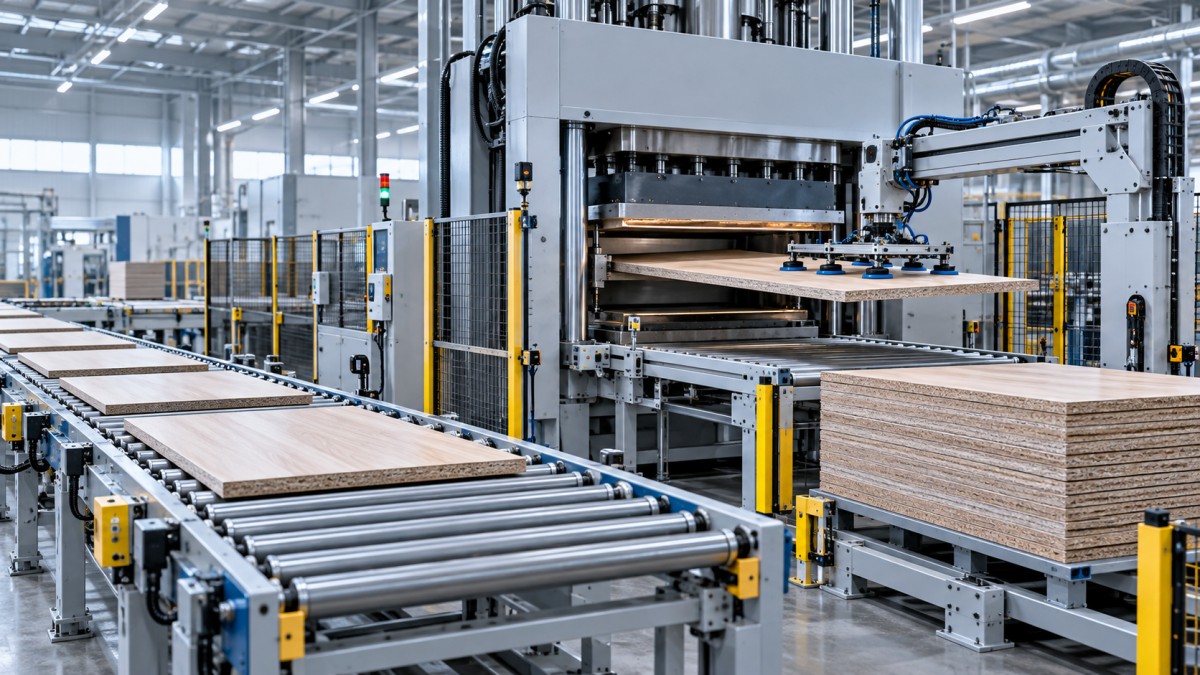
A furniture panel hot press with automatic loading system should be evaluated as a production investment, not simply as a more advanced machine specification.
The relevant financial question is whether the automated system generates cash benefits that exceed its purchase price, installation cost, maintenance requirements, and operating overhead.
Those benefits usually come from four sources: fewer handling labor hours, more productive press time, lower rework or damage, and delayed capital spending elsewhere.
In many furniture factories, the hot press is a critical process step. If panels wait for loading or unloading, downstream capacity cannot compensate.
A manual press may have an acceptable nominal cycle time, while its actual output remains low because operators cannot feed materials consistently.
Automatic loading reduces this difference between theoretical capacity and real production capacity. That gap often determines whether the investment is financially sensible.
For approval purposes, calculate actual daily press cycles before discussing maximum machine specifications. Actual cycle performance is more meaningful than catalog production claims.
Measure loading time, positioning time, waiting time, unloading time, operator travel, panel staging delays, and interruptions caused by material availability.
If manual handling adds meaningful minutes across hundreds of cycles, automation may recover a substantial amount of productive press capacity without adding another press.
When Manual Loading Becomes a Capacity Bottleneck
Automatic loading becomes easier to justify when the press regularly waits for people rather than waiting for heat, pressure, curing, or programmed process completion.
This condition is common in laminated board production, door panel manufacturing, plywood processing, veneer pressing, and furniture component lines with repetitive panel formats.
A warning sign is inconsistent cycle duration between shifts. When output changes materially according to staffing quality, manual loading is already influencing financial performance.
Another sign is that operators must hurry during peak periods, creating rushed positioning, uneven material placement, increased panel damage, or avoidable safety exposure.
Press utilization should be reviewed over complete shifts, not only during a short observation period. Breaks, changeovers, delays, and material shortages matter.
For example, a press with a seven-minute technical cycle may produce far fewer cycles if manual loading adds irregular waiting time before each run.
Even an additional minute per cycle becomes expensive when production operates for two shifts, six days weekly, across most of the year.
Automatic loading can turn those recurring minutes into available capacity. That capacity may support more sales, shorter lead times, or reduced overtime spending.
Finance teams should assign a value to recovered capacity based on contribution margin, avoided subcontracting cost, or the capital cost of purchasing another production machine.
Labor Savings Matter, but Labor Replacement Is Not the Only Benefit
Labor savings are often the first benefit considered, yet direct headcount reduction alone can understate the value of automatic loading.
Many factories do not eliminate employees after automation. Instead, they reassign experienced workers to assembly, quality control, packaging, setup, or higher-value finishing tasks.
That redeployment can still produce a measurable return when labor shortages, overtime costs, turnover, or recruitment difficulties affect production planning.
Manual panel handling also requires physical endurance and consistent attention. Fatigue can slow loading, reduce positioning accuracy, and increase the likelihood of accidents.
An automated loading system creates a more repeatable material flow, allowing employees to supervise, prepare materials, and manage exceptions instead of continuously lifting panels.
For cost modeling, include fully loaded labor cost rather than hourly wages alone. Benefits, overtime premiums, training, turnover, and absenteeism influence the calculation.
Consider the number of workers required at the press during normal production, peak production, breaks, and shift handovers. Staffing resilience has financial value.
Where a manual operation depends on one skilled employee, absence can immediately reduce throughput. Automation lowers that operational dependency and makes output more predictable.
However, labor savings should remain realistic. A factory still needs personnel for supervision, maintenance, material supply, quality checks, and nonstandard production conditions.
How Throughput Improvements Translate Into Lower Unit Cost
The strongest investment case usually combines labor efficiency with higher throughput. Producing more acceptable panels from the same facility lowers fixed cost per unit.
Factory rent, supervision, utilities, depreciation, administrative support, and many maintenance costs are largely fixed over a practical production range.
When an automatic system increases daily output, these costs are spread over more sellable furniture panels. Unit economics improve even without reducing staff.
Financial decision-makers should distinguish between technical capacity and commercially useful capacity. Extra output only creates value when demand exists or capacity solves a real constraint.
If customer orders are delayed because press capacity is limited, faster loading may improve delivery performance and reduce the need for expensive rush scheduling.
If demand is seasonal, automation can help process peak-order periods without temporary labor, excessive overtime, or missed delivery commitments.
For a reliable model, compare annual acceptable output before and after installation. Use expected yield rather than gross panel count.
Then estimate the contribution margin from additional saleable production. Where new sales are uncertain, use avoided overtime or subcontracting as the conservative benefit basis.
A furniture panel hot press with automatic loading system is most compelling when recovered capacity can be converted into profitable output within the factory's sales plan.
Consistency, Quality, and Material Loss Are Financial Variables
Automation is often discussed as a productivity tool, but stable loading also affects quality costs, especially in panel lines requiring accurate alignment and controlled pressure application.
Manual loading can introduce variation in panel positioning, veneer placement, adhesive timing, protective sheet handling, and the interval between preparation and pressing.
These variations may not always create visible defects immediately. They can instead lead to rework, rejected panels, customer complaints, or inconsistent finishing performance later.
Automatic loading supports repeatable placement and timing. That repeatability is particularly valuable for standardized furniture components produced in large quantities.
Finance teams should ask quality managers for data on panel scrap, rework hours, damaged surfaces, adhesive waste, and claims related to pressed products.
Even a small reduction in material loss can materially influence return on investment when boards, veneers, coatings, and adhesives represent significant input costs.
Quality benefits should not be assumed without evidence. The best analysis compares historical defect rates with the expected improvements from more controlled handling.
It is also important to evaluate whether the automatic loading system supports the panel sizes, surface materials, and stacking patterns used in normal production.
A system that improves cycle speed but mishandles delicate surfaces or irregular panels may shift costs rather than reduce them.
Which Production Profiles Benefit Most From Automatic Loading?
High-volume, repetitive furniture production provides the clearest case for automatic loading because the same handling sequence is repeated frequently throughout each shift.
Factories producing cabinet doors, laminated boards, flat-pack furniture panels, tabletops, decorative panels, and standardized components often fit this profile well.
Operations with multiple shifts also gain more value because automated equipment is used for more hours, spreading the investment across greater annual output.
Automation is especially relevant when panel dimensions are reasonably consistent and incoming materials can be organized into predictable loading sequences.
Growing manufacturers may also justify the investment before manual labor becomes an immediate crisis. Automation can provide scalable capacity for planned expansion.
By contrast, highly customized workshops with short runs, frequent size changes, and unusual materials may need flexible manual or semi-automatic arrangements.
That does not mean automation is unsuitable. It means the equipment configuration should be matched carefully to actual batch sizes and product variability.
A semi-automatic solution can sometimes offer a better financial result when full automation would sit idle during setup-intensive or low-volume production.
The decision should therefore be based on production data, not the assumption that the most automated configuration always produces the strongest return.
Build a Payback Model That Management Can Trust
A credible approval model should use conservative assumptions, transparent inputs, and several scenarios. Overstated productivity claims weaken confidence in the entire proposal.
Begin with total investment cost, including the press, automatic loading equipment, unloading interface, installation, electrical work, training, freight, and commissioning.
Next, estimate annual operating benefits from labor redeployment, overtime reduction, higher output, lower scrap, improved yield, and avoided subcontracting.
Subtract annual maintenance, energy changes, consumables, spare parts, software support where applicable, and expected downtime for routine servicing.
Use a simple payback calculation first: total incremental investment divided by annual net benefit. This creates an accessible starting point for management discussion.
Then evaluate discounted cash flow, net present value, and internal rate of return when the investment is large or the business uses formal capital budgeting rules.
Prepare downside, expected, and upside cases. The downside case should assume lower utilization, slower demand growth, and less ambitious labor savings.
Also calculate the break-even utilization level. This shows how many shifts, cycles, or annual panels are required for the automated solution to justify itself.
When the project remains attractive under conservative utilization assumptions, management can approve it with greater confidence and fewer hidden operating assumptions.
Reduce Implementation Risk Before Signing the Purchase Order
Financial value depends on reliable operation after installation. A technically capable system that experiences material-flow problems will not achieve its forecast return.
Before purchasing, provide the supplier with representative panel dimensions, weights, surface conditions, stack heights, production volumes, and required cycle targets.
Ask how the automatic loading system handles panel alignment, vacuum or gripping methods, protective surfaces, misfeeds, emergency stops, and operator intervention.
Request a clear description of included equipment, excluded site work, electrical requirements, compressed air needs, foundations, safety guarding, and control system interfaces.
Acceptance criteria should be defined in advance. These can include cycle time, loading accuracy, repeatability, panel damage limits, safety performance, and training completion.
After-sales support deserves direct financial attention. Downtime costs can quickly outweigh a lower purchase price if spare parts and technical assistance are unavailable.
Qingdao Zhongding Machinery Co., Ltd. supports woodworking customers with machinery, technical guidance, spare parts supply, and responsive after-sales service for long-term operation.
A supplier should also help assess line layout and material flow. Automatic loading works best when upstream staging and downstream unloading are equally well organized.
For finance leaders, implementation planning is not a secondary engineering detail. It protects the cash-flow assumptions used to approve the project.
Conclusion: Approve Automation When It Solves a Measurable Constraint
A furniture panel hot press with automatic loading system is justified when it removes a verified production constraint and produces measurable annual economic benefits.
The strongest cases involve repetitive panel production, sustained press utilization, labor pressure, dependable demand, and costly delays caused by manual handling.
Its value should be measured through recovered cycles, labor redeployment, improved output, lower material loss, more stable quality, and reduced cost per sellable panel.
Finance decision-makers should avoid approving automation based only on equipment sophistication or nominal production speed. Actual factory data must support the investment case.
With realistic assumptions, appropriate line design, and dependable technical support, automatic loading can become a practical tool for scalable furniture production and stronger margins.