


News & Exhibitions
Latest Factory Updates, Industry Trends & Global Exhibition Information
Automatic Pressure Control in Hot Wood Presses: Avoiding Thickness Variation
Thickness variation is one of those press-room problems that can look minor at first and become expensive by the end of a shift. A panel may appear acceptable when it leaves the hot press, yet later cause trouble during sanding, edging, laminating, assembly, or quality inspection. When thickness changes from one area of the board to another—or from one production batch to the next—operators lose time making adjustments, material consumption rises, and rejected panels begin to accumulate.
A hot wood press with automatic pressure control is designed to make this part of production more stable. Instead of relying entirely on manual pressure setting and operator judgment, the system monitors and regulates pressing force throughout the cycle. For furniture factories, plywood and veneered-board producers, door manufacturers, and woodworking workshops, this can be a practical way to reduce thickness inconsistency without turning daily operation into a complicated engineering exercise.
The important point is that automatic pressure control is not a shortcut around good process discipline. It is a tool that makes a well-understood process repeatable. To use it effectively, operators still need to recognize why thickness changes occur, what the press is actually controlling, and which conditions outside the hydraulic system may still affect the final panel.
Why a panel does not always come out at the thickness you expected
In hot pressing, thickness is the result of several forces acting together: platen pressure, temperature, pressing time, material density, moisture content, adhesive behavior, and the structure of the workpiece itself. A pressure gauge may show the correct value, but that does not automatically mean every part of the panel receives the same effective compression.
Consider a typical veneering or lamination job. The core panel may have slightly different density from edge to center. The veneer may carry more or less moisture than usual. Glue may be spread too heavily in one section, while another section begins to dry before loading. If pressure rises too fast, trapped air and excess adhesive may not escape evenly. If it is too low, the layers may not consolidate properly. These conditions can leave the operator with panels that vary in thickness, bond quality, or surface appearance.
Thickness variation is often linked to one of the following conditions:
- Uneven hydraulic pressure across the working area of the press
- Inconsistent loading, such as misaligned panels or uneven stack height
- Warped cauls, damaged press plates, or contamination on platen surfaces
- Changes in board moisture content, core density, or material thickness
- Unstable glue spread and open assembly time
- Manual adjustments that differ between operators or shifts
- Pressure loss, valve response issues, or poor synchronization in the hydraulic system
- Incorrect pressure-time-temperature settings for the material being processed
This is why a single “correct pressure” number is rarely enough. The press must apply force in a controlled and repeatable way, while the operator must make sure the material entering the machine is suitable for that programmed cycle.
What automatic pressure control changes during the pressing cycle
On a conventional manually adjusted press, an operator sets the target pressure, starts the cycle, and checks whether the machine appears to be working normally. If production conditions change, the response may depend on experience: turning a valve, increasing pressure after a problem appears, or compensating based on feel. Skilled operators can achieve good results this way, but consistency becomes harder when product specifications change frequently or when shifts rotate.
With automatic control, pressure is regulated through programmed settings and hydraulic feedback. The system can manage the transition from platen closing to pressure buildup, hold the selected pressure during the required dwell time, and release pressure in a controlled manner at the end of the cycle. Depending on the press configuration, the control system may receive feedback from pressure sensors and coordinate hydraulic components to maintain the specified pressure range.
The benefit is not simply “more pressure.” In fact, too much pressure can create its own problems, including glue starvation, over-compression of low-density cores, veneer damage, or excessive squeeze-out. What matters is applying the right pressure with a predictable profile.
For example, a process may require a gradual pressure increase rather than an immediate full-force clamp. A controlled ramp allows the layup to settle, lets air move out, and reduces the chance of shifting or marking the surface. Once the target pressure is reached, the machine holds it steadily while heat supports adhesive curing. A properly managed release can also reduce stress on the panel and make unloading safer and smoother.
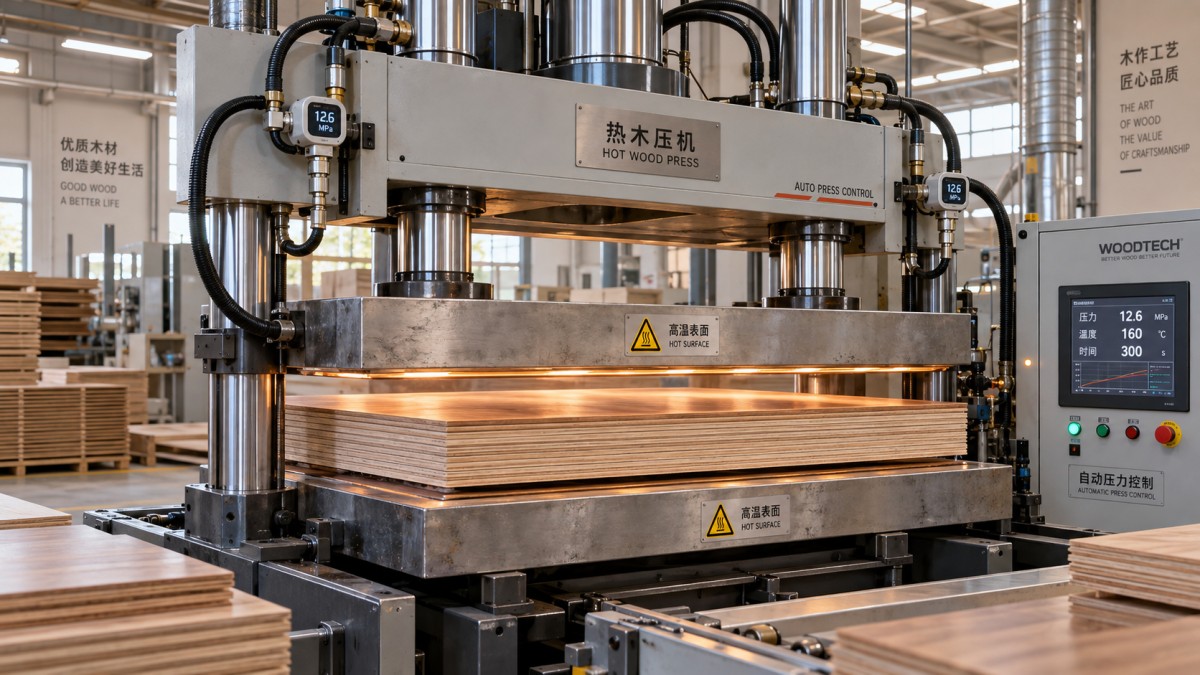
For the operator, this creates a more visible process. Instead of guessing whether pressure is holding correctly, they can monitor the programmed setting, actual machine response, cycle status, and alarms or deviations. That visibility is particularly useful when a quality issue begins to appear. It gives the team a better starting point for troubleshooting than simply changing pressure and hoping the next board improves.
Pressure uniformity is not the same as gauge pressure
One common misunderstanding is to assume that a stable reading on the hydraulic gauge proves uniform compression across the whole panel. The gauge confirms system pressure at a measurement point; it does not directly prove that every square centimeter of the workpiece is being pressed equally.
Uniform pressure at the panel depends on the condition and design of the whole pressing system. Platen flatness, frame rigidity, cylinder arrangement, parallelism between upper and lower platens, and the condition of caul plates all matter. A press may have accurate automatic regulation but still produce inconsistent results if the platen surfaces are not parallel or if debris is trapped under the workpiece.
Operators should pay particular attention to loading discipline. A panel placed off-center can affect force distribution, especially when processing smaller workpieces or using only part of a large press bed. Using suitable cauls, spacer boards, or balanced loading arrangements can help distribute pressure more evenly. The correct approach depends on the machine design and the product, but the principle remains the same: do not ask the control system to compensate for poor physical setup.
A quick shop-floor check before blaming the machine
When thickness variation appears, it is tempting to increase pressure immediately. Before changing the program, inspect the basics. Are the panels clean and flat? Is there glue buildup, dust, or a damaged area on the platen? Are material batches mixed? Has the glue spread pattern changed? Is the panel entering the press at the same moisture condition as the previous batch?
A useful habit is to measure thickness at several defined points: the four corners and center are a practical starting pattern. Record the readings alongside the press recipe, material type, date, shift, and operator. Over several cycles, the pattern often becomes clearer. A repeated thin area in the same location may suggest a mechanical or platen-related issue. Random variation from panel to panel may point more toward material, glue, or loading inconsistency.
Setting pressure for the material, not for the habit
Many production issues begin with a recipe that has been copied from an earlier job without considering what has changed. Veneer species, core construction, panel size, adhesive type, moisture level, and surface finish all influence suitable press settings. A cycle that works well for one door skin or laminated furniture panel may not be appropriate for another.
When setting up a hot wood press with automatic pressure control, use the product specification and adhesive supplier guidance as the starting point. Then validate the settings through controlled trial panels. Avoid adjusting several variables at once. If thickness is inconsistent, changing pressure, temperature, dwell time, glue spread, and loading method together may hide the real cause.
A more dependable approach is to confirm one factor at a time:
- Verify the panel’s incoming thickness, flatness, and moisture condition.
- Confirm that glue application is even and within the intended spread range.
- Check platen cleanliness, parallelism, and the condition of cauls or protection sheets.
- Load the panel consistently, using the same reference position and support method.
- Run the selected pressure-time-temperature cycle and measure the finished panel at fixed points.
- Review whether variation is directional, repeatable, or random before changing the recipe.
For low-density boards, excessive pressure can compress the core beyond the desired final thickness. For dense hardwood constructions, insufficient pressure may leave poor contact between layers. Thick assemblies may need a different heat and dwell strategy than thin veneers. Automatic pressure control gives the operator a repeatable platform, but the recipe must still match the material.
How automatic regulation reduces operator-to-operator variation
In busy workshops, results should not depend entirely on who happens to be standing at the press. Experienced operators bring valuable judgment, especially when evaluating glue behavior, veneer quality, or unusual materials. Yet repetitive control tasks—holding a stable pressure, following a timed sequence, and applying the same pressure profile every cycle—are where automation can make daily production less vulnerable to variation.
Programmed pressure settings establish a common working method. The morning shift and evening shift can run the same validated cycle. If a new operator takes over, they have a defined reference rather than a verbal instruction such as “press it a little harder than normal.” This is especially useful when a factory handles multiple panel types and needs to avoid recipe confusion.
Automatic control also supports faster response when a deviation occurs. If the actual pressure does not reach the target value, falls during holding, or the cycle is interrupted, the operator can investigate a specific condition rather than relying only on finished-panel inspection. That does not eliminate the need for quality checks, but it can prevent a minor equipment issue from becoming a full batch of inconsistent boards.
Signs that the pressure-control system needs attention
Even a well-built press requires routine observation. Pressure control problems may develop gradually: a cycle takes longer to reach its setting, pressure drifts during the hold stage, the machine responds differently at different times of day, or thickness measurements begin to show a pattern. These signals deserve attention before production quality falls further.
Check pressure sensors, gauges, hydraulic oil condition, seals, hoses, valves, and cylinder performance according to the machine maintenance schedule. Leaks should never be treated as cosmetic. Small hydraulic leaks can affect pressure stability and create safety concerns. Oil contamination or incorrect oil condition can also affect valve behavior and response consistency.
Mechanical checks are equally important. Inspect platen surfaces for dents, resin buildup, and wear. Confirm that the press closes evenly and that moving parts operate without unusual noise or resistance. If the machine includes multiple cylinders or synchronized lifting points, unequal movement should be addressed promptly. Automatic pressure control works best when the hydraulic and mechanical systems are both in sound condition.
Building a practical thickness-control routine
The strongest results usually come from a simple routine performed consistently, not from constant adjustment. At the beginning of a run, verify the recipe, material condition, and platen cleanliness. During production, sample finished panels at scheduled intervals rather than waiting for a complaint from the next process. Measure the same locations each time and keep records easy enough for operators to use.
If a reading moves outside the accepted tolerance, isolate the cause methodically. Compare the panel with the previous sample. Check whether the variation follows a machine location, a material batch, or a particular loading method. Review the actual pressure curve if the control system provides it. Then make one informed correction and verify the result with another test panel.
This approach may feel slower than making an immediate pressure adjustment, but it usually saves time over a full production day. Random changes can produce a new defect while masking the original one. Controlled troubleshooting protects both panel quality and operator confidence.
Choosing a press system that supports stable production
When evaluating a new hot press or upgrading an existing production line, buyers should look beyond maximum tonnage. Ask how pressure is monitored and controlled, whether settings can be stored for different products, how clearly the operator interface displays cycle status, and how easily maintenance personnel can access hydraulic components. Platen size, daylight, heating arrangement, frame structure, cylinder layout, and safety features should all suit the actual panel dimensions and production method.
It is also worth considering the support behind the equipment. Qingdao Zhongding Machinery Co., Ltd. manufactures and exports woodworking machinery for furniture plants, woodworking workshops, and industrial production lines. With more than 20 years of industry experience, the company focuses on practical machinery solutions as well as technical support, spare parts availability, and responsive after-sales service. For users, that matters because stable hot pressing is not only about installation day; it depends on keeping the machine correctly maintained and understood over its working life.
A hot wood press with automatic pressure control cannot correct every material defect, but it can remove a major source of unnecessary inconsistency from the process. When paired with clean platens, consistent layups, suitable recipes, and regular measurement, it gives operators a firmer grip on thickness control. The result is not merely a more automated press cycle—it is a calmer, more predictable production floor where fewer panels become surprises after they leave the machine.
Send Your Inquiry
We welcome your cooperation and we will develop with you.