


News & Exhibitions
Latest Factory Updates, Industry Trends & Global Exhibition Information
Nesting CNC Router vs. Beam Saw: Which Fits Custom Cabinet Production?
A cabinet order can look straightforward on a cutting list and become surprisingly complicated on the workshop floor. Rectangular carcass panels may need shelf-pin holes, hinge drilling, grooves, labels, and careful sorting before they reach assembly. Add a curved end panel or a last-minute dimensional change, and the fastest cutting machine is not necessarily the fastest route to a finished cabinet.
Choosing a nesting CNC router versus a beam saw therefore means balancing part complexity, batch size, material utilization, and downstream machining. For technical evaluators, the useful comparison is not simply routing speed against sawing speed. It is the time, labor, and cost required to produce a complete set of assembly-ready components.
Start with the production route, not the machine specification
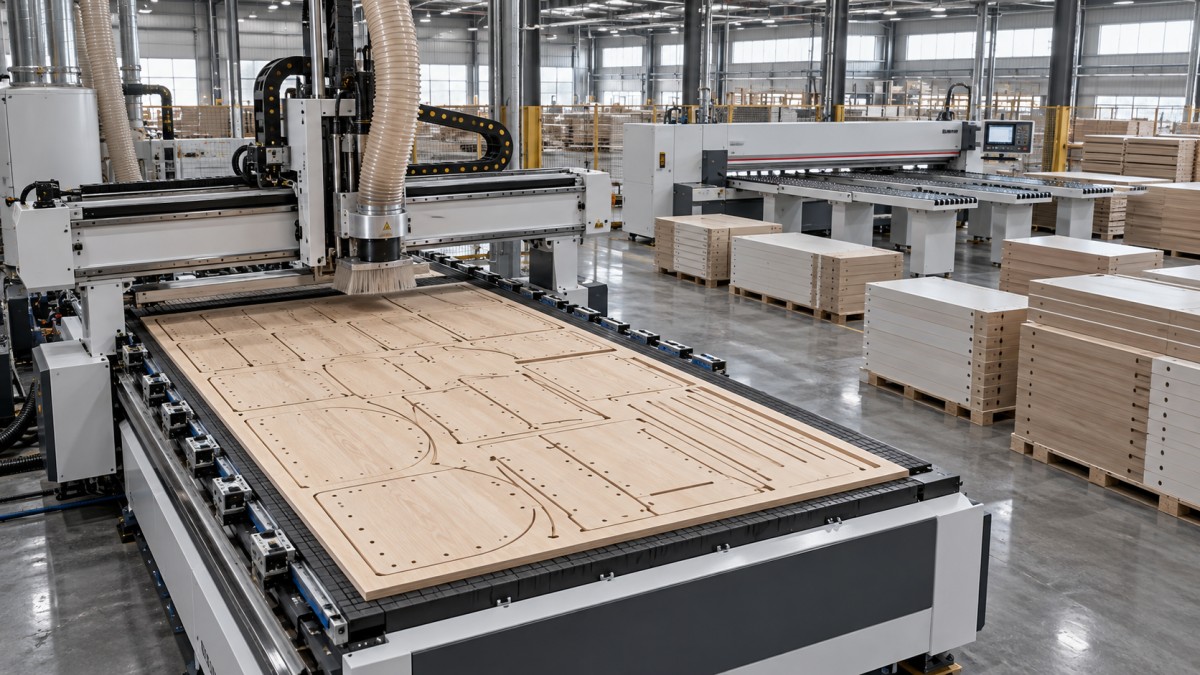
A nesting CNC router arranges components within a sheet and machines them using rotating tools. Depending on its configuration, it can cut outside profiles, drill vertical holes, machine pockets, and create grooves in one setup. This makes it attractive when cabinet designs change frequently and individual panels need several machining operations.
A beam saw divides sheets into rectangular parts through straight cutting sequences. Its strengths include efficient panel sizing, repeatable dimensions, and stack cutting where material, machine capacity, and quality requirements permit. Drilling, pockets, and most shaped features are normally completed on separate equipment.
Neither machine automatically delivers a finished cabinet component. A nesting router may still require separate machining for underside features or horizontal edge holes. A beam saw can form part of a highly productive cell when paired with suitable drilling, routing, and handling equipment. The right comparison is between these complete workflows.
Where a nesting CNC router earns its place
High variation without repeated physical setup
Custom cabinet production often involves many similar-looking parts that are not interchangeable. Widths change between rooms, service cutouts move, and shelf positions vary. With validated design-to-machine software, a nesting workflow can translate these differences into machining programs without preparing a separate manual setup for every component.
The benefit is particularly clear when the same panel needs an outside profile, shelf-pin holes, and a back-panel groove. Combining these operations reduces transfers and opportunities for orientation errors. However, this depends on the machine having the appropriate tools, drilling capability, and software support. A router with only a basic spindle should not be evaluated as though it includes a dedicated drilling block.
Shaped parts within a predominantly rectangular workload
Curved shelves, angled fillers, desk returns, and decorative panels can be nested alongside ordinary cabinet parts when material and machining requirements are compatible. A beam saw cannot directly create these contours, so a saw-based route needs an additional machining stage.
Occasional shaped parts alone may not justify a new machine. But when they regularly interrupt production or depend on manual templates, their impact extends beyond machining minutes: they also consume skilled labor and complicate scheduling.
The practical limit: holding small components securely
Vacuum hold-down deserves as much attention as spindle power. Small or narrow parts have less effective holding area and may move as their outlines are cut free. Sheet porosity, spoilboard condition, vacuum zoning, leakage, and cutting forces all influence stability.
Strategies such as leaving a thin skin for a final pass or retaining tabs can help, but may introduce additional machining or cleanup. Ask the supplier to process your smallest routine components—not just large demonstration panels—and inspect their dimensions and edge quality after removal.
When the beam saw is the better production engine
For workshops producing substantial quantities of rectangular panels, a beam saw can provide a direct, efficient sizing process. Repeated side panels, shelves, and door blanks may be cut in stacks where the machine’s cutting height, clamping capability, material consistency, and surface-finish requirements allow.
This distinction matters: a saw cutting several compatible sheets together is performing a different production task from a router typically processing one sheet at a time. Comparing only feed rates obscures that advantage. Equally, quoting maximum stack height without checking actual panel quality and handling conditions can exaggerate usable capacity.
A beam saw becomes especially compelling when the workshop already has dependable downstream drilling capacity. If cut panels move smoothly into a CNC drilling machine with reliable identification, the separation of operations may support higher overall throughput than performing every feature on one nesting table.
The weakness appears when sized parts accumulate between machines. Searching for the correct panel, turning it to the proper reference edge, and waiting for a drilling setup can consume the apparent cutting advantage. A fast saw attached to an unbalanced workflow simply creates work-in-progress faster.
Material utilization: compare real layouts, not general claims
Nesting software can arrange mixed sizes and irregular shapes efficiently, but a nesting CNC router does not automatically deliver better yield on every job. Router tool diameter creates spacing requirements, while beam-saw optimization must respect straight-cut sequences and saw kerf. Results depend on the actual part mix.
Grain direction, decorative matching, edge-trimming allowances, sheet dimensions, and defective areas can constrain both approaches. A layout with excellent theoretical utilization may be unacceptable if visible grain runs in the wrong direction or adjacent door fronts lose their intended pattern.
Offcuts also need honest accounting. A rectangular remnant that is labeled, stored, and reused has value. An awkward leftover that never re-enters production does not provide the same benefit. Compare usable material yield, including a realistic remnant-reuse process, rather than relying only on the software’s utilization percentage.
Measure the time until parts are ready for assembly
A technical evaluation should follow a representative order through cutting, machining, identification, and handling. For nesting, record loading, sheet positioning, tool changes, drilling, routing, unloading, part separation, and spoilboard-related interruptions. For the saw route, include cutting, destacking, labeling, transfers, and all required secondary machining.
Do not simply add every machine’s cycle time and call that the order lead time. Some operations run in parallel. Instead, distinguish total equipment time, operator labor, and elapsed completion time. Then identify the station that limits output.
Consider a shop cutting mixed cabinet orders in small batches. Nesting may reduce handling because several features are completed before the parts leave the table. In another shop, a beam saw and drilling cell may work concurrently, allowing one batch to be drilled while the next is cut. Both can be sensible arrangements; the deciding factor is whether capacity remains balanced under the actual order mix.
Check the interfaces that demonstrations often miss
- Edgebanding: Confirm finished edge quality, dimensional allowance, and whether any preliminary trimming is required.
- Drilling: Identify horizontal holes, opposite-face features, and connector details that cannot be completed in the initial setup.
- Identification: Verify that labels remain readable and correctly associated with parts throughout machining and sorting.
- Assembly: Check reference faces, hole positions, and component orientation against the intended hardware system.
A panel that is accurately cut but incorrectly referenced for drilling still creates an assembly problem. These interface checks are often more revealing than the machine’s headline positioning specification.
Build the cost comparison around the whole cell
Purchase price is only one part of the decision. A meaningful comparison includes installation, utilities, extraction, tooling, software, training, labor, maintenance, and the supporting equipment needed to complete the process.
For nesting, evaluate router-tool consumption, spoilboard replacement and surfacing, vacuum-system requirements, and dust extraction. For a beam-saw route, include blades, sharpening, handling space, and the cost of required drilling or routing capacity. Both approaches need provisions for safe material movement and routine maintenance.
A useful internal measure is cost per accepted, assembly-ready component. Divide the relevant production costs by the number of usable parts produced, rather than by sheets processed. This exposes rework, damaged panels, and incomplete machining that a simple cutting-cost calculation can hide.
Also test the economics at realistic utilization. A machine justified by uninterrupted full-shift production may disappoint in a workshop where order preparation, material availability, or staffing limits actual running time. Conversely, a more integrated process may be worthwhile even at modest volume if it removes persistent handling and rework costs.
A practical acceptance trial before committing
Send candidate suppliers the same representative production package: cabinet drawings, panel specifications, hardware requirements, grain rules, and expected batch sizes. Include ordinary jobs and difficult components. An evaluation based only on ideal parts gives little confidence about everyday production.
- Validate the digital route. Follow an order from design data through optimization, program generation, and labels. Check how revisions are controlled.
- Run the actual material. Assess surface chipping, edge finish, dimensional consistency, and small-part stability on the grades and thicknesses you use.
- Record the full cycle. Include operator intervention, unloading, sorting, and secondary operations—not just automatic machining.
- Inspect finished joints. Assemble representative components to confirm that machining results suit the selected hardware.
- Review maintainability. Ask about service access, consumable availability, spare parts, training, and troubleshooting support.
Qingdao Zhongding Machinery Co., Ltd. brings more than 20 years of woodworking machinery industry experience to equipment discussions. For a useful selection conversation, provide the company with your component drawings, material mix, existing machines, and output targets. This gives a stronger basis for assessing a woodworking solution than requesting a machine recommendation from sheet volume alone. Technical support and spare-parts arrangements should form part of that evaluation.
Choose for the workload you actually need to deliver
A nesting CNC router is often the stronger candidate when cabinet orders vary widely, shaped components are common, and combining cutting with face machining removes significant handling. A beam saw is often preferable when repeated rectangular parts dominate, stack cutting is practical, and downstream equipment can absorb the output without creating queues.
Some factories benefit from both: the saw handles repeat rectangular work while nesting processes variable or shaped components. That arrangement only makes sense when volume, staffing, software, and floor space support it.
The most dependable choice is the one that produces complete, correctly identified cabinet parts at a sustainable cost. Judge each option against representative orders and the entire production route. Cutting speed matters—but what reaches assembly, and how reliably it gets there, matters more.
Send Your Inquiry
We welcome your cooperation and we will develop with you.