


News & Exhibitions
Latest Factory Updates, Industry Trends & Global Exhibition Information
Planning a Woodworking Production Line for High-Mix Cabinet Orders
A cabinet factory can appear busy while still losing time in the places that matter most: panels waiting for the next operation, operators searching for the right program, hardware packs separated from their parts, and completed cabinets held back by one missing component. These problems become more visible when order mix is high. A production plan that works well for a long run of identical kitchen units may break down when the next shift includes wardrobes, vanity cabinets, office storage, curved doors, and one-off dimensions.
Planning a woodworking production line for high-mix cabinet orders is therefore not simply a machine-selection exercise. It is a routing and control challenge. Project managers need to decide which processes should be standardized, where flexibility is worth the investment, how panels will move between workstations, and how the line can absorb frequent order changes without creating confusion on the shop floor.
The best result is rarely the most automated line on paper. It is the line that matches the manufacturer’s actual product range, available skills, order profile, floor space, and expected growth. The following planning approach helps turn a collection of woodworking machines into a practical cabinet production system.
Begin with the order mix, not the machine list
Before discussing panel saws, CNC nesting centers, edge banders, or drilling machines, map the orders the factory truly receives. “Customized cabinets” can mean very different production conditions. One company may produce mostly standard carcasses with changing door colors. Another may process every panel to a different size, drill pattern, material, and edge specification.
For project planning, sort orders according to the operational characteristics that affect routing:
- Panel materials: MDF, particleboard, plywood, solid wood components, laminated boards, acrylic-faced panels, or compact boards.
- Lot size: repeat batches, small series, individual projects, or mixed daily orders.
- Panel complexity: straight rectangular parts, angled components, grooves, special-shaped doors, and integrated handle profiles.
- Edge requirements: no edge, one edge, two edges, full perimeter edging, PUR adhesive, laser-style zero-joint appearance, or thick edge strips.
- Drilling and hardware: shelves, hinges, drawer runners, connectors, dowels, cam fittings, and custom assembly features.
- Delivery priority: whether jobs are grouped by project, material, cabinet type, or due date.
This information exposes the real bottleneck. In some plants, cutting capacity is sufficient but drilling programs cause delays. In others, edge banding becomes the constraint because operators constantly change tape colors, thicknesses, and glue settings. If the planning team starts with individual machine specifications instead of these production facts, the final woodworking production line may look capable but remain difficult to schedule.
Choose a flow model that accepts variation
High-mix production needs structure, but it should not force every order through the same path. A useful cabinet line often combines a controlled main flow for common rectangular panels with flexible side routes for exceptions.
For example, standard carcass panels may move from cutting to labeling, edge banding, drilling, sorting, and packaging in a relatively predictable sequence. Special-shaped doors, solid wood parts, or panels requiring unusual grooves can be directed to a CNC machining cell without disrupting the main stream. This approach prevents low-volume exceptions from stopping high-volume work.
A practical routing principle: standardize the common 70–80 percent
The exact ratio varies by factory, but the principle is sound: identify the part families that recur most often and build a stable route around them. Standard cabinet sides, shelves, bottoms, backs, doors, and drawer components should pass through as few unnecessary handling steps as possible. The remaining diverse work should have a defined alternative route rather than being handled informally “when there is time.”
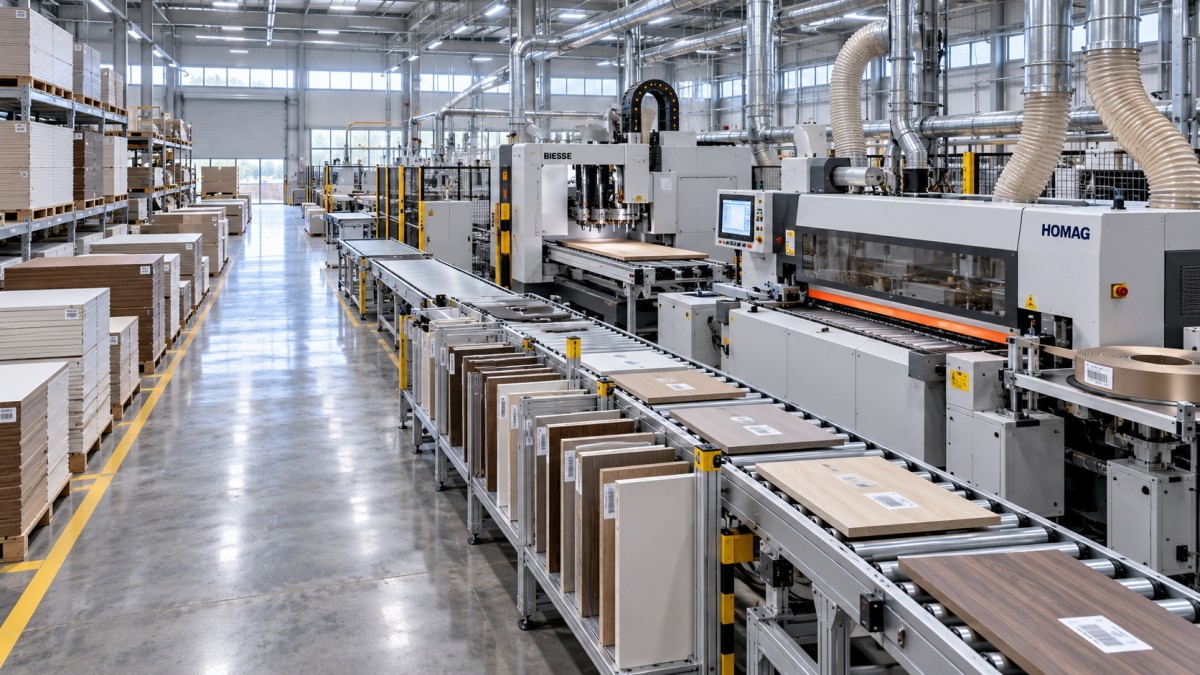
This does not mean a rigid conveyor line is always the right answer. For high-mix orders, excessive fixed automation can make changeovers harder and reduce the freedom to resequence urgent jobs. Roller tables, buffer zones, return conveyors around an edge bander, barcode-controlled sorting stations, and mobile carts may provide more useful flexibility than a fully connected transfer system.
Build the line around information flow as carefully as material flow
A panel only moves efficiently when its production information moves with it. Every component should be traceable from the cutting stage to final kit preparation. In customized cabinet work, handwritten markings or visual memory quickly become unreliable once several projects are open at the same time.
At a minimum, the production system should connect design data, cutting optimization, machining programs, labels, and work-order status. A label can carry the part number, project number, cabinet location, dimensions, material code, edge-banding instruction, drilling program, and downstream destination. The goal is not to add paperwork; it is to reduce the number of decisions an operator must make repeatedly.
For a project manager, the key question is: What happens when a panel leaves its expected route? A good answer includes a clear identification method, a designated rework location, and a way to update status without creating duplicate parts. Without these controls, customized production can become expensive through hidden losses rather than obvious machine downtime.
Cutting strategy: beam saw, nesting, or a combined approach?
Cutting is usually the first major decision in a woodworking production line because it influences panel labeling, downstream batching, waste control, and the pace of the entire factory. The best choice depends on product design and order mix rather than a universal preference for one technology.
A panel beam saw is well suited to large volumes of rectangular parts, especially where material sheets are handled in batches and cut accuracy must remain stable. It supports efficient cutting patterns for cabinet sides, shelves, and doors with predictable geometry. When paired with automatic loading, labeling, and unloading options, it can create a fast start to the main production stream.
A CNC nesting center offers a different kind of flexibility. It can cut, shape, groove, and drill components in one setup, which is valuable for irregular parts, integrated design features, or frequent dimensional changes. For a factory producing many special doors, shaped panels, and one-off furniture components, nesting may reduce handling and simplify routing.
Many high-mix cabinet manufacturers benefit from a combined strategy: a beam saw or panel saw for common rectangular components, supported by a CNC nesting or machining cell for complex parts and exceptions. This prevents the flexible machine from being overloaded with simple work while preserving a fast route for customized designs.
Do not overlook cutting buffers
High cutting output can create disorder if downstream operations cannot absorb it. Panels should be released according to the capacity of edging, drilling, and sorting—not merely according to saw availability. A modest, well-managed buffer is useful. An uncontrolled pile of panels is not a buffer; it is inventory with an uncertain production status.
Edge banding is often where high-mix plans succeed or fail
Edge banding is frequently underestimated during line planning. Cabinet panels may need different tape materials, colors, thicknesses, glue systems, corner treatments, and finishing quality. Even a capable automatic edge bander loses productivity if changeover procedures are unclear or if the factory releases orders in a sequence that causes constant tape replacement.
When specifying an edge-banding solution, evaluate more than maximum feed speed. Consider the real daily pattern of panel sizes and edge requirements. Important points include:
- How quickly tape rolls, glue systems, and pressure settings can be changed.
- Whether the machine configuration supports pre-milling, end trimming, rough and fine trimming, scraping, buffing, and corner rounding needed for the intended finish.
- Whether return handling is appropriate for one-person operation on selected jobs.
- How narrow, small, or unusually shaped panels will be processed safely.
- Whether edge tape and panel identification remain matched throughout the process.
Production scheduling matters just as much as machine capability. Grouping similar edge colors or thicknesses can reduce changeovers, but grouping must not cause late delivery of an urgent project. A practical planning system balances these two goals, often by defining controlled production windows for common material families while keeping a flexible slot for priority jobs.
Separate drilling capacity from drilling complexity
Cabinet production depends on accurate hole patterns. A slight mistake in hinge drilling, connector positions, or drawer runner holes may not be visible until assembly, when correction becomes costly. Yet project teams sometimes select drilling equipment based only on the number of spindles or nominal speed.
For high-mix work, programming simplicity, automatic tool selection, reference accuracy, and the ability to handle varied panel sizes are often more important than peak speed. CNC drilling and routing centers can process diverse hardware patterns with less manual adjustment. Through-feed drilling machines may be effective where part families are standardized and production volumes justify a stable flow.
A hybrid layout can be sensible here as well. Common carcass panels can use a dedicated drilling route, while special panels move to a CNC cell. The decision should be based on the percentage of parts that genuinely repeat, not on an assumption that all cabinet components are similar.
Plan work cells around assembly readiness
A cabinet is not complete when individual panels are machined. It is complete when all required components, hardware, labels, and instructions arrive together at assembly or packing. This makes sorting and kitting one of the most important, yet least glamorous, areas in the line.
Instead of allowing panels to accumulate by machine, create a clear point where components are grouped by cabinet or project. Depending on production volume, this may be a manual rack system, barcode-guided sorting area, automated buffer, or a combination of these. The design should make missing parts visible early.
Consider where hardware is introduced. Some manufacturers prepare hardware kits alongside panel sets after drilling confirmation. Others keep hardware separate until final assembly. Either method can work, but the responsibility must be clear. The most damaging situation is when a project appears finished in the panel department but cannot move because the correct fittings, hinges, or fasteners were not prepared.
Use layout planning to reduce crossing traffic
A line layout should show more than machine footprints. It must account for raw board storage, sheet loading, offcut handling, operator access, maintenance clearance, forklift routes, finished-part staging, dust extraction, electrical supply, compressed air, and safety zones. A narrow shortcut in a drawing can become a daily collision point after installation.
Where possible, maintain a directional flow from raw material to finished kits. Avoid layouts in which finished panels repeatedly cross paths with incoming boards or waste removal. If the building forces a U-shaped arrangement, make the handoff points explicit and provide enough space for temporary staging without blocking access.
Dust extraction deserves early attention. High output from cutting, CNC machining, and sanding processes cannot be treated as an afterthought. Ducting routes, airflow requirements, collection capacity, and machine connection points affect both installation design and long-term operating stability.
Decide where automation adds resilience—and where it adds rigidity
Automation is valuable when it removes repetitive handling, protects accuracy, improves traceability, or stabilizes a known bottleneck. Automatic panel loading, labeling, feeding, return conveyors, barcode scanning, and intelligent sorting can all strengthen a woodworking production line when they are matched to the factory’s production rhythm.
However, every automated connection also creates dependencies. If one transfer section stops and blocks several machines, the line may become less resilient than a well-organized cell layout. For high-mix manufacturers, phased automation is often a safer route: establish reliable processes and data control first, then automate the handoffs that repeatedly consume labor or cause errors.
Future expansion should be planned from the beginning. Leave room for an additional CNC unit, a second edge bander, expanded buffer storage, or upgraded sorting. Reserve utility capacity where practical. These decisions cost little on a layout drawing and much more after the factory is operating.
A commissioning checklist for project managers
Before accepting the completed line, test it with realistic mixed orders rather than only standard demonstration panels. Include different board materials, small components, full-size side panels, varying edge tapes, urgent changes, and a part that requires rework. Observe not only machine performance but also communication between stations.
- Can operators identify each panel and its next process without relying on memory?
- Are changeover procedures documented and realistic for the expected shift schedule?
- Can a priority order enter the line without losing traceability?
- Is there a defined process for damaged, incorrect, or missing parts?
- Do machine programs, labels, and hardware information match the approved design data?
- Are maintenance access, dust collection, safety protection, and spare-part planning already considered?
These tests reveal whether the solution is genuinely suited to high-mix cabinet production or only performs well under ideal conditions.
Turning equipment into a workable cabinet operation
A successful woodworking production line for customized cabinets is built on disciplined choices: keep frequent processes flowing, give exceptions a controlled route, protect part identity, and avoid adding automation that the scheduling system cannot support. The result is not necessarily a perfectly straight line. It may be a carefully coordinated network of cutting, edge-banding, CNC machining, drilling, sorting, and assembly-preparation stations.
For manufacturers planning a new facility or upgrading an existing workshop, equipment partners should be involved early enough to discuss material flow, process priorities, utilities, staffing, and expansion plans—not only machine models. Qingdao Zhongding Machinery Co., Ltd. brings more than 20 years of woodworking machinery experience to these discussions, supporting customers with machine selection, production-line planning, technical guidance, spare parts, and after-sales service. The objective is practical: help cabinet producers create a production system that can handle changing orders with greater control, lower avoidable handling, and consistent finished quality.
Send Your Inquiry
We welcome your cooperation and we will develop with you.