


News & Exhibitions
Latest Factory Updates, Industry Trends & Global Exhibition Information
Is a Segmented Sanding Pad Worth the Extra Cost for MDF Cabinet Doors?
A segmented sanding pad can be worth the extra cost for MDF cabinet doors when edge damage, uneven sanding, or repeated finishing work is limiting production. Its value is strongest when you process mixed door sizes or sand primer that leaves little room for error. For uniform, flat MDF blanks with a stable sanding process, a conventional pressure pad may already deliver an acceptable result.
The buying decision comes down to whether selective pressure control solves a recurring defect at a reasonable cost. Before comparing quotations, separate problems caused by sanding pressure from those caused by abrasive selection, machine setup, dust extraction, or the doors themselves.
What a segmented sanding pad actually changes
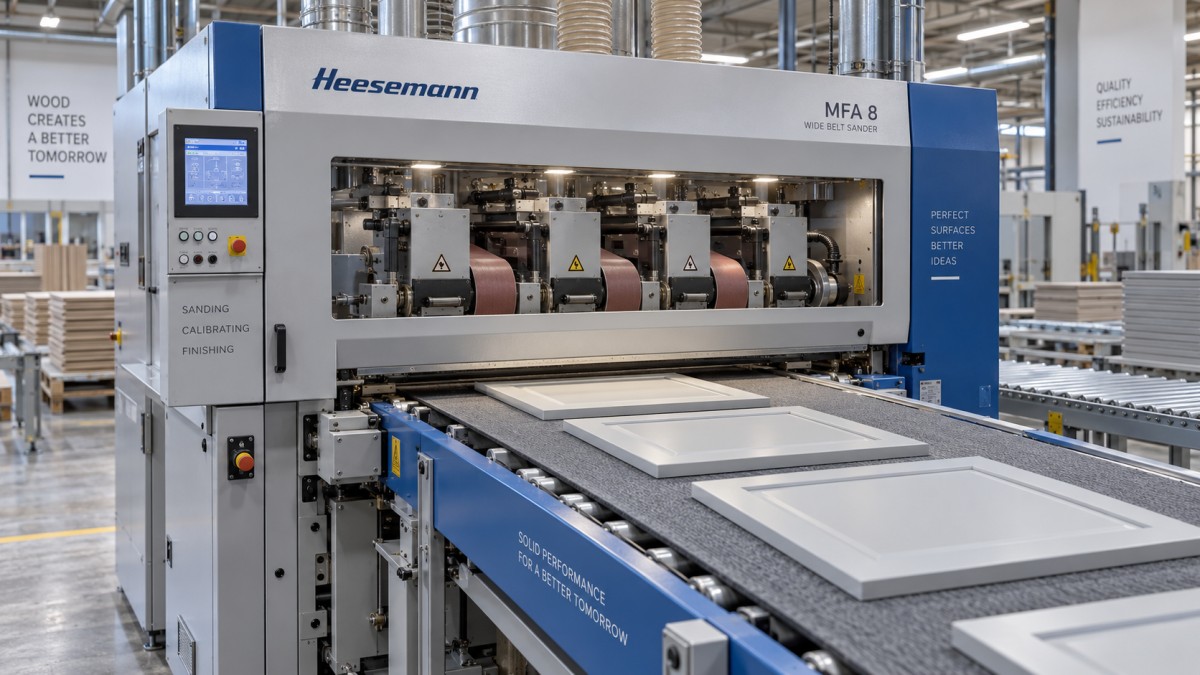
In a wide-belt sander, the pressure pad, also called a platen, supports the abrasive belt against the workpiece. A conventional pad applies pressure across a continuous contact area. A segmented pad divides that support into separately controlled sections across the machine’s working width.
Depending on the machine, workpiece detection and conveyor tracking activate the sections above the door as it passes through. Some systems also offer adjustable edge offsets, engagement timing, or pressure settings. These functions differ between machines; a segmented pad does not automatically include every form of pressure adjustment.
This selective contact can reduce unnecessary sanding pressure around vulnerable boundaries. At the leading and trailing edges, the timing of pad engagement and release matters. Along the sides, segment width and the control system’s treatment of partially covered segments influence how closely the active sanding area follows the door.
A segmented pad manages where the belt receives support; it does not make the belt follow every surface contour. This distinction matters for MDF cabinet doors with routed details, recessed panels, or narrow raised areas.
Start with the door geometry and sanding stage
Two doors made from the same MDF sheet can need quite different sanding processes. A plain slab presents a continuous face. A routed door introduces openings, shoulders, and changes in height that complicate belt contact.
For unfinished MDF, decide whether you are correcting thickness, removing machining marks, or preparing an already flat surface for coating. A finishing pad should not be expected to correct substantial thickness variation. On machines with multiple heads, calibration and final surface preparation may belong to different heads.
Primer sanding often provides a stronger reason to consider segmentation. Excessive removal near an edge can expose MDF and create another filling, priming, or sanding operation. More controlled contact may reduce that risk, provided the primer is ready to sand and the belt cuts cleanly.
Routed doors require particular care. Standard workpiece detection should not be assumed to recognize every internal recess. Even where a machine can respond to openings, the belt and pad still have physical limits. Profile sanding, brush sanding, or targeted manual work may remain necessary for shaped areas.
Identify whether pressure control is causing the defects
Before paying for an upgrade, examine rejected doors and record where the defects occur. Consistent damage at leading, trailing, or side edges points toward contact pressure, timing, or support as possible causes. Scratches across the whole face suggest a different starting point.
Use the defect pattern to guide the investigation:
- Rounded edges or primer cut-through: Check pad pressure, engagement timing, stock removal, abrasive condition, and repeated passes.
- Long scratches or isolated deep marks: Inspect the belt for damage, contamination, or trapped particles.
- Loading, heat, or smearing during primer sanding: Review coating readiness, abrasive suitability, extraction, and operating settings.
- Uneven sanding across the face: Check workpiece flatness, conveyor condition, head alignment, and pad wear.
- Defects concentrated inside profiles: Reconsider the sanding method for that geometry.
A segmented platen can address only part of this list. If a worn belt is producing scratches, reducing pressure may make the scratches less obvious while leaving the underlying problem unresolved. Likewise, a warped door may sand unevenly because its contact with the machine changes under load.
Stabilize the existing process before making the comparison. Start with a suitable abrasive, a clean machine, sound conveyor support, and repeatable incoming material. Otherwise, the apparent advantage of a new machine may come from better maintenance or a fresh belt rather than segmentation.
Compare the controls, not just the number of segments
Narrower segments can provide finer control across the door width, but segment count alone is a weak purchasing criterion. The useful result depends on the complete system: detection, activation timing, pressure behavior, pad construction, and workpiece transport.
Ask the supplier to explain what happens when a door edge covers only part of a segment. Also establish how the machine handles narrow parts, angled feeding, short doors, and gaps between successive workpieces. These situations reveal more than a demonstration using one large rectangular panel.
Distinguish between switching a segment on or off and adjusting its pressure. Both can be useful, but they offer different levels of control. For delicate primer sanding, the ability to maintain gentle, repeatable contact may matter more than an impressive control-screen description.
Check the rest of the sanding head as well. Pad compliance and contact length affect how the belt works against the surface. A softer contact can be more forgiving, while excessive compliance may encourage edge rounding. Segmentation does not remove this tradeoff.
Machine capacity must also match the doors. Minimum workpiece dimensions, thickness range, hold-down arrangements, and conveyor grip remain relevant even when the sanding head has sophisticated controls. Poorly supported parts cannot be made stable through software settings alone.
Run a trial that exposes the difficult work
A useful demonstration should reproduce your production conditions closely enough to support a buying decision. One carefully selected sample with a flawless finish tells you little about mixed batches or recurring edge defects.
- Choose representative doors. Include normal production sizes, narrow parts, and the geometry most likely to need rework. Keep incoming material and coating condition comparable.
- Define the required result. Agree on acceptable scratch appearance, edge shape, coating coverage, and remaining manual work before the trial begins.
- Compare realistic processes. Use suitable abrasives and settings for each machine. Record feed speed, passes, setup time, and any hand sanding needed afterward.
- Inspect beyond the freshly sanded surface. Examine doors under consistent lighting and carry representative samples through the intended coating sequence. Finishing can reveal scratches that raw MDF conceals.
- Repeat with different sizes and settings changes. Check whether the result remains consistent after changing door dimensions and recalling a saved program.
If practical, compare conventional and segmented operation on otherwise similar equipment. When machines differ substantially, assess the whole production result and avoid attributing every improvement to the pad.
Record failures as carefully as successful pieces. A process that produces an excellent face but leaves extra work around profiles may still be useful, but that remaining labor belongs in the cost calculation.
Calculate the premium against avoidable production costs
The purchase-price difference is only one part of the investment. Installation, training, maintenance, and replacement components can change the economics. The benefit comes from costs the improved process actually removes.
Simple payback period = additional installed investment ÷ annual net operating savings.
Build annual savings from your own production records. Relevant items can include less hand sanding, fewer doors requiring another primer cycle, reduced scrap, and additional saleable output. Subtract any increase in maintenance, consumables, or operating costs.
Avoid counting the same benefit twice. If reduced rework frees labor time, count either the labor cost genuinely saved or the value of useful work that time enables, using a consistent basis. Extra machine capacity has financial value only when demand and downstream processes can use it.
Separate savings by door family where possible. A segmented pad might provide little benefit on standard slabs but substantial value on a frequently produced primed range. Using a single average can hide which products justify the upgrade.
Include the cost of ownership beyond routine sanding. Ask about pad components, actuators, sensors, replacement procedures, and service access. Understand how a failed segment is diagnosed and how it affects operation. Availability of spares and competent support matters when the sander feeds the rest of the finishing line.
When the extra cost is justified—and when to keep the simpler setup
The case for a segmented sanding pad is strongest when a controlled trial reduces recurring edge defects or finishing rework across a meaningful share of production. Mixed door widths, frequent size changes, and sensitive primer sanding can make selective contact particularly useful.
A conventional pad remains a reasonable choice for consistent flat blanks when it already meets finish requirements at the required output. It can also be the better investment when production is limited and the measured savings would recover the premium too slowly.
If most labor goes into routed grooves and shaped edges, direct the investment toward that operation. Improving flat-face sanding will have limited impact when profile preparation remains the bottleneck. The same reasoning applies if coating problems, incoming MDF variation, or weak extraction dominate the reject rate.
When discussing equipment with Qingdao Zhongding Machinery Co., Ltd. or another woodworking machinery supplier, provide actual door drawings, size ranges, sanding stages, and examples of rejected surfaces. Request a proposed head configuration, a representative trial, and details of technical support and spare-parts supply. These make the quotation useful for a production decision.
Pay the premium when the machine can demonstrate a repeatable improvement on your doors and the avoided costs support the investment. The deciding evidence is an acceptable finished door produced with less total work.
Send Your Inquiry
We welcome your cooperation and we will develop with you.