


News & Exhibitions
Latest Factory Updates, Industry Trends & Global Exhibition Information
Which Machinery Reduces Labor Costs in Furniture Production?
Where Labor Costs Actually Accumulate
The machinery that reduces labor costs most effectively in furniture production is usually the equipment that removes repeated handling, measuring, positioning, and rework from high-volume operations. For panel furniture factories, that commonly means a combination of CNC nesting centers or panel saws, automatic edge banders, CNC drilling equipment, and automated sanding systems. The best choice depends on where employees are spending time today, not on which machine has the highest level of automation.
A factory may employ many people without having a single obvious “labor-intensive” station. One operator may cut panels, another may label and sort parts, several workers may apply and trim edge banding, and assemblers may spend time correcting hole-position errors or searching for the next component. Labor cost is therefore often embedded in waiting, movement, inspection, and correction. A machine that shortens only the cutting cycle may not reduce payroll much if manual sorting and downstream processing remain unchanged.
For most furniture producers, the useful question is: which operation has enough repetition, volume, and predictable workflow that a machine can replace several manual touches without creating a new bottleneck elsewhere?
Cutting Equipment: Choose Between Faster Cutting and Fewer Handling Steps
Panel cutting is often the first area considered for automation because it affects nearly every later process. However, different cutting machines reduce labor in different ways.
A beam saw or automatic panel saw can substantially reduce manual measuring and repeated cutting work when a factory processes large volumes of standardized sheet materials. Once cutting programs are prepared, operators can process cutting lists with more consistent dimensions and less layout work at the machine. This is particularly useful for cabinet carcasses, wardrobes, office furniture, and other products made from melamine-faced board, MDF, plywood, or particleboard.
Its labor-saving effect is strongest where sheet sizes, part dimensions, and daily output are relatively stable. If workers currently mark boards manually, push material through a sliding table saw, and repeatedly check dimensions, an automatic saw can remove much of that routine effort. It can also reduce the labor spent correcting inconsistent cuts before edge banding or assembly.
But a panel saw does not eliminate the need to manage parts after cutting. Small components still need to be identified, stacked, protected from damage, and sent to the correct next station. A factory that upgrades cutting capacity without improving labeling or material flow can simply shift labor from cutting to sorting.
A CNC nesting center is often a better labor-reduction tool for mixed-product production, customized furniture, and operations with frequent design changes. It can cut shapes, drill holes, create grooves, and machine special features from a sheet in one programmed sequence. This reduces the number of times an operator must move a panel between separate cutting, drilling, and routing machines.
That flexibility carries a condition: CNC nesting depends on reliable drawings, nesting software, tool management, and material loading. A poorly prepared program can produce a complete batch of incorrect components quickly. The machine saves shop-floor labor only when the production data entering it is controlled.
- Use an automatic panel saw when production is dominated by repeatable rectangular parts and high sheet throughput.
- Consider CNC nesting when products vary often, components need machining beyond straight cuts, or several operations can be combined on one machine.
- Review unloading, labeling, and part sorting before assuming cutting automation will remove all manual work in that department.
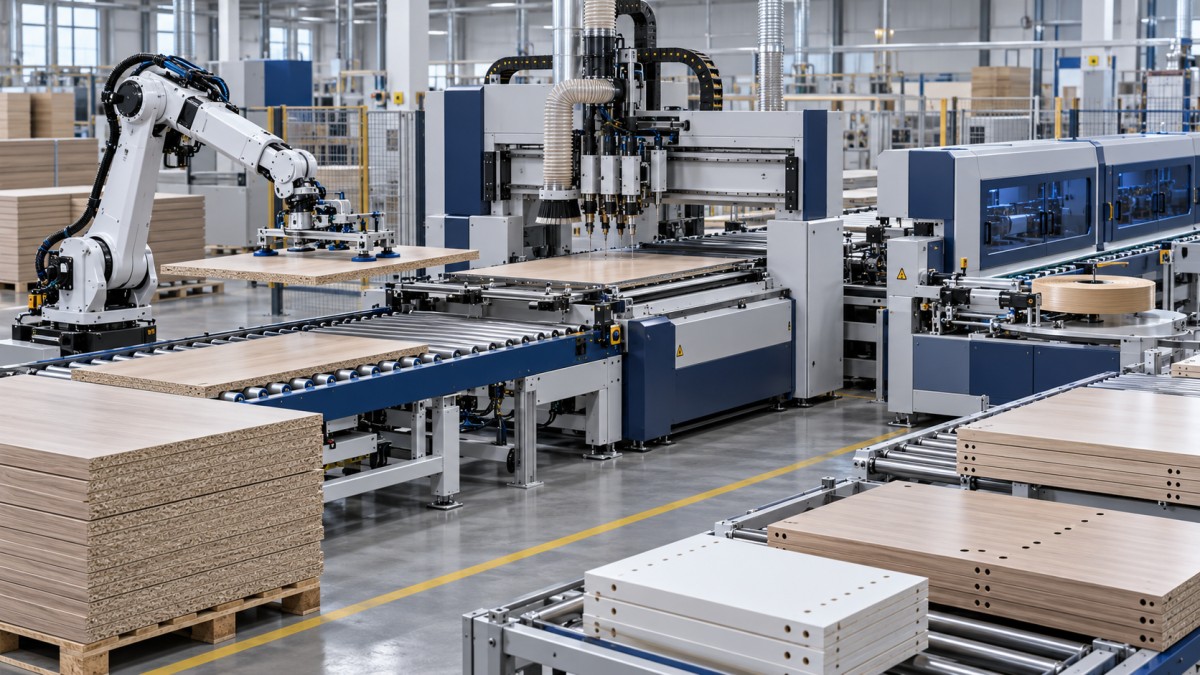
Automatic Edge Banding Often Delivers the Most Visible Labor Reduction
Edge banding is one of the clearest examples of a process where automation can reduce both direct labor and hidden quality costs. Manual edge application requires workers to feed parts, control adhesive, press the tape, trim excess material, and inspect the finished edge. Even where a semi-automatic machine is used, final trimming and cleaning may still require considerable handwork.
An automatic edge bander can combine pre-milling, glue application, edge feeding, pressing, end trimming, rough trimming, fine trimming, scraping, buffing, and sometimes corner rounding in a continuous pass. The practical advantage is not simply higher speed. It is the removal of several separate hand operations that can vary by operator and by shift.
For manufacturers producing cabinets, wardrobes, desks, retail fixtures, or flat-pack furniture, an automatic edge bander can reduce the number of people required at the edge-finishing station while improving consistency at visible edges. Consistent glue application and trimming also reduce the chance that assembly workers or quality inspectors must deal with chipped panels, loose edging, adhesive residue, or mismatched finish quality later.
Still, edge banding machines should be matched to the actual product mix. A compact automatic model may be suitable for straight panels and moderate output, while products with many narrow pieces, curved components, or frequent color changes may require a different setup. Installing a large, high-speed machine in a low-volume workshop can create unnecessary setup work and leave an expensive asset underused.
Buyers should inspect more than feed speed. They should ask how quickly operators can change edge tape, adhesive, and program settings; whether the machine handles the minimum and maximum workpiece sizes used in production; how easily glue pots and trimming units can be maintained; and whether replacement cutters and service support are accessible. Lost production time can erase the labor savings promised by an automated line.
Drilling Automation Reduces Assembly Delays, Not Just Drilling Time
Manual drilling is labor-intensive because it relies on repeated positioning. Operators must identify the panel face, select the correct reference edge, set stops or jigs, drill holes, and verify their location. The drilling itself may take seconds, but the preparation and checking around it take longer. Errors are also expensive because an incorrectly drilled cabinet side or door panel may become unusable.
CNC drilling machines, point-to-point boring centers, and multi-spindle drilling systems reduce this burden by using programmed coordinates and repeatable positioning. They are especially valuable for modular cabinets, kitchen furniture, office systems, and other products that use standardized connector holes, shelf-pin holes, hinge cups, dowel holes, and cam fittings.
The labor benefit appears in three places. Fewer operators are needed to measure and drill individual panels. Assemblers receive parts that fit together with less adjustment. Quality checks can focus on exceptions rather than inspecting every hole pattern by hand. In a production line with many hardware-dependent components, that downstream effect can be more significant than the minutes saved at the drilling station.
Drilling automation is less compelling when products are genuinely one-off, drawings are often incomplete, or the workshop lacks a dependable method of converting design information into machine programs. In those conditions, operators may spend as much time resolving programming and identification problems as they previously spent drilling. The machine is not the issue; unstable engineering data is.
Sanding Machinery Helps When Finishing Work Has Become a Manual Inspection Department
Sanding is frequently underestimated in labor-cost discussions because it is often treated as a finishing detail. In reality, manual sanding can consume substantial time, particularly for painted furniture, veneered panels, solid-wood components, doors, and table parts. Workers may make multiple passes to remove machining marks, level surfaces, soften edges, and prepare parts for coating.
Wide-belt sanders, brush sanders, profile sanders, and automatic sanding lines can reduce the repetitive portion of this work while providing more uniform surface preparation. For panel products, a wide-belt sander can produce consistent thickness and surface quality before finishing. For shaped or profiled parts, more specialized equipment may reduce the hand sanding needed around contours and edges.
The limitation is straightforward: sanding machinery does not make poor upstream machining disappear. Tear-out, glue squeeze-out, warped panels, and inconsistent routing can still require manual repair. A sanding machine is most effective when cutting, pressing, machining, and material storage are already controlled well enough that incoming parts are reasonably consistent.
Finishing operations also need a realistic quality standard. Some premium furniture products still require skilled hand sanding at selected stages because surface feel, veneer direction, grain variation, and complex profiles cannot always be judged by a conveyor system. Automation can reduce the volume of manual finishing without fully replacing craftsmanship where the product demands it.
Material Handling Can Be the Missing Part of a Labor-Saving Investment
Factories often compare machine cycle times but overlook the labor needed to supply and remove workpieces. A CNC router that finishes a nesting sheet quickly provides limited payroll savings if two people must continuously load panels, remove parts, clear waste, and carry components to the next process. The same issue applies to edge banding and drilling lines.
Loading systems, automatic unloaders, return conveyors, roller tables, panel lifts, and sorting arrangements may look secondary compared with the main machine, yet they determine whether operators can run equipment continuously with fewer interruptions. In a high-throughput panel line, these supporting systems can reduce lifting, walking, waiting, and the risk of handling damage.
They are not necessary for every workshop. Smaller manufacturers may gain more from arranging machines in a logical sequence, using simple roller tables, and improving part identification before investing in fully automatic handling. The principle is to reduce avoidable movement around the equipment already in use.
How to Decide Which Machine Comes First
The most productive automation purchase is rarely chosen by asking which machine replaces the largest number of workers on paper. A better approach is to map one representative product through the factory. Record each time a person measures, carries, waits, reworks, searches for a part, or checks a dimension. Then identify the operation that combines high labor content with repeatable inputs and enough production volume to keep equipment utilized.
Several questions help separate a useful investment from an impressive but poorly timed one:
- Is the process repeated often enough that programming and setup time can be spread across sufficient output?
- Are the drawings, cut lists, and hardware specifications accurate enough for automated processing?
- Will the machine remove a complete group of manual tasks, or only make one isolated step faster?
- Can upstream stations supply material at the required rate, and can downstream stations absorb the output?
- Does the factory have trained operators, preventive maintenance discipline, spare parts access, and technical support for the equipment?
- Will product design, order mix, or material thickness change often enough to reduce machine utilization?
Labor savings should include more than the operator standing in front of the machine. Reduced rework, lower dependence on difficult-to-recruit skills, fewer material handling errors, and more predictable lead times can all improve the economics. At the same time, automation introduces programming, maintenance, tooling, and training requirements. Ignoring those costs leads to unrealistic payback expectations.
Build a Connected Process Rather Than Buying Isolated Automation
For many furniture producers, the strongest sequence is to automate the process causing the most repeated manual work, then address the bottleneck that emerges next. A workshop may begin with an automatic edge bander because edge finishing is slow and inconsistent. Once that station runs faster, drilling may become the constraint. Another factory may start with CNC nesting because cutting, routing, and drilling are currently spread across several manual machines.
There is no universal machine that reduces labor costs in every furniture plant. Automatic panel saws and CNC nesting centers reduce layout and machining labor; edge banders reduce repetitive finishing work; CNC drilling systems improve fitting accuracy and reduce assembly correction; sanding equipment reduces manual surface preparation; and handling equipment prevents automation from being slowed by manual movement.
The right machinery is the machinery that fits the factory’s product structure and removes a real, recurring source of labor without moving the same burden to another station. When that connection is clear, automation becomes a production decision rather than a purchase driven by machine specifications alone.
Send Your Inquiry
We welcome your cooperation and we will develop with you.