


News & Exhibitions
Latest Factory Updates, Industry Trends & Global Exhibition Information
How Plywood Processing Machinery Reduces Veneer Waste in Cabinet Production
Veneer waste in cabinet production rarely comes from one dramatic failure. More often, it accumulates through small losses: oversized trim allowances, chipped edges, panels cut from the wrong sheet direction, misaligned decorative faces, damaged parts during transfer, and rejected laminated boards. For a project manager, these losses affect more than material cost. They consume machine time, disrupt downstream assembly, complicate purchasing, and make delivery dates less dependable.
Plywood Processing Machinery reduces waste when it is treated as a connected production system rather than a collection of individual machines. Accurate panel preparation, stable handling, controlled pressing, and usable production data allow a factory to convert a greater share of each veneer sheet into acceptable cabinet components. The goal is not simply to cut faster. It is to prevent a panel from becoming scrap after value has already been added to it.
Start by separating waste by where it occurs
Before selecting equipment or changing a line layout, classify rejected material by production stage. This prevents a common mistake: buying a more precise cutting machine when the main loss actually occurs during lamination or panel handling.
This classification also changes how a project should be evaluated. A cutting optimization calculation may show excellent material yield on paper, but that result has little value if panels are later rejected because their decorative surface is damaged or poorly bonded. The usable yield is the proportion of material that reaches assembly in acceptable condition, not the theoretical area left after cutting.
Cutting accuracy matters, but nesting discipline matters more
Cabinet components often contain a mix of large side panels, shelves, narrow rails, doors, drawer fronts, and filler pieces. When production planning treats every order as a separate cutting task, leftover pieces tend to become unusable. A better approach groups parts by substrate thickness, decorative finish, grain direction, and required edge quality before the saw schedule is released.
Machine accuracy then makes that plan repeatable. A panel saw or CNC nesting process needs dependable referencing, correct tool condition, stable hold-down, and a cutting program that protects grain direction and visible-face requirements. A precise machine cannot compensate for a parts list that ignores veneer orientation or for operators manually substituting material without a clear rule.
Trim allowance deserves particular attention. Excessive allowance is sometimes used as a safety buffer for unstable feeding or inconsistent board dimensions. It may avoid an occasional undersized component, but it turns every part into a source of unnecessary offcut. The better corrective action is to identify why the reference edge is unreliable: board squareness, stack alignment, saw calibration, or panel movement during cutting. Once the source is controlled, the allowance can be reduced without creating a new quality risk.
Protect the visible face during every transfer
Veneer and decorative paper surfaces can be damaged long before final inspection. A scratched cabinet side may still be structurally sound, but it is often unusable when the defect is on an exposed face. Manual transfer between cutting, cleaning, pressing, and stacking stations creates inconsistent contact points and increases the chance of dragging one panel over another.
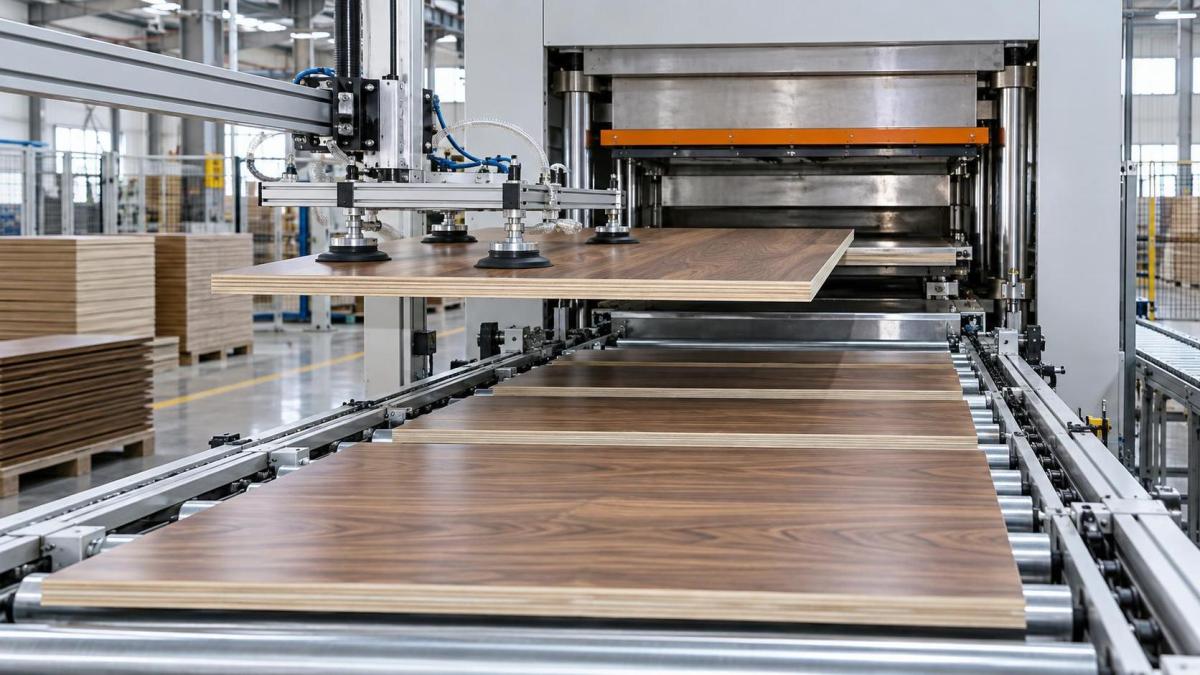
Automated loading and unloading are useful here for more than labor reduction. Vacuum lifters, board feeders, alignment stations, and controlled stacking systems reduce uncontrolled handling. They are especially relevant where panels have large formats, finished faces, or high-volume repeat production. In lower-volume work, a full automation package may not be justified, but clear transfer rules, protected tables, and suitable support surfaces still prevent avoidable rejects.
Lamination is a major source of hidden veneer waste
A laminated board can look acceptable immediately after pressing and still fail later during trimming, machining, or installation. Weak bonding, trapped air, uneven gloss, surface imprinting, and veneer movement are all expensive because the substrate, decorative layer, labor, and machine time have already been invested.
The pressing stage should therefore be assessed as a quality-control point, not only a throughput point. Uniform temperature and pressure across the platen area help produce consistent bonding. Controlled closing and pressing cycles reduce the chance that the veneer or melamine paper shifts before the board is stabilized. Accurate alignment before the press is equally important; no pressure system can correct a sheet that enters off-center.
For cabinet lines laminating large quantities of board with melamine-impregnated paper, a short-cycle press can be part of the waste-control strategy. The Short Cycle Melamine Paper Lamination Hot Press Machine for MDF, Particle Board & Plywood is designed for double-sided veneer applications and uses PLC and touch-screen control, separate temperature-control zones for upper and lower heating plates, and adjustable infeed and outfeed speed. Its precision-ground heating platens and stainless-steel cushion pads are intended to support an even surface finish.
That does not mean a high-capacity press is the right answer for every cabinet operation. Its value is strongest where the board format, finish program, and production volume justify a controlled, repeatable lamination process. A job shop producing frequent small batches with many finish changes may gain more from disciplined setup procedures, faster changeover methods, and better material identification than from choosing capacity beyond its practical workload.
Choose automation around the actual bottleneck
It is easy to overinvest in the most visible machine on a line. A faster saw may create a larger queue at the press. An automated press may wait because material preparation is inconsistent. The useful question is not “Which machine is most advanced?” but “At which point does material stop becoming recoverable?”
If edge chipping and incorrect sizing dominate, prioritize cutting reference, tool maintenance, and nesting control. If good panels are scratched or chipped between stations, prioritize handling and stacking. If boards are rejected after surface finishing, investigate temperature consistency, pressure distribution, paper or veneer conditioning, cleaning, and alignment before increasing output speed.
Project teams should also examine the interfaces between machines. Panel sizes, feed direction, stack height, cycle time, and buffer capacity must work together. A line with technically capable individual machines can still waste material when transfer timing forces operators to rush, stack boards improperly, or bypass alignment steps to keep output moving.
A practical commissioning sequence
Waste reduction is easier to sustain when it is built into commissioning and daily control rather than treated as an occasional improvement project. A useful sequence is:
- Record rejects by defect type and production stage for representative cabinet orders.
- Confirm which parts require grain matching, face-side protection, tight dimensional tolerances, or premium finishes.
- Set cutting plans around full-sheet yield and reusable offcuts, while keeping grain direction and edge-banding requirements intact.
- Validate each machine interface with actual board sizes, not only nominal dimensions shown in layout drawings.
- Establish approved settings for each board type and finish, including feed conditions, alignment checks, and press parameters where applicable.
- Inspect the first panels after cutting, after lamination, and after final trimming. Detecting a drift early protects the remaining batch.
- Review recurring defects with maintenance and production together. A worn cutting tool, unstable guide, contaminated platen, or weak vacuum pickup can all appear as “operator error” if the failure mode is not traced.
This approach also gives purchasing and production planning a clearer basis for decisions. Rather than judging machinery only by rated capacity, compare it against the cost of rejected finished boards, material handling interruptions, setup stability, spare-parts availability, and the support needed to keep calibration and controls reliable over time.
Do not confuse fast cycles with efficient material use
A shorter cycle can lower exposure to handling damage and reduce work-in-process, but speed alone does not reduce veneer waste. If the feeder delivers misaligned boards or the surface material is poorly prepared, a faster cycle simply produces defects more quickly. The process must be stable before it is accelerated.
The same principle applies to automation. Automatic vacuum loading, alignment, feeding, and stacking can improve consistency when they are matched to panel format and line rhythm. They can be less useful when incoming materials vary widely, maintenance discipline is weak, or frequent setup changes are not properly managed. Automation should remove a known source of variation, not conceal an unresolved process problem.
What to confirm before approving a machinery plan
For a cabinet production project, the most valuable early decision is to define the material flow from sheet receipt to finished component. Confirm the maximum and minimum panel sizes, substrate types, veneer or paper finish requirements, grain-direction rules, expected batch mix, permitted trim allowance, and the point at which panels are inspected. These details determine whether equipment should emphasize flexibility, continuous output, surface protection, or pressing consistency.
Also confirm who will maintain reference accuracy after installation. Calibration access, operator controls, spare-parts support, and fault response affect waste over the life of the line. Qingdao Zhongding Machinery Co., Ltd. supplies woodworking machinery and complete solutions for furniture workshops and industrial lines, with technical support and spare-parts service positioned as part of long-term operating value. For projects where material loss has become a recurring cost, that ongoing support is relevant because stable performance depends on more than the initial machine specification.
The most effective veneer-waste program is usually not a single equipment purchase. It is a production flow in which cutting plans preserve usable material, handling protects visible faces, pressing creates dependable bonding, and inspection catches variation before an entire batch is affected. When those controls work together, more of each sheet reaches the cabinet assembly line as a usable component instead of leaving the factory as scrap.
Send Your Inquiry
We welcome your cooperation and we will develop with you.