


News & Exhibitions
Latest Factory Updates, Industry Trends & Global Exhibition Information
Designing an Edge Banding Production Line for Mixed Cabinet Orders
Designing an Edge Banding Production Line for Mixed Cabinet Orders
Mixed cabinet orders are where an edge banding department either proves its value or becomes the factory’s daily source of delay. A line may need to process narrow drawer parts in the morning, tall wardrobe side panels after lunch, and moisture-resistant kitchen components before the shift ends. The board materials may change from melamine-faced particleboard to MDF, plywood, lacquered panels, or compact laminate. Edge tape thickness, glue requirements, panel dimensions, and quality expectations change with them.
That is why designing an Edge Banding Production Line for mixed cabinet orders is not simply a matter of purchasing the fastest edge bander available. A high-speed machine can still sit idle if the return system is poorly arranged, if panel sorting is unclear, or if operators spend too much time resetting guides and changing adhesive settings. The practical objective is stable flow: panels arrive prepared, the line handles variation without excessive intervention, and finished parts leave ready for the next process.
For a project manager, the most useful question is not “How many panels per minute can this machine run?” It is “What mix of panels will pass through it on a normal difficult day, and what will interrupt that flow?” The answer usually determines the right configuration more accurately than a headline speed rating.
Begin with the real order mix, not the ideal production target
Many line plans start with a monthly output estimate. That figure matters, but it does not reveal the operational complexity behind the output. Two factories can process a similar number of cabinet panels while needing very different line designs. One may run repeated batches of standard kitchen cabinets. The other may handle custom wardrobes, small commercial projects, replacement parts, and several board colors each day. The second factory is likely to lose more time to sorting, tape changes, program selection, and manual handling.
Before defining equipment, map the order profile over a representative period. Review panel length and width ranges, thicknesses, edge tape types, board substrates, and the proportion of one-sided, two-sided, and four-sided parts. Also identify the awkward pieces: narrow strips, very long panels, heavy worktops, curved parts, and panels with sensitive finished surfaces. These parts are often not the highest-volume items, but they shape the line’s practical limits.
A mixed-order operation should also separate “frequent variation” from “exceptional variation.” If 18 mm panels dominate but 25 mm work appears once or twice a week, the line should accommodate both, yet the everyday setup should remain optimized for the dominant work. Designing every station around rare jobs can make the main flow unnecessarily expensive and complicated.
Build the flow around bottlenecks that actually occur
An edge banding line is rarely limited by only the edge bander. Bottlenecks often appear before and after it. Panels may arrive unsorted from the nesting or panel saw area. Operators may need to inspect labels manually because batches are mixed on the same trolley. Finished panels may pile up because drilling, cleaning, or assembly cannot receive them at the same pace. In those conditions, adding another high-specification finishing unit does not solve the real problem.
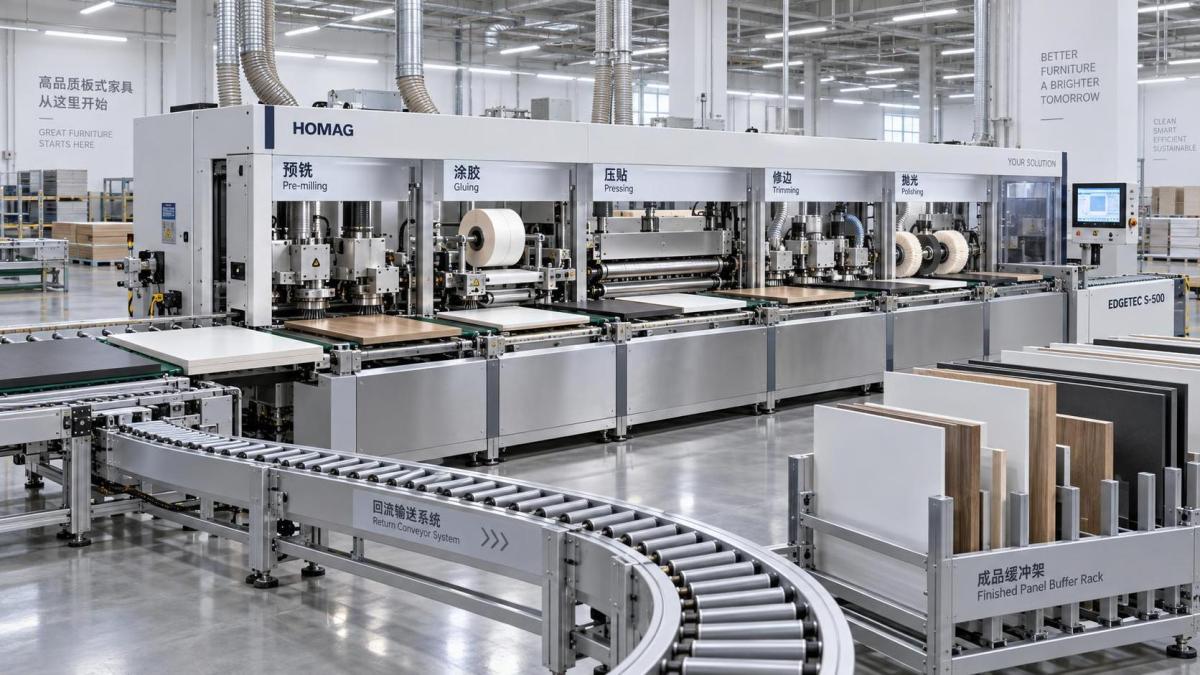
A sensible workflow normally includes four connected zones: panel preparation and identification, edge banding, return or transfer handling, and downstream buffering. The exact layout depends on building constraints, but the logic should remain visible. Material should not cross the same aisle repeatedly, and operators should not walk around the machine to retrieve every finished panel. Those small movements become expensive when repeated hundreds of times during a shift.
For single operators processing medium-sized batches, a return conveyor can be more valuable than adding a rarely used advanced unit. It allows the operator to feed and receive panels from a controlled working area, reducing walking and lowering the chance that the wrong panel is picked up. However, a return system is not automatically the right answer. Very long, heavy, or flexible panels may require more support, wider turning space, or a second person. The return path must be reviewed against the largest and least stable workpiece, not only a standard cabinet side.
Choose machine functions based on finish requirements and changeover burden
For mixed cabinet production, the core edge banding sequence typically needs reliable pre-milling, glue application, pressure rollers, end trimming, top-and-bottom trimming, corner rounding where required, scraping, and buffing. The important issue is not whether every module can be listed in a proposal. It is whether the modules can maintain a consistent finish across the materials and edge tapes used in the factory.
Pre-milling deserves particular attention. Saw marks, minor chip-out, and uneven panel edges can compromise glue adhesion and make a finished edge look inconsistent. In a workshop processing well-cut panels from a stable upstream process, lighter correction may be sufficient. In a production environment where panels come from different saws, nesting machines, or suppliers, stronger and more stable pre-milling capability can prevent downstream quality disputes.
Glue selection should be considered as a production decision, not merely a consumable choice. EVA adhesive remains common for many cabinet applications because it is familiar and practical for standard work. PUR adhesive may be considered where heat, moisture resistance, or demanding substrate conditions justify the extra process discipline. But PUR changes the maintenance conversation: cleaning procedures, storage, shutdown practices, and operator training all become more critical. It should not be selected solely because it sounds more advanced.
Likewise, automatic adjustment systems can reduce setup time when panel thicknesses and tape specifications change often. Yet automation only pays off when order data and operator practices are organized enough to use it consistently. A factory with weak labeling and manually revised cut lists may still suffer stoppages, even with a highly automated machine. The line should match the maturity of the surrounding production system.
Do not underestimate panel identification and batch discipline
Mixed orders create a traceability problem. Once panels are separated from their cutting batch, similar-looking pieces can easily be confused. A cabinet side with white PVC edging may look nearly identical to another side intended for a different project, drilling pattern, or hardware specification. Edge banding may be correct, while the final cabinet is still wrong.
The most reliable solution is usually simple: assign a clear panel identity before edge processing and keep the identity readable after it. This can be a printed label, barcode workflow, or another production control method suited to the factory’s software and habits. What matters is that the line operator can verify the required edge treatment without relying on memory or verbal instructions.
In practice, it is useful to define a small number of production families rather than treating every order as completely unique. For example, standard cabinet carcass panels, visible door and end panels, moisture-resistant kitchen components, and thick decorative parts may each follow different settings or inspection requirements. Grouping work in this way reduces unnecessary changes while still allowing custom orders to move through the system.
Plan quality control into the line instead of placing it at the end
An edge defect discovered at final assembly is expensive because the panel has already consumed cutting, machining, handling, and perhaps drilling time. Quality checks should therefore be positioned close to the process where correction is still manageable. Operators need a clear standard for checking glue lines, edge alignment, corner finish, surface scratching, trimming marks, and edge adhesion.
The inspection method should reflect the product. A utility cabinet component may have different visual expectations from a high-gloss wardrobe door. Dark edges and light panels often make glue-line variation more visible. Thin tape can reveal substrate imperfections, while thick ABS or acrylic edging may demand more careful corner finishing. These are not reasons to over-specify every machine; they are reasons to define the acceptable result before installation and trial production.
There is also a maintenance aspect to quality. Dull cutters, contaminated glue systems, poorly adjusted scraping tools, and insufficient dust extraction can gradually reduce finish quality without causing an immediate machine alarm. A line that looks productive on a dashboard may be creating rework at the bench. Routine checks of tool condition, glue application, pneumatic systems, and extraction performance should be part of the operating plan from day one.
Leave room for expansion, but avoid buying unused complexity
Scalability is important in cabinet production because order patterns change. A company may begin with a compact edge bander and a simple return conveyor, then later add automatic loading, panel transfer, or more integrated material handling. Planning utility connections, floor space, access routes, and control interfaces in advance can make that later expansion far less disruptive.
Still, expansion planning should not turn into speculative purchasing. A larger line requires more floor space, more cleaning, more setup discipline, and more technical capability from the maintenance team. If current orders are highly variable but total throughput remains moderate, flexibility and accessible adjustment may be more valuable than an extensive automated system. The best line is usually the one that removes today’s real constraints while preserving sensible options for the next stage.
This is where an experienced machinery supplier can contribute beyond the machine specification. Qingdao Zhongding Machinery Co., Ltd., with more than 20 years in woodworking machinery manufacturing and export, approaches line planning as a connection between equipment, material flow, technical support, spare-parts availability, and the customer’s actual production conditions. For mixed-order projects, the installation discussion should include layout drawings, panel samples, expected material variation, operator skill levels, and future process links—not only machine configuration.
Questions worth settling before the line is ordered
- Which panel sizes, thicknesses, and materials account for most daily production, and which difficult parts set the true operating limit?
- How often will edge tape, glue type, panel thickness, or color change during a normal shift?
- Can the upstream cutting process deliver panels with sufficiently clean, consistent edges for the required finish?
- Will one operator, two operators, or an automated handling system manage loading and unloading?
- Where will panels wait when downstream drilling or assembly is temporarily slower than edge processing?
- What local electrical, extraction, safety, and installation requirements need confirmation before shipment and commissioning?
These questions may seem operational rather than strategic, but they are exactly where production lines succeed or fail. A layout that ignores maintenance access, panel staging, or dust collection can create recurring problems that no software setting will fix later.
A mixed-order line should be designed for controlled variation
The goal is not to eliminate variation; custom cabinet manufacturing will always have it. The goal is to make variation predictable enough that it does not interrupt the entire workshop. A well-designed Edge Banding Production Line combines appropriate finishing modules with clear panel identification, practical material handling, planned buffers, and maintenance routines that protect finish quality.
Before committing to a layout, run representative panels through the proposed process on paper and, where possible, during machine testing: the smallest strip, the longest side panel, the most demanding visible surface, and the material that requires the strictest adhesive performance. If the line can handle those parts without awkward workarounds, it is much more likely to support the everyday cabinet mix with fewer surprises.
Send Your Inquiry
We welcome your cooperation and we will develop with you.