


News & Exhibitions
Latest Factory Updates, Industry Trends & Global Exhibition Information
How to Specify a Wood Panel Lamination Line for High-Volume Furniture Plants
For a high-volume furniture plant, specifying a lamination line is primarily a capacity-and-control exercise. A line that looks fast on a supplier layout can still become a bottleneck if panel preparation, adhesive application, press dwell time, loading, unloading, or downstream trimming are not balanced around the same production rhythm.
The first decision is therefore not the nominal line speed. It is whether the proposed Wood Panel Lamination Line can produce the required mix of panels with stable bond quality across normal shifts, material changes, and routine maintenance intervals. For most technical evaluations, four areas deserve the closest attention: the panel and surface-material range, the adhesive and curing method, the real throughput model, and the level of automation required to keep the line supplied.
Start with the production mix, not the equipment catalogue
A lamination line should be specified around the panels that will actually pass through it. Furniture plants may laminate MDF, particleboard, plywood, blockboard, honeycomb panels, or composite substrates. These materials differ in surface smoothness, density, moisture behavior, thickness tolerance, and ability to withstand pressing pressure. A line suited to flat, consistent MDF panels may need different pressure control, handling design, and adhesive settings when the plant also processes lightweight or less uniform boards.
Surface material matters just as much. Decorative paper, melamine-impregnated paper, PVC film, PET film, veneer, HPL, and foil products do not behave alike during feeding, glue application, pressing, cooling, and trimming. A plant that expects to add new decorative surfaces later should avoid specifying a line too narrowly around one film thickness or one roll width. Future flexibility does not require every possible option, but it does require that width ranges, unwind systems, tension control, press settings, and temperature capability have been considered before installation.
The technical team should prepare a panel matrix before asking suppliers for quotations. It should identify:
- Substrate types, thickness range, panel length and width range, and minimum panel size.
- Surface materials to be laminated, including roll or sheet format, thickness, backing condition, and width tolerance.
- Single-sided or double-sided lamination requirements.
- Finished-panel quality criteria, such as surface flatness, edge condition, visual defects, bond strength, and allowable rework.
- Expected production proportions rather than only the highest-volume product.
This matrix exposes an important issue: high-volume output usually comes from a limited group of repeatable products, while production disruption often comes from short runs, unusual sizes, color changes, or material substitutions. The line should be optimized for the dominant production pattern, but its changeover process must be realistic for the secondary mix. A system that requires lengthy mechanical adjustment or difficult cleaning after every adhesive or film change can lose much of its theoretical advantage.
Specify capacity as a balanced process
Published speed figures are useful only when their operating assumptions are clear. A conveyor may be capable of moving panels quickly, while the press, adhesive station, curing section, or unloading cell determines the actual output. Capacity should be calculated from panel dimensions, panel spacing, press cycle or continuous-press residence time, product mix, and the time needed for planned changeovers.
Technical evaluators should ask suppliers to describe the bottleneck station for each intended product group. The answer should distinguish between mechanical maximum speed and sustainable production speed. It should also state what happens when panels arrive with normal dimensional variation, when an operator needs to splice a roll, or when adhesive application needs inspection and adjustment.
A useful evaluation approach is to map the full material flow:
- Panel infeed from sanding, storage, or prior machining.
- Dust removal and surface preparation before adhesive application.
- Adhesive dosing, mixing, delivery, coating, and recovery where applicable.
- Film or veneer unwinding, alignment, cutting, and placement.
- Pressing, heating or curing, cooling, and stabilization.
- Stacking, transfer, trimming, edge processing, inspection, and buffer storage.
Each stage must have enough buffer capacity to absorb ordinary variation without letting panels wait too long after glue application. Adhesive open time is especially important. If upstream accumulation can leave coated panels exposed beyond the adhesive's effective working window, bond inconsistency may appear even when the press is functioning correctly.
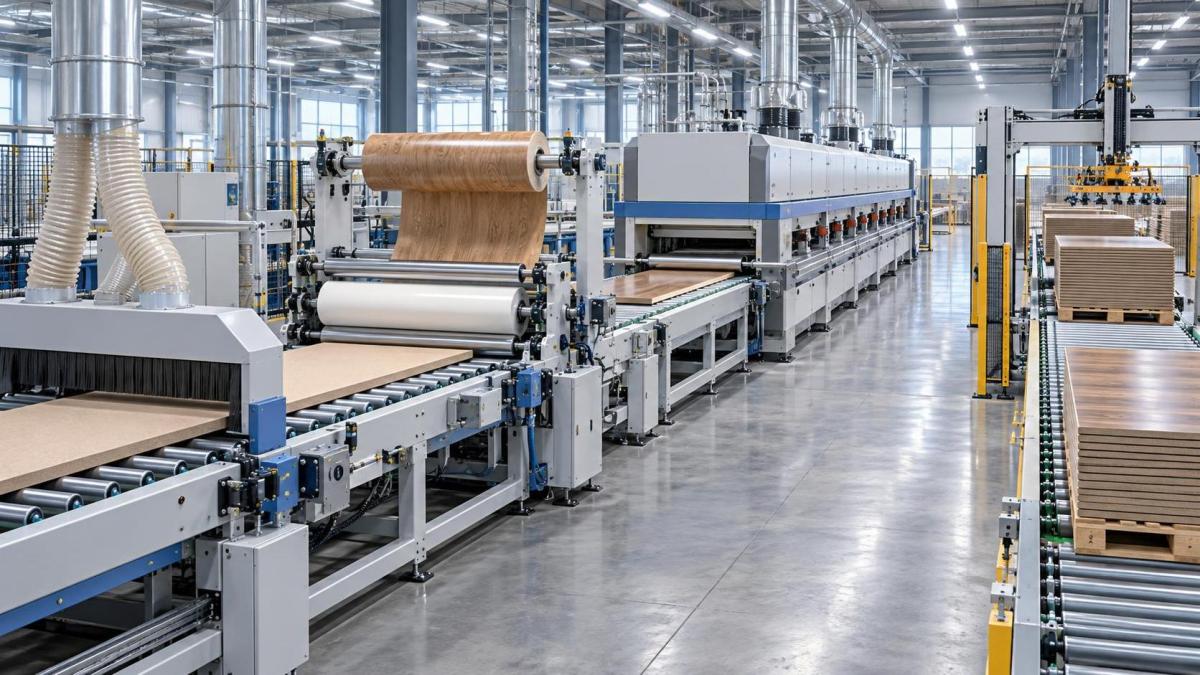
Line capacity should also be checked against downstream operations. A lamination line that produces panels faster than trimming, CNC nesting, edge banding, or warehouse handling can accept them creates hidden work-in-process inventory. Conversely, a slow upstream sanding or panel-cleaning process may starve an expensive laminating line. The correct specification is often a coordinated cell design, not an isolated press purchase.
Match the adhesive system to the product and operating discipline
Adhesive choice shapes much of the line design. Water-based systems, hot melts, reactive hot melts, urea-formaldehyde systems, PVAc-based adhesives, and other formulations have different requirements for temperature control, viscosity management, open time, cure development, cleaning, and storage. The right choice depends on the surface material, substrate, required resistance properties, press type, finish expectation, and production environment.
It is risky to treat adhesive selection as a consumables decision that can be finalized after machinery installation. The adhesive affects pump configuration, hose heating, applicator design, roller selection, metering precision, cleaning arrangements, ventilation needs, and the length or temperature profile of the curing process. A line designed around one adhesive family may not switch easily to another without changes to both hardware and operating procedures.
For technical evaluation, request a clear process window rather than a general statement that the machine is “compatible” with a given adhesive. The evaluation should cover the acceptable substrate condition, adhesive application quantity, temperature range, assembly time, press pressure, press duration, and post-press handling conditions. The process window is more useful than a single recommended setting because it shows how much room the plant has to manage ordinary production variation.
Substrate moisture and surface cleanliness deserve particular attention. Dust, loose fibers, oil contamination, excessive moisture variation, and poorly sanded surfaces can all reduce bonding reliability. An automatic dust-removal section may be justified where panel sanding generates significant residue or where high-gloss surface materials make minor defects highly visible. If cleaning is included, its effectiveness should be judged alongside the whole line, not merely by the presence of brushes or air knives in a layout.
Press design should follow quality requirements
The press is where a nominal lamination process becomes a finished panel. Its design needs to suit the selected materials and required visual standard. Important questions include pressure uniformity across the full working width, platen flatness, heating consistency where heat is used, response to thickness variation, and the ability to repeat settings from one production run to the next.
Pressure alone does not guarantee a strong bond. Excessive pressure can force adhesive into a porous substrate or create surface distortion, while insufficient or uneven pressure can leave localized weak bonding, bubbles, or poor edge adhesion. For large furniture panels, uneven pressure distribution may create defects that only become visible after downstream machining or during later handling.
Press selection should therefore be connected to a defined inspection method. The plant should decide how it will verify coating uniformity, panel alignment, surface appearance, flatness, and bond integrity during production. Depending on the materials and quality standard, this may include visual inspection under controlled lighting, checks at panel edges and corners, routine destructive samples, or measurement of panel geometry after cooling.
A supplier proposal should identify how press settings are stored, recalled, and protected from unauthorized changes. Recipes are valuable only when operators can reproduce the associated conditions: panel type, surface material, adhesive parameters, press setting, line speed, and any curing or cooling requirement. A control interface with many recipes does not by itself deliver repeatability if those recipes are built without disciplined parameter control.
Choose automation for flow stability, not for appearance
High-volume furniture plants often need automatic loading, panel orientation, transfer, stacking, and connection to upstream and downstream conveyors. Yet automation should be selected for the operational problem it solves. Automatic feeding is useful when manual handling cannot sustain panel spacing, damages decorative surfaces, or creates an ergonomic and staffing constraint. Automatic stackers and return systems are useful when they prevent output accumulation and reduce the risk of panel damage after lamination.
For mixed production, the ability to identify panel dimensions and route panels correctly may matter more than the highest possible automatic cycle rate. For repeatable, large-batch production, a simpler and robust handling arrangement can be more productive than a highly complex system that requires frequent intervention.
Integration requirements should be written down early. They commonly include conveyor height, panel travel direction, communication interface, emergency-stop logic, barcode or production-order data exchange, and the physical space needed for maintenance. Existing production lines may also impose limits on electrical supply, compressed air, extraction, access routes, and floor loading. These are installation constraints, but they directly affect whether a line can operate at its planned capacity.
Assess maintainability before comparing prices
The lowest purchase price can become expensive when adhesive circuits are difficult to clean, rollers require lengthy adjustment, critical components are hard to access, or common wear parts have long replenishment times. Lamination lines run best when cleaning, inspection, and replacement tasks are built into normal operating routines rather than deferred until quality problems appear.
A technical evaluation should ask for a maintenance schedule that separates daily, weekly, and periodic work. It should identify consumable parts, recommended spare parts, lubrication points, cleaning methods, and the access required around the machine. Adhesive-contact components require special scrutiny because residue buildup can affect coating consistency and eventually create avoidable downtime.
Controls and diagnostics also matter. Fault messages should help maintenance personnel identify whether an issue comes from material feeding, tension, adhesive delivery, heating, pressure, safety interlocks, or panel transfer. Remote support may be useful, but it does not replace documentation, electrical drawings, mechanical drawings, and a spare-parts plan that the plant can use independently.
Use acceptance criteria that reflect factory conditions
Before placing an order, convert broad expectations into measurable acceptance conditions. This avoids a common gap between a demonstration using carefully prepared sample materials and normal production using the plant's own panels, films, operators, and product changes.
The acceptance plan should define which panel and surface combinations will be tested, the required output condition, the inspection criteria, the acceptable defect types, and the procedure for documenting settings. It should also establish whether the supplier will demonstrate changeover, adhesive preparation, line cleaning, safety functions, and the recovery procedure after a stoppage.
A sound specification does not demand the highest speed, widest format, or most automation by default. It defines the production envelope the plant must reliably maintain, then selects equipment, controls, handling, and service support that can hold that envelope. For a high-volume furniture operation, that discipline is what turns a Wood Panel Lamination Line from a promising machine layout into a dependable production asset.
Send Your Inquiry
We welcome your cooperation and we will develop with you.