


News & Exhibitions
Latest Factory Updates, Industry Trends & Global Exhibition Information
When woodworking production line integration reduces material handling
Material handling is often treated as a secondary issue in woodworking plants because it does not directly cut, drill, edge-band, or finish a panel. Yet in panel furniture production, repeated loading, unloading, stacking, searching, and repositioning can consume more time than the machining cycle itself. The cost is not limited to labor. Every unnecessary transfer increases the chance of surface damage, wrong-part routing, identification errors, production imbalance, and work-in-progress accumulation.
Woodworking production line integration reduces these losses by treating machines, transfer systems, buffers, and production data as one operating system rather than as separate equipment purchases. The objective is not to connect every machine with conveyors. It is to remove handling steps that do not add value while preserving the flexibility needed for the product mix, batch size, and factory layout.
Where material handling actually accumulates
In a disconnected workshop, a panel may be moved several times before it becomes a finished component. After cutting, an operator may sort parts by order, stack them on a cart, move them to temporary storage, locate them again for edge banding, then transfer them to drilling or routing. If the next machine is busy, parts wait. If a label is damaged or a mixed stack is created, the next process may receive incomplete or incorrect components.
These movements are often accepted as normal because each individual transfer seems small. The problem appears when the whole route is measured: handling time per panel, queue time between processes, number of touches, distance traveled, and the volume of work-in-progress occupying floor space. A line can have capable individual machines and still suffer low effective throughput because materials do not arrive at the right process in the right sequence.
Handling pressure is particularly high in cabinet, wardrobe, office furniture, and custom panel production, where a single order may contain many component sizes, edge treatments, drilling patterns, and hardware requirements. The material flow is not simply “cut, then process.” Different parts may require different routes, and some operations must occur in a defined sequence. Integration matters because it creates a controlled path for those parts rather than relying on manual memory and visual sorting.
Integration is a flow design, not a conveyor project
A common mistake is to define integration by the presence of automatic feeding and discharge conveyors. Conveyors can reduce carrying, but they do not solve a poorly designed production route. If a machine sequence conflicts with the actual part flow, an automated transfer system may move bottlenecks faster rather than remove them.
Effective woodworking production line integration begins with the route of the workpiece. For each part family, the manufacturer needs to establish what happens after cutting, which edges require banding, whether drilling occurs before or after edge treatment, where inspection is required, and how completed parts are grouped for assembly or packing. Only after that route is clear can the appropriate level of automation be selected.
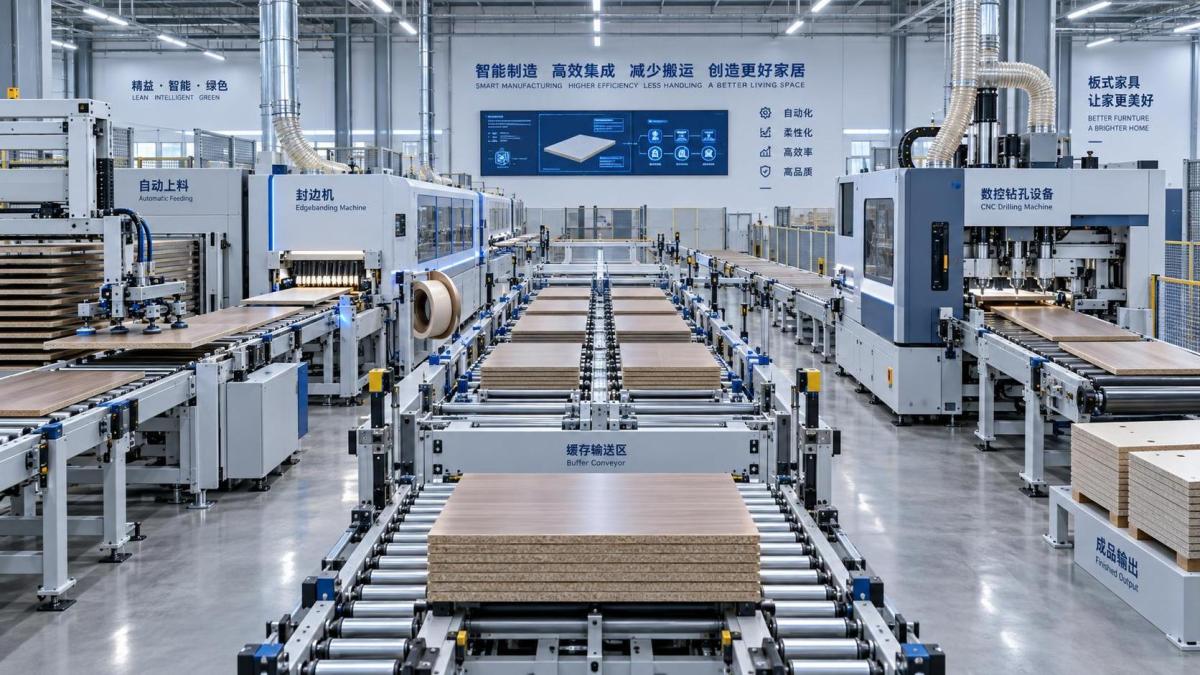
For a relatively stable panel furniture range, a linked cell may connect panel sizing, label printing, edge banding, and drilling through infeed/outfeed equipment, turning devices, return conveyors, or automated routing. For a higher-mix operation, the better solution may be controlled buffer zones and barcode-based dispatching rather than a rigid continuous line. The principle is the same: material should move because the next operation is ready, not because an operator has found a temporary place to put it.
The largest gains usually come from fewer touches
Material handling reduction is frequently discussed in terms of labor saving, but labor is only one element. A panel handled by fewer people and fewer devices is less exposed to corner damage, laminate scratches, misorientation, and loss of order identity. These risks are especially relevant after decorative surfaces have been cut, edged, or drilled, when rework may be expensive and a replacement part can disrupt an entire order set.
Reducing touchpoints also improves production discipline. When a panel leaves a beam saw or nesting cell with a readable identifier, and that identifier follows it through edge banding and drilling, the line can maintain a clearer relationship between the physical part and its production instructions. Operators no longer need to rely solely on handwritten notes, stack position, or recollection of the day’s priorities.
The practical result is not necessarily a fully unattended factory. In many facilities, people remain essential for quality checks, exception handling, changeovers, tooling control, and process supervision. Integration changes where their time is used. Instead of transporting panels and searching for work, labor can be concentrated on tasks requiring judgement.
Machine balance determines whether integration helps or exposes a bottleneck
Connecting processes makes imbalances more visible. If cutting capacity is substantially higher than edge-banding capacity, a direct connection will quickly create a queue. If drilling is slower than the preceding process, parts may accumulate in buffers, and the factory simply exchanges manual piles for automated congestion.
That is not a reason to avoid integration. It is a reason to size the line around actual operating conditions rather than nominal machine output. The relevant measure is not the maximum feed speed shown in a machine specification. It is the usable output across the intended mix of panel dimensions, edge programs, drilling patterns, setup intervals, and operator interventions.
Edge banding is often a critical point because processing time varies with edge length, band type, glue system, trimming requirements, corner treatment, and cleaning operations. Drilling and routing may also vary sharply according to the number of holes, groove operations, hardware patterns, and part orientation. A line designed only around board-per-hour estimates can fail when a new product mix contains more narrow components, more four-sided edging, or more complex hole patterns.
Buffers are therefore not an admission of poor planning. Properly designed buffers absorb normal timing variation, allow machines to continue through short interruptions, and protect upstream equipment from immediately stopping when a downstream process needs attention. The important distinction is between a controlled buffer with defined capacity and traceable part status, and an uncontrolled accumulation area where panels lose order sequence.
Part identification is as important as physical transfer
Physical automation without information control can create expensive confusion. A conveyor may deliver a part quickly, but it cannot determine whether that part should be processed, held, reworked, or diverted unless the line knows its identity and route.
Labels, barcodes, scanners, and production software are therefore central to an integrated line. At a basic level, each panel needs a unique identifier linked to its dimensions, material, edging instructions, machining program, order reference, and process status. The identifier must remain readable after the operations it is expected to survive. Label location matters: a label placed in an area that will be edged, drilled, cleaned, or trimmed may not be available when it is needed downstream.
The control system should also account for exceptions. A panel may be rejected because of chip-out, a damaged surface, incorrect edging, a machining fault, or an operator safety stop. If the only process logic assumes that every panel moves forward normally, one exception can break the sequence of an order. A usable integration plan includes rework paths, manual release procedures, and a way to update the production record when a replacement component is made.
This is one reason why software compatibility deserves the same scrutiny as machine interfaces. The key question is not merely whether individual machines have network connections. It is whether cutting optimization, labeling, machine programs, material tracking, and order management use consistent data. Manual re-entry between systems can reintroduce the very errors that physical integration was intended to eliminate.
Layout decisions have long-term consequences
Factories often begin with a machine placement problem: where can each unit fit? A better starting point is the intended flow of boards, parts, operators, carts, maintenance access, dust extraction, and finished component staging. A layout that minimizes the distance between machines but blocks forklift access, tooling changes, repair work, or safe operator movement can become difficult to run.
Raw panel storage and cutting are usually logical starting points for flow analysis, but the end of the line requires equal attention. After drilling, where do components wait for assembly? Are completed kits kept together? Can parts for different orders be separated without requiring large staging areas? If assembly or packing cannot absorb output at the same pace, the integrated machining section may create an even larger downstream inventory problem.
Utilities should be included early. Dust extraction capacity, compressed air quality, electrical load, network reliability, floor condition, fire protection arrangements, and service access can all affect the performance of automated handling equipment. Transfer devices may appear simple, but their availability depends on sensors, drives, controls, mechanical alignment, and clean operating conditions. A material-handling system that cannot be maintained without interrupting the entire line may create avoidable operational risk.
Rigid integration is not always the right answer
The strongest case for direct machine-to-machine transfer exists when part routes are repeatable, volume is sufficient to keep connected processes active, and product design follows a relatively consistent logic. Under these conditions, fewer manual transfers can improve rhythm, traceability, and output consistency.
However, a highly rigid line may be unsuitable for operations that frequently change panel materials, produce irregular shapes, run small custom batches, or require substantial manual craftsmanship between machining stages. In such settings, modular cells may offer better control. A saw or nesting machine can feed identified components into organized buffers; edge banding and drilling cells can pull work according to priority; carts or assisted handling equipment can bridge processes that do not justify permanent conveyors.
Integration should therefore be assessed as a spectrum. At one end is basic process discipline: labeled parts, standard carts, defined staging areas, and clear routing rules. In the middle are linked cells with return conveyors, automatic infeed/outfeed, and barcode-directed processing. At the highest level are automated storage, robotic handling, centralized production scheduling, and closed-loop data exchange. The appropriate point depends on the cost of handling, the cost of mistakes, the product mix, and the ability to sustain the system after installation.
Evaluating the investment beyond machine price
The business case should compare the current and future cost of flow, not simply compare the price of individual machines with the price of an integrated line. Relevant baseline questions include how many times a typical component is handled, how long it waits between processes, how much floor space is tied up in intermediate stacks, how frequently parts are remade because of routing or identification errors, and how often one process waits for another.
Capacity should be evaluated at the level of saleable completed components, not panels cut or meters of edge banded. An upstream machine may produce a high number of parts while downstream operations are constrained. The line’s commercial value comes from the number of correct, traceable, assembly-ready components released within the required production window.
Implementation cost also includes layout changes, installation downtime, electrical and extraction upgrades, software integration, operator training, spare parts planning, and commissioning support. These items are sometimes treated as peripheral expenses, yet they influence whether a system reaches stable operation. A lower initial equipment cost can become less attractive if it requires extensive manual intervention, lacks serviceable control architecture, or cannot adapt when product programs change.
A practical test: follow one order through the factory
The most useful way to identify integration opportunities is to trace a representative order from raw board to assembly-ready component. Record every movement, every queue, every point where a part is placed down and later picked up, and every instance in which someone must ask where a component belongs. Then distinguish necessary handling from handling created by layout, scheduling, missing information, or machine imbalance.
That exercise often reveals that the first priority is not a fully automated line. It may be a reliable labeling process, a return conveyor at a high-frequency edge-banding station, a better buffer before drilling, or a revised layout that removes cross-traffic. Once these constraints are understood, woodworking production line integration becomes a targeted operational decision rather than a broad automation ambition.
The central measure is simple: materials should spend more of their time being transformed and less of their time waiting, traveling, being sorted, or being recovered from disorder. When the production route, machine capacity, information flow, and layout support that objective together, integration can reduce handling without sacrificing the flexibility that woodworking production still requires.
Send Your Inquiry
We welcome your cooperation and we will develop with you.