


News & Exhibitions
Latest Factory Updates, Industry Trends & Global Exhibition Information
Cabinet-Making Machinery: CNC Nesting Router or Beam Saw for Panel Cutting?
Cabinet-Making Machinery: CNC Nesting Router or Beam Saw for Panel Cutting?
Choosing between a CNC nesting router and a beam saw requires more than comparing cutting speeds. When evaluating woodworking machinery for cabinet making, the decision depends on batch size, panel specifications, machining requirements, and downstream workflow. A nesting router can combine cutting, face drilling, and routing in one setup, while a beam saw often has advantages in repetitive, straight-line panel cutting.
The useful comparison is not “Which machine cuts faster?” It is “Which production route delivers correctly machined, identifiable parts to the next operation at the lowest practical cost?” A fast cutting machine can still leave operators sorting panels, waiting for drilling capacity, or handling parts twice.
Start with the part mix, not the machine specification
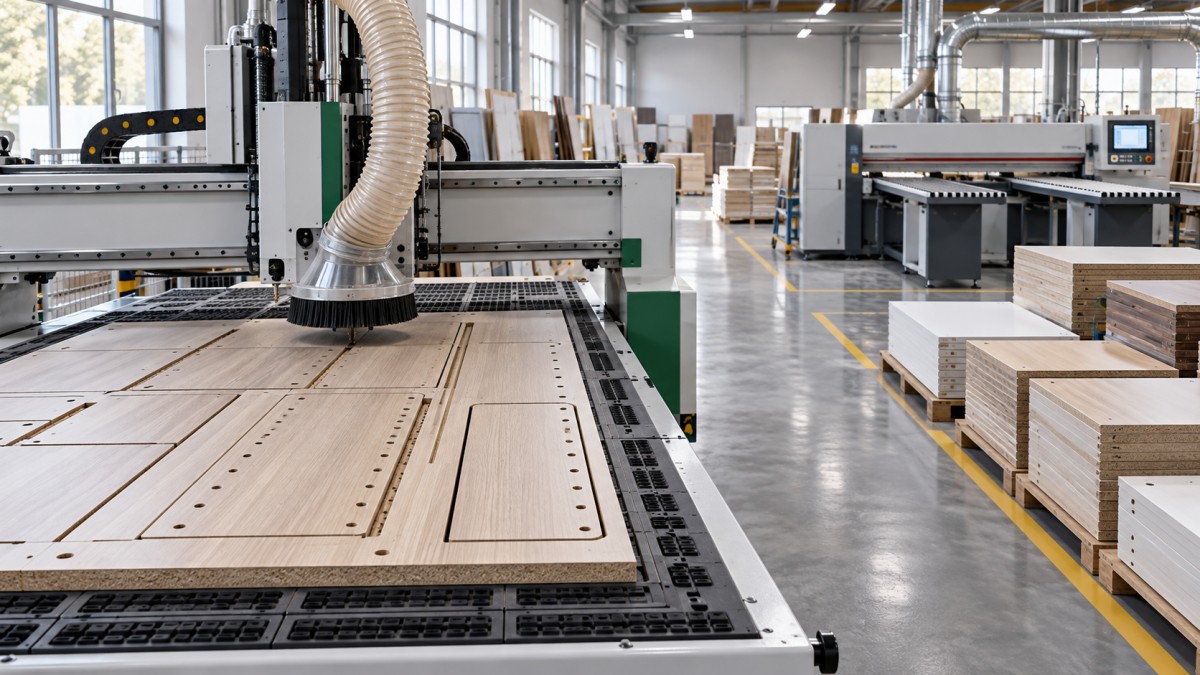
A CNC nesting router holds a sheet on a vacuum table and follows programmed toolpaths to separate components. Depending on its tooling and drilling configuration, it can also machine grooves, pockets, face holes, and shaped profiles before parts leave the table. This makes it attractive for mixed cabinet orders with frequent dimensional changes.
A beam saw clamps and positions panels for straight cuts. Suitable machines can cut stacks, provided panel properties, stack height, clamping, and cut-quality requirements allow it. Its strength is producing rectangular blanks efficiently, particularly when several orders share materials, thicknesses, and dimensions.
Consider two production patterns. One workshop makes made-to-measure cabinets with changing shelf sizes, service cutouts, and hardware positions. Another repeatedly produces standard carcass components. The first pattern generally favors nesting flexibility; the second deserves a serious beam-saw evaluation. These are starting points, not automatic verdicts: drilling capacity and order scheduling can change the result.
Compare complete routes through the workshop
The process difference becomes clearer when the same cabinet side panel is followed from sheet storage to assembly. A nesting router may cut its outline, drill shelf-pin holes, and route a back-panel groove in one setup. A beam saw produces the rectangular blank; drilling and grooving then move to other equipment.
That does not mean nesting eliminates every later machining operation. Horizontal dowel holes, edge drilling, underside features, and some hardware preparations may still require another machine or a second setup. Confirm which faces and edges the proposed configuration can actually reach.
Evaluate the route in the sequence required by the product. Some drilling follows edge banding; other features are machined earlier. Labels must remain readable and must not interfere with finished surfaces. If a beam saw feeds an existing CNC drilling center smoothly, adding nesting may provide less benefit than expected. If drilling and sorting are already overloaded, integrated machining becomes more valuable.
Also check how work is released. Cutting all parts for one cabinet together simplifies kit assembly, but may reduce opportunities to group identical panels. Grouping by material can improve cutting efficiency while increasing sorting and work-in-progress. The right machine should support the scheduling policy the factory can realistically maintain.
Throughput: measure accepted parts, not headline speed
Maximum feed speed is a weak basis for comparing these technologies. Router cycle time includes drilling, tool changes, acceleration, positioning, cutting, loading, unloading, and spoilboard care. A job with many small parts and holes can behave very differently from a sheet containing large rectangular panels.
Beam-saw output depends on the cutting pattern, stack suitability, panel repositioning, strip handling, and unloading arrangements. Stacking can multiply output per cutting cycle, but mixed materials, short batches, or surface-quality concerns may limit that advantage.
Ask suppliers to process the same representative production files rather than separately optimized demonstration jobs. Include routine work, a difficult small-part layout, and a high-volume repeat order. Record the following:
- Elapsed time from loading through unloading and identification.
- Accepted parts produced, including any required secondary machining.
- Operator involvement, sorting time, and interruptions.
- Rejects, rework, and the reason for each failure.
A machine demonstration should expose the bottleneck, not hide it. If unloading cannot keep pace with cutting, the advertised machining capacity will not become sustained factory output.
Material yield depends on usable layouts and reliable holding
Nesting software can place shaped components within a sheet, offering opportunities that straight-cut patterns cannot use. For rectangular cabinet parts, however, a well-optimized beam-saw pattern can also achieve strong utilization. Neither technology guarantees better yield across every order mix.
Compare layouts with identical constraints: grain direction, decorative pattern matching, edge trimming, defect exclusion, part rotation, and tool allowance. Router tool diameter and saw kerf affect spacing, but layout geometry often matters more than one isolated cutting-width figure.
For nesting, the tightest layout is not necessarily the most reliable. Small parts can move as the sheet is divided and vacuum holding becomes less effective. Spoilboard condition, leakage, panel flatness, vacuum zoning, cutting sequence, and tool forces all affect stability. Leaving a thin material layer for a final pass may help in some applications, but adds process considerations and must be tested on the actual substrate.
Offcuts deserve equal attention. A reusable remnant has value only if its dimensions, material, and storage location are recorded and the software can allocate it to later jobs. Otherwise, an attractive yield report may simply produce a growing rack of untracked leftovers.
Cut quality must match edge banding and assembly
Both systems can produce cabinet-quality components when correctly specified and maintained. Their failure modes differ. Beam-saw performance depends on blade selection, scoring alignment where applicable, blade condition, panel support, and clamping. Router quality depends on cutter geometry, sharpness, runout, feed strategy, extraction, and secure workholding.
Test the materials actually purchased, including the relevant melamine-faced boards, MDF, plywood, or laminates. Inspect both faces for breakout, then check squareness, dimensions, and edge condition. A clean-looking cut is not enough if parts drift dimensionally or require extra trimming.
Send trial pieces through the intended edge bander. Pre-milling can address certain edge defects, but it also removes material and must be accounted for in finished dimensions. Check groove positions and hole-to-edge distances against the finished component, not only against the freshly cut blank. This prevents an apparently accurate cutting process from creating assembly problems later.
Labor savings depend on software and handling
A nesting cell can reduce transfers between machines, yet manual unloading, part separation, labeling, and spoilboard cleaning still consume time. A beam-saw route can require more handling between operations, although automated storage, lifting, labeling, and material flow can change the labor balance substantially.
Count people across the whole route. Do not compare an automated nesting cell with a manually handled saw installation and attribute every difference to the cutting technology. Include the programming effort needed to prepare jobs and the training required to recover from errors.
Software compatibility needs a practical test. Confirm how cabinet-design data becomes machining instructions, whether post-processors support the selected equipment, and how revisions are controlled. A barcode workflow is useful only when the label, part record, and downstream drilling program remain synchronized. Re-cutting one damaged component should be straightforward without accidentally releasing an outdated version.
Build the cost comparison around the installed process
Purchase price is only one line in the evaluation. Include extraction, electrical installation, compressed air where required, vacuum equipment, loading aids, software, training, freight, commissioning, and space for safe material movement. Confirm local electrical, safety, and dust-control requirements before finalizing the installation.
Operating costs should cover cutters or blades, sharpening, spoilboards, maintenance parts, energy, direct labor, and expected rework. For a beam-saw route, include the secondary machines needed to deliver equivalent finished components. For nesting, include any remaining edge drilling or second-side machining. Comparing unequal production scopes can make either option look artificially inexpensive.
Use cost per accepted component or completed cabinet kit as the common measure. Base the calculation on realistic utilization, not continuous nameplate output. Run a second scenario with smaller batches or reduced demand: a system that depends on full stacks and uninterrupted repeat work may be less economical when the order mix changes.
Maintenance access and support response also matter. Ask which components are locally available, what diagnostic access is provided, and which spare parts should be held on site. A lower purchase price offers little protection against a prolonged stoppage caused by an unavailable component.
Make the decision with a production acceptance plan
Favor a nesting router when frequent design changes, shaped parts, and integrated face machining dominate the workload. Favor a beam saw when repeatable rectangular cutting can exploit suitable stacks and the downstream drilling route has adequate capacity. Where both workloads are substantial, a hybrid arrangement may make sense—but only if volume supports the additional investment and scheduling complexity.
Qingdao Zhongding Machinery Co., Ltd. manufactures and exports woodworking machinery, drawing on more than 20 years of industry experience. Its focus on complete woodworking solutions, technical support, spare parts, and after-sales service is relevant to this decision: equipment selection should address how the production route will be installed, supported, and maintained, not just which machine is supplied.
Before approving woodworking machinery for cabinet making, prepare a shared acceptance plan with the supplier. Specify representative drawings, substrates, dimensional tolerances, edge-quality criteria, staffing assumptions, and the operations included in the timed trial. Confirm software interfaces, utilities, training scope, spare-parts arrangements, and commissioning responsibilities in writing. Choose the route that passes those tests under your production conditions—not the one with the most impressive isolated cutting demonstration.
Send Your Inquiry
We welcome your cooperation and we will develop with you.