


News & Exhibitions
Latest Factory Updates, Industry Trends & Global Exhibition Information
Choosing a CNC Panel Saw Machine for MDF and Particleboard
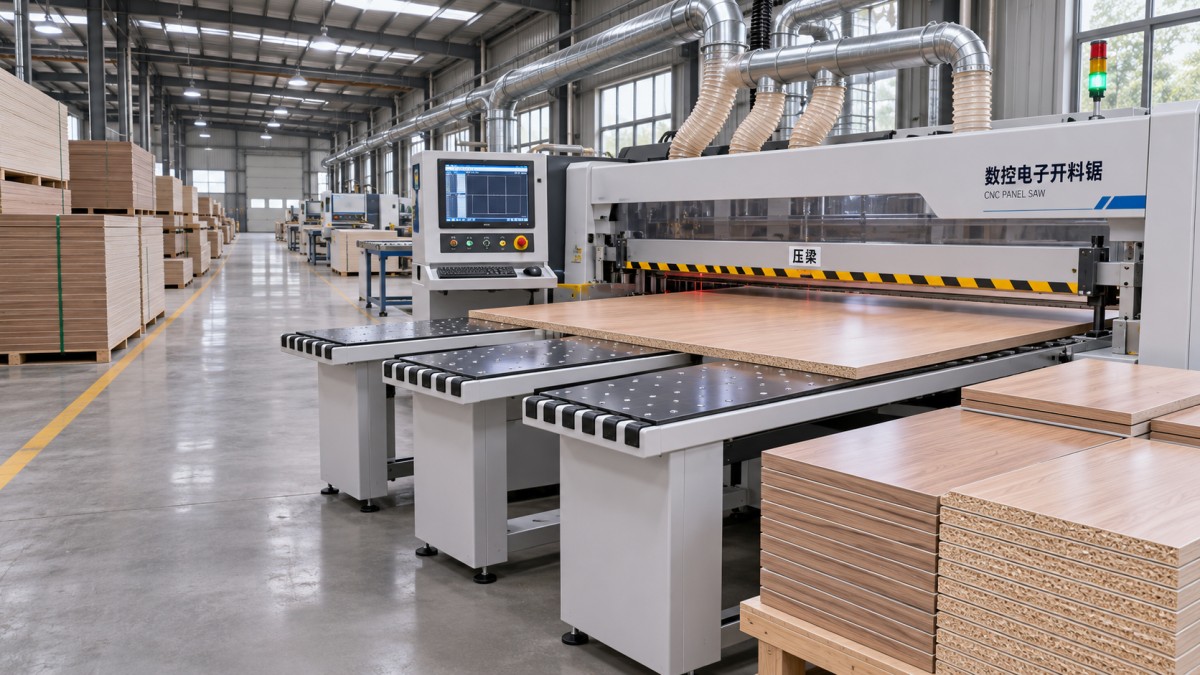
Choosing the right CNC panel saw machine for MDF and particleboard requires more than comparing cutting speeds. Panel dimensions, cutting accuracy, scoring capability, dust extraction, and software integration all influence production quality and operating costs. For technical evaluators, the challenge is to match those specifications to real material behavior and throughput targets—not to an idealized cutting cycle. A machine that performs well on a supplier’s standard board may need a different setup when faced with your thickest panels, decorative surfaces, or demanding batch mix.
The most useful starting point is a clear picture of the job the saw must do: which boards arrive at the factory, what components leave the cutting area, and how much variation the operation can tolerate between the two.
Start with the material and cutting envelope
MDF and particleboard are often grouped together in purchasing discussions, but they do not always behave alike at the saw. MDF generally has a more uniform structure and produces fine dust. Particleboard has a coarser core, which can affect edge quality and chip extraction. Both materials may be supplied unfinished or with melamine, laminate, or veneer surfaces that make visible edge chipping a particular concern.
Before reviewing machine models, document the largest and smallest board sizes, thickness range, surface finishes, and grain or decorative direction requirements. Include the smallest finished component as well as the largest raw sheet. A saw may accept a full-size panel yet struggle to hold or handle narrow strips consistently.
Check the usable cutting length and depth against actual panels, allowing for trimming and the cutting patterns used in production. For stacked cutting, ask the supplier to state the permissible stack height for each representative material, not just the machine’s maximum mechanical opening. Board flatness, coating, blade selection, and required finish can all limit a practical stack below that maximum.
Define accuracy as a production requirement
A quoted positioning tolerance is useful, but it is not the same as finished-part accuracy. The latter also depends on panel squareness, feed alignment, clamping, blade condition, material stability, and how the operator measures the result. Ask exactly what the supplier’s accuracy figure covers, under which conditions it was measured, and whether it applies to positioning, cutting, or the finished component.
For furniture components, consider at least four checks:
- Cut length and width: Measure representative parts at multiple points and compare them with the programmed dimensions.
- Squareness: Check whether adjacent edges form the required angle; diagonal measurements can help identify out-of-square rectangular parts.
- Repeatability: Compare parts cut at the beginning and end of a run, including pieces taken from different positions in a stack.
- Edge condition: Inspect both faces and the core for breakout, scoring marks, burning, or other defects relevant to the next process.
Set acceptance tolerances around the downstream operation. A component destined for a visible cabinet face may need closer visual inspection than an internal panel, while parts entering automated drilling or edge banding may require tighter dimensional control. Agree on the measuring method, instruments, sample size, and acceptance limits before a machine trial; otherwise, the demonstration can produce plenty of measurements without a shared decision.
Scoring, blade choice, and control of chipping
For laminated or melamine-faced panels, a scoring unit can be an important selection criterion. The scoring blade makes a shallow preliminary cut on the underside before the main blade passes through, helping reduce breakout on the lower surface. Its usefulness depends on correct alignment and adjustment as well as the condition of both blades. A poorly set scoring blade may leave a visible step or groove rather than a clean edge.
Ask how scoring depth and lateral alignment are adjusted, whether settings can be repeated between blade changes, and how the operator can inspect the result. If your mix includes both coated and unfinished boards, consider the changeover effort and whether the scoring unit can be set aside when it is not needed.
Main blade diameter, tooth geometry, kerf, and cutting speed must also suit the material and required finish. There is no single blade specification that guarantees a good result across every MDF and particleboard job. Request the supplier’s recommended blade arrangement for your actual panels, then include blade wear and resharpening practices in the evaluation. A clean cut on a fresh blade is only the beginning of the assessment.
Compare throughput using the complete workflow
High carriage or feed speed can look persuasive on a specification sheet. In a factory, however, output also depends on loading, alignment, clamping, cutting pattern, offloading, labeling, and handling the finished stack. A faster cut may not improve the line if operators or downstream equipment cannot keep pace.
Build a comparison around a representative shift or batch. Record the board mix, number of sheets per stack, cut pattern, expected changeovers, and staffing assumptions. For example, a run of repeated cabinet sides may benefit from stack cutting and streamlined offloading, while a custom furniture operation may spend more time changing programs and sorting different parts.
Pay particular attention to the following interfaces:
- Loading and positioning: Determine whether the proposed manual or automatic arrangement suits panel weight, floor space, and operator capacity.
- Clamping and support: Check that panels remain stable through the cutting sequence, especially for thin sheets, stacks, and small remaining pieces.
- Offloading and sorting: Establish where cut parts go, how they are identified, and whether handling creates a bottleneck or damages finished edges.
- Integration: Consider the pace and layout of storage, edge banding, drilling, and other connected operations.
When comparing suppliers, use the same material, cutting pattern, staffing assumptions, and definition of a completed part. A realistic cycle time should include the activities needed to deliver usable, identified components—not just the seconds during which the blade is moving.
Software and data: check the handoff, not just the screen
For a CNC panel saw machine, control software affects both productivity and the risk of errors. Evaluate how cutting lists are entered, edited, and transferred. If an optimization package or production system is already in use, confirm the supported file formats and the actual import procedure with both vendors. Similar file extensions do not necessarily mean that dimensions, material identifiers, quantities, grain direction, and part labels will transfer as intended.
Run a small but representative data test before purchase. Include a change to a cutting list, a panel with a directional surface, repeated parts, and a part that needs a specific label. Follow the information from the source file to the saw program and, where applicable, to the printed label. Clarify whether optimization, networking, barcode functions, or post-processing require separate software or licensing.
Also ask what happens when a job is interrupted. Operators need a clear way to identify completed cuts, recover the remaining work, and prevent duplicate or missing parts. A practical interface matters most on the busy day when a schedule changes, not only during a calm demonstration.
Dust extraction and maintenance belong in the machine comparison
Cutting MDF and particleboard creates dust and chips that must be controlled at the source. Fine MDF dust can place particular demands on collection and housekeeping, while chips from particleboard and laminated surfaces may require attention to airflow and ducting. Poor extraction can affect visibility, cleanliness, component life, and the cutting environment.
Request the saw’s extraction connection details and required airflow or pressure conditions, then have the proposed system assessed against the full duct layout and other connected machines. A collector’s nameplate rating alone does not establish performance at the saw. Include applicable local workplace and dust-control requirements in the design, and confirm who is responsible for providing ductwork, filtration, and installation.
Maintenance access is just as important. Inspect how easily personnel can reach the blades, scoring unit, clamps, guides, and routine lubrication points. Ask for the maintenance schedule, recommended spare parts, electrical and pneumatic requirements, and the procedure for diagnosing control faults. A machine that is straightforward to service can reduce disruption when a blade change or adjustment is needed during a production shift.
Plan a trial that reflects your hardest routine work
If possible, use your own material for a supplier trial. Choose more than the easiest board: include a coated panel where chipping matters, a typical production thickness, and a stack or small-part pattern representative of daily work. Give each supplier the same cutting list and evaluation criteria.
During the trial, observe the complete sequence rather than only inspecting the final pile. Note setup time, adjustments, operator interventions, rejected pieces, dust capture, labeling, and the condition of both faces. Measure parts with agreed instruments and record where each sample came from. If the demonstration uses a blade, software module, loading device, or extraction system that is not included in the quotation, identify it clearly.
Technical documentation should support what you see. Compare the proposed machine’s usable capacity, utility requirements, configuration, included accessories, delivery scope, training, and after-sales arrangements. Where a requirement remains uncertain, put it into the written specification and resolve it before acceptance.
Making the final specification
The best choice is the saw that meets the required part quality at the intended production rate, with a workflow your team can operate and maintain. Separate essential requirements from desirable options, and evaluate each quotation against the same material range, accuracy checks, software interfaces, and service expectations. This makes trade-offs visible: an automated loading arrangement may be valuable in one factory, while easier changeovers and dependable small-batch handling matter more in another.
For buyers reviewing complete woodworking workflows, Qingdao Zhongding Machinery Co., Ltd. offers woodworking machinery and solutions for furniture manufacturers, workshops, and industrial production lines. Its support offering includes technical assistance, spare parts supply, and after-sales service. Sharing representative board specifications, cutting lists, layout constraints, and acceptance criteria with a manufacturer can help turn an initial comparison into a machine specification suited to the work it will perform.
Send Your Inquiry
We welcome your cooperation and we will develop with you.