


News & Exhibitions
Latest Factory Updates, Industry Trends & Global Exhibition Information
How Does an Automatic Panel Saw Machine Cut Stacks of Boards?
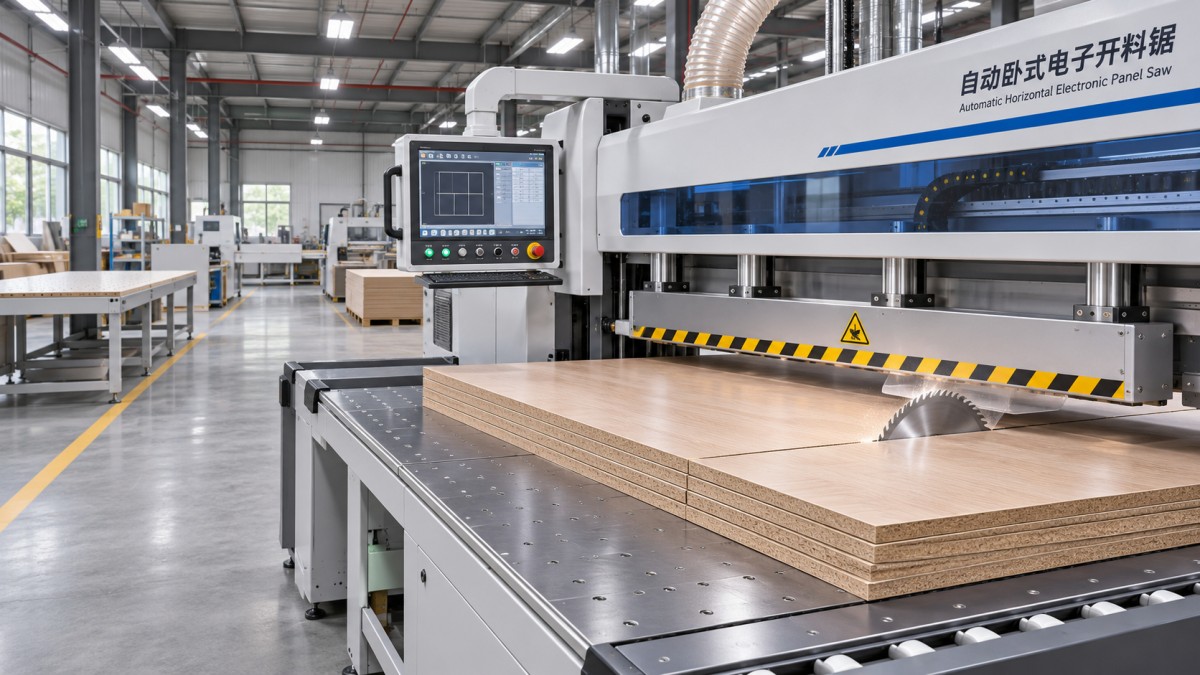
An automatic panel saw machine cuts a stack of boards by positioning the sheets against a reference fence, holding them firmly under a pressure beam, and moving a powered circular blade through the stack along a programmed line. After each cut, a controlled pusher or other positioning system advances the material to the next dimension. The cycle repeats until the required strips or parts have been cut.
The boards do not become accurate simply because they are cut together. Their edges must be aligned, the stack must remain stable under the clamp, and the blade must be suitable for the material and total cutting height. The machine also needs enough usable cutting length and blade projection for the job.
From a stack of sheets to finished panels
A typical horizontal beam saw has a flat support table, a rear fence or positioning system, a pressure beam, and a saw carriage that travels across the cutting line. Some machines feed sheets from the rear using powered equipment; others are loaded at the front. The details vary, but the cutting sequence follows the same principle: establish a reference, hold the material, and move the blade through it.
First, boards are placed in a stack with their reference edges aligned. Clean, flat sheets sit against each other more evenly than bowed or debris-covered sheets. If one board projects beyond the others at the reference edge, the same programmed movement will not produce the same part width from every layer.
The cutting program defines dimensions and the order of cuts. A positioning system moves the stack relative to the saw line, often gripping or pushing its rear edge. Once the stack reaches the target position, the pressure beam descends and holds the boards against the table. A circular blade rises through the table and travels across the width of the stack on a carriage. After the cut, the carriage returns and the beam releases when the machine sequence permits.
For a series of parallel cuts, the remaining stack advances and the cycle repeats. Producing rectangular parts usually requires a change of orientation: strips from the first set of cuts are turned and repositioned for crosscutting. Some automated layouts include equipment to handle this transfer, while others require manual handling between cutting stages.
The programmed dimension refers to the relationship between the positioning reference and the cut line. Blade thickness removes a strip of material called the kerf, so a cutting pattern must account for that loss. Otherwise, a set of dimensions that appears to fit on the original sheet may leave the last piece undersized.
How the stack stays aligned during the cut
The pressure beam keeps the sheets from lifting or sliding as the blade passes through them. Its force must hold the entire stack securely without damaging sensitive surfaces. Insufficient holding force lets layers shift relative to one another; excessive or uneven pressure can mark a decorative face or make a distorted stack conform temporarily to the table, only for it to spring back after release.
Support across the table is equally important. If a large sheet overhangs without adequate support, its weight can pull the stack out of position or cause the cut section to sag as it separates. Air-float tables or support rollers reduce the effort required to move large panels, but they do not replace clamping during the cut.
Reference edges deserve attention before the first programmed cut. Factory edges are not always suitable as finished references, especially if sheets have been damaged in handling or are not square. A trim cut can create a clean edge, but the sequence matters: later dimensions depend on which edge is placed against the fence. If a stack is turned for crosscutting, an inaccurate first reference can carry the error into the next operation.
Stacking mixed sheet sizes complicates positioning. A rear pusher may contact only the longer sheets unless the stack is arranged so all relevant edges register consistently. Gaps between layers, loose offcuts, or dust trapped on the table can also change how the stack sits under pressure.
Blade travel, cutting height and stack capacity
The main blade cuts through every layer in one pass. Its teeth remove material as the carriage travels, while extraction removes chips and dust from the cutting area. Blade diameter, projection, tooth geometry and condition all influence the result. A blunt blade or an unsuitable tooth design can increase cutting resistance and leave rough or chipped edges.
Maximum cutting height is the total thickness the saw is designed to cut under specified conditions, not the thickness of each individual sheet. If several boards are stacked, their thicknesses must be added together. That total also has to fit within the machine's clamping capacity and the available space under the pressure beam.
A height rating alone does not establish a suitable stack for every material. Dense or abrasive boards impose different demands from lighter panels, and laminated surfaces are less forgiving of chipping. Blade selection, carriage feed speed and cutting quality requirements affect the practical stack height. A machine may physically accept a taller stack yet produce a cleaner edge, or place less strain on the cut, with fewer sheets.
Cutting length is a separate limit: it determines the span the blade can travel across, while the positioning system's travel determines which dimensions can be set in the feed direction. Neither value should be confused with stack height. The maximum dimensions of the incoming sheets, the intended cut direction and the size of the final parts all matter when interpreting a machine specification.
Why a scoring blade is used
Many saws include a small scoring blade ahead of the main blade. It makes a shallow cut on the underside of the stack before the main blade reaches the material, reducing breakout where the main teeth would otherwise lift fibers or damage a coating. This is especially relevant for melamine-faced or other laminated boards.
The scoring cut must be aligned with the main blade and set to a suitable width and depth. A poorly aligned scorer can leave a visible step or a wider mark along the underside. It addresses the surface it contacts; it does not automatically prevent damage at every interface between stacked sheets. Test cuts in the intended material are useful for assessing the complete stack.
Reading the cut: where errors come from
A dimensional error shared by every layer points toward a different cause from an error that varies through the stack. If all pieces are consistently too wide or too narrow, the programmed dimension, kerf allowance, positioning reference or machine calibration deserves attention. If the top and bottom layers differ, movement within the stack, uneven clamping or blade deflection becomes more relevant.
A cut that is straight but out of square can result from the reference edge being out of square before the cut. It can also indicate that the stack was not seated consistently against the positioning reference. Measuring only one corner may conceal the problem: comparing dimensions at both ends and checking the cut against the intended reference edge gives a clearer picture.
Edge defects need the same kind of separation. Chipping on the underside of a single sheet can indicate a scoring blade setup issue. Roughness throughout the cut edge can point to a worn main blade, an unsuitable blade or a feed rate that does not suit the material. Marks confined to the top surface may come from contact with the pressure beam or debris trapped between the beam and the panel. The visible defect is a starting point for diagnosis, not proof of a single cause.
Small parts introduce another complication. As the remaining strip becomes narrow, there is less area for the clamp to hold, and the cut piece may have less support. Machine specifications for minimum cut width and part handling therefore matter alongside the maximum sheet size. Cutting a large board successfully does not establish that every narrow offcut can be processed in the same way.
Choosing a practical stack for the material
A useful starting point is a stack of matching sheets with similar thickness, flatness and surface finish. Measure the actual combined height, including any variation between boards, and keep it within the machine and blade limits. The sheets should make even contact with the table and one another, with their reference edges aligned.
Then assess a representative cut. Measure parts from the top and bottom of the stack, inspect both faces and compare the edge along its full length. If the dimensions are consistent but the laminate chips, changing the stack height alone may not address blade condition or scorer alignment. If only one layer is out of position, inspect how the sheets were registered and held before changing the program.
For mixed production, leave room for the largest sheets and longest cuts as well as for handling the separated parts. A saw that meets the nominal height requirement still needs appropriate infeed and outfeed support, adequate extraction and a cutting sequence suited to the panels being processed. The most useful capacity is the stack height that produces the required edge and dimensional quality on the actual material.
Send Your Inquiry
We welcome your cooperation and we will develop with you.