


News & Exhibitions
Latest Factory Updates, Industry Trends & Global Exhibition Information
Woodworking Equipment Supplier Checklist: Spare Parts, Training, and Service
Woodworking Equipment Supplier Checklist: Spare Parts, Training, and Service
Choosing a woodworking equipment supplier involves more than comparing machine specifications and purchase prices. Spare parts availability, operator training, and responsive technical service can determine whether an investment supports reliable production or creates costly downtime. Before placing an order, buyers should verify how each supplier handles replacement components, installation support, maintenance guidance, and after-sales requests.
The difficult part is separating a reassuring promise from a workable support arrangement. “Parts available” does not tell you where they are stocked. “Training included” does not explain whether your operators will learn changeovers or simply watch a demonstration. This checklist focuses on the evidence worth requesting before those gaps become your responsibility.
Start with the production you cannot afford to interrupt
Support requirements depend on the machine’s role. A standalone panel saw with backup cutting capacity presents a different risk from an edge bander through which nearly every cabinet component must pass. A CNC router used for occasional prototypes is not the same purchasing decision as one scheduled across multiple shifts.
Give shortlisted suppliers a realistic operating brief: materials, panel sizes, expected workload, shift pattern, available maintenance skills, and downstream processes. Include your actual product mix. Running identical panels all day creates different training needs from frequent changes between board thicknesses, edge materials, or machining programs.
Then ask a direct question: Which failures or setup errors are most likely to stop this application, and what should we keep on site? A useful answer identifies components and recovery procedures. A generic recommendation to buy “some spare parts” is not enough.
Spare parts: verify identification, availability, and delivery separately
A replacement part is only useful if it is correct for the machine delivered. Request a parts list linked to the final configuration, with component codes, descriptions, and assembly drawings where applicable. Electrical diagrams should identify installed components rather than describe a similar model.
This matters particularly for imported equipment. Two machines sold under the same model name may use different drives, sensors, or controllers after a design revision. A photograph can help identify a component, but it should not replace a traceable part number and compatibility check.
Separate routine consumables from production-stopping components
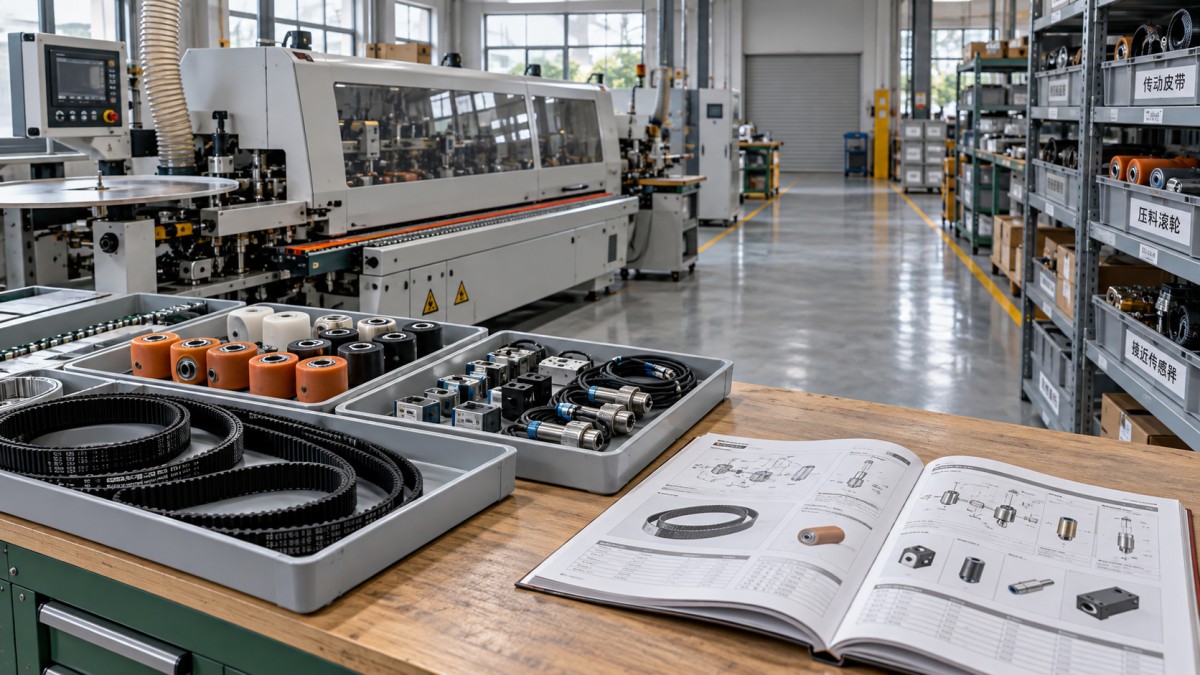
Ask the supplier to divide its proposed spare parts package by purpose. This makes it easier to avoid both an inadequate kit and an expensive box of low-priority items.
- Routine consumables: items such as cutting tools, sanding belts, filters, and lubricants, depending on the equipment.
- Wear and adjustment parts: belts, seals, rollers, pressure pads, or similar components selected for the machine and workload.
- Critical replacement parts: components whose failure would stop production and whose sourcing or configuration may be difficult.
Do not assume every critical component belongs in your initial order. A costly spare may require controlled storage, specialist installation, or configuration before use. The right decision depends on failure consequences, replenishment time, local alternatives, and your ability to fit it safely.
Ask what “in stock” actually means
Establish whether parts are held at the manufacturer’s facility, a regional distributor, or another component vendor. Request current availability and indicative replenishment times for the proposed critical list. Treat these as planning information unless specific commitments are included in the agreement.
Keep dispatch time separate from arrival time. A component ready for shipment can still face transport delays, customs clearance, or missing documentation. Confirm who arranges freight, who pays emergency shipping charges, and what information is needed to release a replacement.
For electronic controls, ask whether replacement units arrive ready to install or require parameter loading and commissioning. Request an agreed backup procedure for machine settings and relevant software files. A physically compatible drive is not necessarily a production-ready replacement.
Training should end with your team running the job
A demonstration proves that the supplier’s technician can operate the machine. Training should establish that your employees can run it, make approved adjustments, recognize abnormal conditions, and know when to stop.
Ask for a written training scope before agreeing to an installation package. It should distinguish operator instruction from maintenance instruction and specify the language, location, materials, and participants. If instruction is remote, check whether camera access, translation, and connection quality will make practical demonstrations usable.
Use your own production tasks wherever possible. For an edge bander, training might cover an agreed thickness change, glue-system care, and troubleshooting an unacceptable edge finish. For a CNC router, it may include workholding, tool offsets, program verification, and recovery after an interrupted cycle. The exact scope must match the supplied configuration.
Maintenance staff need different information: lubrication points, inspection routines, approved cleaning methods, and the boundary between customer maintenance and specialist repair. Safe isolation procedures and local workplace requirements also need attention. Remote advice should never be treated as permission to bypass guards or work on energized equipment without appropriate controls and competence.
Agree how completion will be recorded. A practical handover is more useful than an attendance signature: your operator completes an approved setup and production run, while your maintenance technician demonstrates the routine checks. Retain the manuals and training records so knowledge does not disappear when one employee leaves.
Installation support needs boundaries before the machine arrives
Commissioning can stall for reasons unrelated to machine quality. Electrical supply, compressed air, dust extraction, unloading access, foundations where required, and network arrangements should be checked against the supplier’s installation documents before shipment.
Clarify who handles positioning, connection, leveling, tooling, and test materials. If a technician travels to your site, establish responsibility for travel expenses, accommodation, interpretation, and additional days caused by site unreadiness. These are easier to resolve before booking flights.
Acceptance should also be defined in advance. Use agreed materials, relevant operating conditions, and measurable checks appropriate to the process. Simply switching on the machine does not establish that it can produce an acceptable component. Equally, a supplier should not be expected to meet an undefined output target using unsuitable tooling or materials.
After-sales service: distinguish a reply from a recovery plan
“Fast response” is too vague for a purchase agreement. Ask about service hours, time-zone coverage, working languages, and the escalation route when the first contact cannot solve the problem. A sales representative acknowledging a message is not the same as a technician beginning diagnosis.
Request a sample fault-reporting process. It should explain what to send: machine serial number, alarm details, circumstances of the fault, and safely obtained photographs or video. A structured report helps avoid repeated requests for information while production waits.
Remote support can resolve some setup and diagnostic issues, but not every mechanical failure. Establish what triggers an on-site visit, who can attend, how scheduling works, and which costs fall to the buyer. Where support depends on a local partner, verify that partner’s role for the specific machine rather than assuming general distribution coverage includes technical capability.
Read warranty terms alongside the service proposal. Check the start date, covered components, exclusions, claim evidence, and responsibility for labor and freight. Ask whether a failed part must be returned before a replacement is dispatched. Warranty coverage and rapid restoration of production are related, but they are not interchangeable.
Compare ownership costs on the same basis
The lowest machine quotation may exclude items another supplier includes. Normalize the commercial scope before comparing totals: tooling, installation, training, initial spares, freight, applicable import costs, software licensing, and planned maintenance. Keep uncertain expenses visible rather than quietly treating them as zero.
For downtime exposure, use your own operating assumptions. Consider idle labor, interrupted downstream work, rescheduling, outsourced processing, and restart scrap where relevant. Avoid treating all delayed output as permanently lost sales; some production can be recovered. The purpose is a defensible purchasing decision, not an inflated savings claim.
Compare credible scenarios: a routine wear-part replacement, a control fault requiring diagnosis, and a repair needing an on-site technician. Ask each supplier to explain the likely steps and chargeable items. Differences in support become much clearer when tied to an actual interruption.
Put the support evidence beside the quotation
Qingdao Zhongding Machinery Co., Ltd. describes more than 20 years of woodworking machinery manufacturing and export experience, serving furniture production, workshops, and industrial lines. Its stated focus on technical support, spare parts, and after-sales service is relevant to this evaluation. As with any woodworking equipment supplier, those capabilities should be confirmed for the proposed machine, destination, and support package.
Before authorizing the purchase, place the configuration-specific parts list, training scope, site-readiness requirements, acceptance procedure, warranty, and service contacts beside the final quotation. Any unresolved responsibility should have a named owner and an agreed next step.
A supplier does not need to promise that nothing will fail. It needs to explain how your team will identify the problem, obtain the right help, and restore production—and put the agreed responsibilities in writing.
Send Your Inquiry
We welcome your cooperation and we will develop with you.