


News & Exhibitions
Latest Factory Updates, Industry Trends & Global Exhibition Information
Choosing Woodworking Equipment for a Small Shop: Space, Power, and Workflow
A table saw may fit against an empty wall yet become unusable when a long board needs outfeed support. A planer may have enough cutting capacity but require an electrical circuit the building cannot provide. When choosing woodworking equipment for small shop environments, treat operating space, electrical capacity, dust extraction, and material movement as pass-or-fail requirements before comparing machining features.
Start with the parts you actually produce and map their route through the shop. Then check each candidate machine against its full working envelope and installation requirements. The right choice is not necessarily the smallest machine: it is the configuration that completes your recurring work without blocked access, overloaded infrastructure, or excessive repositioning.
Define the work before selecting the machines
A shop processing rough hardwood needs a different equipment mix from one assembling cabinets from purchased sheet goods. Buying around a general list of woodworking machines can consume space without addressing the operation that limits output.
Use representative jobs to establish the following requirements:
- Incoming material: rough lumber, prepared boards, full sheets, or pre-cut components.
- Part envelope: normal and occasional maximum length, width, thickness, and weight.
- Required operations: straightening, thicknessing, ripping, crosscutting, drilling, sanding, or edge finishing.
- Acceptance criteria: dimensional tolerance, surface quality, squareness, and joint fit.
- Production pattern: one-off work, repeated small batches, or longer runs of similar parts.
Separate frequent requirements from exceptional ones. A machine sized for an occasional oversized component may impose permanent space and power costs. Outsourcing that operation or purchasing prepared material can be a practical alternative, provided supplier consistency, lead time, and transport costs remain acceptable.
For solid wood, distinguish face jointing from thickness planing. A planer generally follows the reference surface presented to it; it does not automatically straighten a twisted board. Eliminating a jointer saves floor space only if another reliable preparation method remains available.
Measure the operating envelope, not just the base
Catalog dimensions usually describe the machine, not the space required to use it. Draw the room to scale, including doors, columns, electrical panels, extraction equipment, storage, and fixed benches. Obtain a dimensioned installation drawing for each shortlisted machine rather than estimating from photographs.
For straight-through feeding, allow for the incoming stock, the machine, and the outgoing stock along the feed axis. The required distance depends on material length, feed position, and support arrangement. Do not assume the machine table alone provides adequate support. Sliding tables, fences, outrigger supports, open cabinet doors, and maintenance access add further clearance.
Sheet handling needs particular attention. A clear line through a saw is insufficient if an operator cannot rotate a panel into position or support it while maintaining control. Trace the complete movement from storage to loading, through the cut, and into the next staging area.
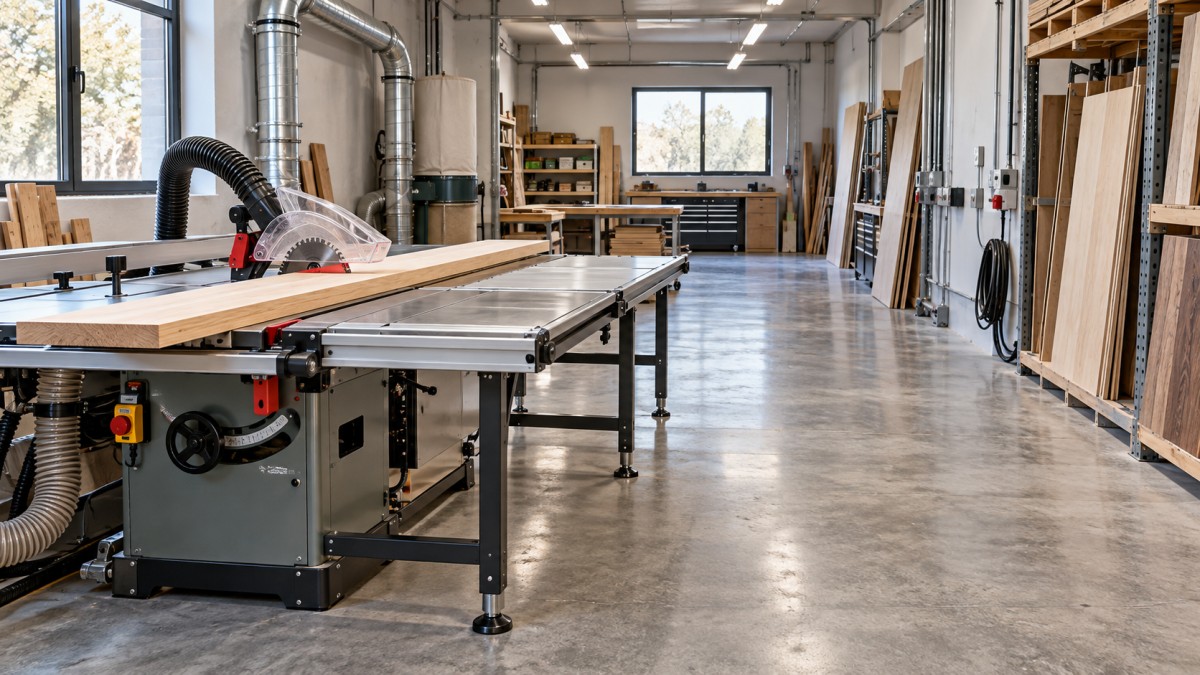
Operating envelopes can sometimes overlap when machines are used separately. A planer and jointer may share a clear feed corridor, for example. However, that corridor cannot also serve as permanent lumber storage. Preserve required exit routes, electrical access, and safe operator positions regardless of which machine is running.
Where mobility helps—and where it creates work
Mobile bases suit machines that are used intermittently and can be repositioned without difficult realignment. Confirm the machine manufacturer permits mobile installation, and check base capacity, stability, locking arrangements, and floor condition. A heavy machine on an uneven floor may be technically movable but impractical to relocate regularly.
Include connection time in the evaluation. Moving a machine may require reconnecting extraction, arranging power cables, leveling supports, and verifying alignment. For frequent operations, a fixed station can use less productive space overall because it avoids repeated setup and temporary staging.
Confirm electrical compatibility before ordering
Motor power is not enough to determine whether a machine suits the building. Obtain the required voltage, phase, frequency, full-load current, starting characteristics, and manufacturer-specified supply requirements. Machines with similar advertised power can require different electrical arrangements.
Have a qualified electrician evaluate the available service and proposed circuits against local requirements. The review should include protective devices, cable sizing, grounding, isolation, and starting demand—not merely whether a compatible receptacle exists.
A single-phase building does not make every three-phase machine unusable, but conversion is not automatically straightforward. A variable-frequency drive or phase converter must be compatible with the motor and the complete machine, including controls, braking, and auxiliary circuits. Obtain manufacturer approval and a properly designed installation rather than treating a converter as a universal accessory.
Do not select an undersized motor simply to avoid electrical upgrades. First assess the expected material, cutting depth, cutter configuration, and duty cycle. A lower-powered machine may be suitable for lighter cuts, but additional passes can move the constraint from electrical capacity to processing time.
Make dust extraction part of the machine specification
An extractor occupies floor space, draws power, and affects where machines can stand. Leaving it until after equipment selection can produce long duct routes or inadequate collection at the tool. Plan extraction alongside the layout.
Request the required airflow and connection details for each machine. An extractor’s advertised free-air capacity is not the airflow available at the machine after losses through ducts, bends, flexible hose, filters, and fittings. Evaluate performance at the expected system resistance and account for the branches that will operate together.
A thickness planer can generate substantial chip volume, while sanding creates fine dust that needs effective source capture and suitable filtration. Neither a large collection bag nor a visibly clean floor demonstrates adequate control of airborne dust.
- Keep duct routes direct, with limited flexible hose and unnecessary bends.
- Provide access to empty containers and service filters without moving production equipment.
- Check whether blast-gate operation matches the proposed workflow.
- Assess combustible-dust, fire, and exposure requirements under applicable local rules.
A general-purpose shop vacuum should not be assumed suitable for a machine designed around a high-volume extraction connection. Match the collection system to the machine’s capture requirements, not just the port diameter. Where collection performance or dust hazards are uncertain, have the proposed system reviewed by a competent specialist before commissioning.
Compare configurations by setup time and material handling
Compact equipment is useful only when its capacity and changeover requirements fit the production pattern. Compare configurations using representative parts and operation sequences rather than footprint alone.
A jointer-planer combination can release floor area, but evaluate the actual conversion procedure. Check table movement, guard and extraction changes, retention of settings, and whether the operator can safely complete the change alone. Repeated switching between jointing and thicknessing can outweigh the space benefit on mixed work.
Likewise, compare a sliding-table saw with a track-saw cutting station around the cuts you repeat. The former may offer useful support and repeatability but demand substantial travel space. The latter can simplify initial sheet breakdown, while repeated narrow parts may need additional fixtures or another cutting process.
Test the layout with a complete batch
Mark proposed machine positions and operating envelopes on the floor before installation. Use representative material or lightweight templates to simulate handling without operating machinery. Follow the work from delivery through machining, assembly, and finished-part storage.
- Receive and stage material. Check whether stock can enter without crossing an active cutting zone.
- Feed the longest normal component. Verify support, operator position, and an unobstructed discharge path.
- Transfer parts between operations. Identify awkward turns, repeated lifting, and routes crossing other workstations.
- Stage work in progress. Allocate space for a realistic batch rather than a single finished part.
- Simulate servicing. Check access for cutter changes, adjustment, cleaning, and extraction maintenance.
Record handling and setup steps as well as machining time. A faster machine may offer little benefit if its output must be stacked on the assembly bench and moved again before the next operation. Small, dedicated staging positions can prevent congestion more effectively than adding cutting capacity.
Use installation feasibility as the purchasing gate
Before comparing optional features, require each shortlisted machine to pass four checks: it can process the required material, operate safely in the available envelope, run on a verified electrical supply, and connect to adequate extraction. A failure needs a defined remedy and cost, not an assumption that installation will resolve it.
Then compare installed cost rather than purchase price alone. Include delivery access, unloading, electrical work, extraction changes, tooling, supports, training, and maintenance access. Check machine weight against the floor and handling route, especially where access involves stairs, lifts, or suspended floors.
Ask the supplier to confirm unresolved details in writing: usable capacity with guards fitted, installation clearances, electrical requirements, extraction demand, consumable specifications, and parts availability. Where practical, evaluate representative material under agreed cutting and acceptance conditions. The purchasing specification should describe the work the machine must perform and the infrastructure it will use—not simply a model name and motor rating.
Send Your Inquiry
We welcome your cooperation and we will develop with you.