

News & Exhibitions
Latest Factory Updates, Industry Trends & Global Exhibition Information
Hot Press vs. Cold Press: Which Is Right for Wood-Based Panels?
Choose a hot press when the panel and adhesive need controlled heat to cure within the required production cycle. Choose a cold press when the bond can develop at ambient temperature and the longer time under pressure fits the production schedule. Neither method is inherently better: the right presse panneau bois depends on the complete panel assembly, the adhesive system, the required output and the utilities available at the plant.
The decision starts with a practical distinction. A press does not create a good bond by pressure alone. It must hold the surfaces in contact while the adhesive develops enough strength for the next operation. Heat can accelerate or enable that process, but it also introduces limits on materials, temperature control and energy use.
What changes between hot and cold pressing?
Both machines use platens to apply pressure across a panel assembly. In hot pressing, heated platens transfer energy into the assembly while pressure is maintained. Depending on the process, heat helps cure a thermosetting adhesive, activates a bonding layer or assists a surface-lamination operation. A cold press applies pressure without deliberately heating the platens; the adhesive develops its bond under ambient conditions.
“Cold” does not mean that temperature is irrelevant. Room temperature, board temperature and humidity can still influence adhesive behavior and the time needed before a panel can be handled. Likewise, the temperature displayed on a hot press is not necessarily the temperature at the glue line. Heat must travel through the facing and substrate before the bond reaches its intended conditions.
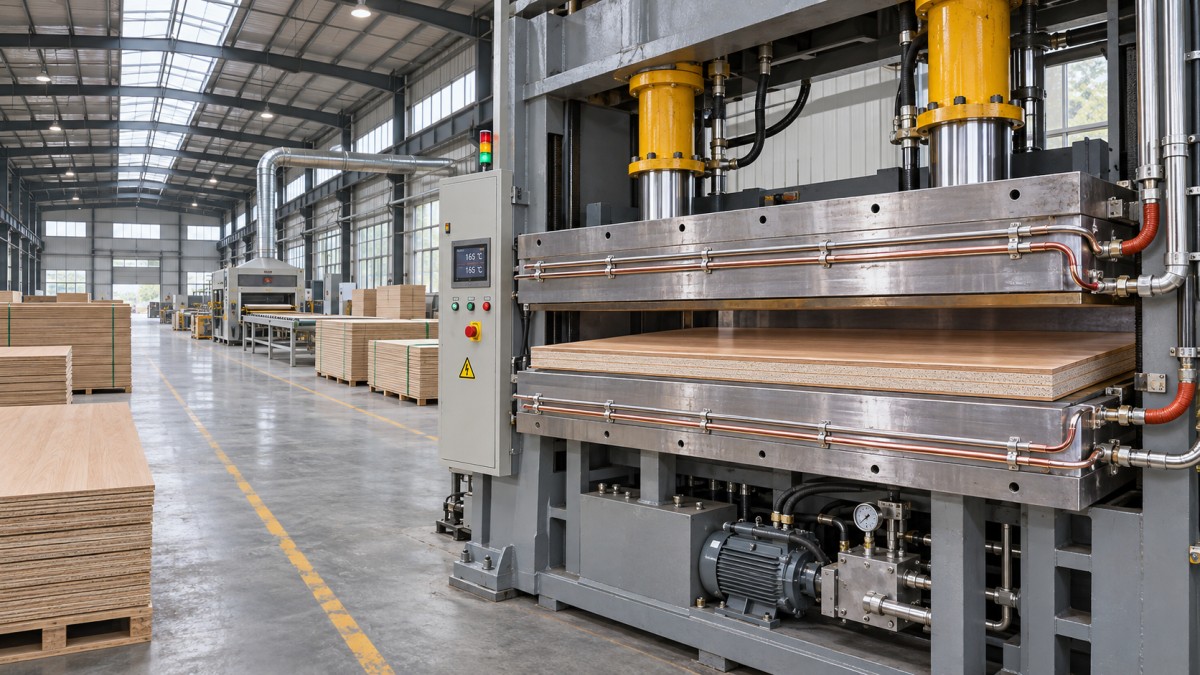
These are selection tendencies, not interchangeable recipes. A cold-curing adhesive cannot automatically be run through a hot press at an arbitrary temperature, and a heat-activated system may not bond adequately in a cold press.
Start with the adhesive and the complete panel
Define the layers before comparing machines: substrate, adhesive, veneer or decorative surface, and any backing layer. Then establish the adhesive supplier’s recommended application rate, open assembly time, pressure, temperature and pressing time for those materials. Open time is the period between applying adhesive and closing the press; it matters when several panels must be assembled and loaded together.
For example, a furniture shop bonding veneer to an MDF core may consider either method if the chosen adhesive and veneer are suitable for both. A cold press can avoid exposing a delicate facing to elevated platen temperature, but the assembly may occupy the press longer. A hot press can shorten the bonding cycle with an appropriate adhesive, provided the veneer, core and surface finish tolerate the temperature and pressure without marking, checking or other damage.
Other applications are less flexible. Decorative surfaces made for a specified heat-and-pressure lamination process need equipment capable of delivering that cycle. Conversely, an assembly containing heat-sensitive components may favor ambient-temperature bonding if a compatible adhesive can provide the required bond. Do not select a press on the assumption that all laminates, films or adhesives behave alike.
Moisture also deserves attention. Differences in moisture content between a wood veneer and its substrate can contribute to movement or panel distortion after pressing. Adding a facing to only one side can create an unbalanced construction, so consider the backing and storage conditions as part of the panel design rather than trying to correct every warp with more pressure.
Compare output using the whole production cycle
A shorter press time does not automatically translate into the same improvement in finished output. Calculate capacity around the complete sequence: applying adhesive, assembling the panel, loading, closing, pressing, opening and unloading. Include any cooling, conditioning or time needed before machining or stacking.
For an initial comparison, divide the number of acceptable panels produced per load by the total elapsed cycle time. Then account for the number of working hours actually available, changeovers and planned downtime. If multiple openings or press stations are involved, include the handling work required to keep them supplied. This gives a more useful estimate than comparing advertised platen closing speeds or nominal pressing times alone.
A cold press with a long dwell time may be a practical choice for a varied workshop schedule if panels can remain clamped while operators prepare other work. At higher volumes, that same dwell time can tie up capacity and increase the space needed for assemblies waiting to enter the press. Additional cold-press capacity may solve the bottleneck, but it should be compared with the cost and complexity of a hot-press line.
Hot pressing shifts the constraint rather than eliminating it. An operator must still load within the adhesive’s workable time, and hot panels may need controlled handling or conditioning before cutting and finishing. Thick assemblies can also require more time for heat to reach the bond line. The relevant figure is acceptable output from the entire line, not the fastest theoretical press cycle.
Specify pressure as a panel requirement, not just machine tonnage
When comparing presses, ask for the usable platen area and the pressure range that can be applied and controlled over the intended panel size. A large total closing force is not, by itself, a bond specification. As an initial check, average nominal pressure is total force divided by the loaded area. Use consistent units, and ask how the machine’s rating relates to its actual working area.
That calculation does not prove uniform contact. Platen flatness, stiffness, parallelism and the way the load is distributed all affect the result. A panel can have an acceptable average pressure while edges or local areas receive too little contact. Conversely, excessive pressure can crush a soft core, print defects through a thin veneer or squeeze too much adhesive out of the joint.
Mixed panel sizes make this more complicated. A small stack placed in an unsuitable position can load the platen unevenly. Discuss minimum load area, positioning and any required caul plates or loading arrangements with the equipment supplier. The machine must be able to hold the required pressure for the full dwell time, including when the adhesive layer or panel compresses.
Temperature uniformity matters as much as the setpoint
For a hot press, evaluate how heat is supplied and controlled across the usable platen area. Ask where temperatures are measured, how the system regulates the platens and how it indicates a heating or control fault. Uneven heating can leave one area under-cured while another sees more heat than the facing or adhesive can comfortably tolerate.
Heat-up time and standby operation also affect scheduling and energy use. An electrically heated press and a press served by a separate heating system place different demands on plant utilities and maintenance. Compare the proposed system against the available electrical supply, installation space and maintenance capability, including the heating infrastructure rather than only the press itself.
For a cold press, assess the environment around the machine. Adhesive performance and assembly time may change when panels, adhesive or the workshop become colder or more humid. A process that works on a stable production day needs enough control to remain repeatable across the range of conditions in which the shop operates.
Match the press to the rest of the line
The press opening, daylight between platens, loading direction and access for forklifts or handling equipment should suit the actual panel sizes and stack arrangement. Also consider how operators will apply adhesive and move assemblies without exceeding open time. A press with sufficient platen dimensions can still be inconvenient if there is no clear space to load a long panel or remove it safely.
Downstream cutting requirements belong in the discussion, but a beam saw does not replace a panel press. For a furniture line that also needs to size MDF, plywood, particle board or melamine-faced panels, the BEAM SAW MJ6226 is a separate cutting option, with a stated maximum working length of 2,600 mm and maximum working thickness of 70 mm. Its dimensions and capacity should be considered alongside the size and condition of panels leaving the pressing process.
Allow for practical service access as well. Hydraulic components, controls, platens and, where fitted, heating equipment all need inspection and maintenance. Ask how spare parts and technical support are supplied, particularly when the machine will be installed far from the manufacturer. Guarding, emergency stops and safe loading arrangements should be assessed for the complete installation and operating method.
Use a representative trial before finalizing the specification
The strongest comparison uses the actual panel construction and adhesive under a proposed production cycle. Prepare representative samples, including the largest and most difficult assembly expected in normal work. Record the material condition, adhesive application, assembly time, pressure, platen temperature where applicable, dwell time and subsequent conditioning.
Examine the finished panels for bond quality, surface marking, edge contact, warping and suitability for the next operation. Use the adhesive supplier’s recommended evaluation method and the acceptance criteria for the intended product. A panel that appears sound immediately after unloading may still need further curing or conditioning before its bond and dimensional stability can be assessed meaningfully.
Bring the results back to the purchasing decision. If both methods meet the quality requirement, compare the total installed system, expected throughput, work-in-process space, energy demand and maintenance support. If only one process consistently produces an acceptable panel within the required cycle, that process establishes the equipment specification.
Send Your Inquiry
We welcome your cooperation and we will develop with you.