


News & Exhibitions
Latest Factory Updates, Industry Trends & Global Exhibition Information
Which small woodworking machines fit a compact workshop?
A compact workshop can accommodate a productive set of woodworking machines when each machine matches the material, the workpiece size, and the available handling space. For furniture made primarily from sheet goods, a small table saw or track saw, a router, and a compact edge bander may cover the main operations. For solid wood, a bandsaw and a planer-thicknesser often deserve higher priority. The best selection changes with the work passing through the shop, not simply with the dimensions of the machines.
When comparing maquinas pequenas para marcenaria, start with the largest piece that must be processed and trace its path through cutting, machining, assembly, and extraction. A machine that fits against a wall on a floor plan may still be impractical if a long board cannot enter it or a full panel cannot be safely supported.
Match the machine to the workpiece
Sheet-based cabinet work and solid-wood joinery place different demands on a small floor area. A panel must be supported across its width while it is cut; a long board needs clear space before and after a planer. Write down typical and maximum workpiece dimensions, including thickness, before comparing capacity figures.
Capacity on a specification sheet describes what the machine can accept under stated conditions. It does not automatically describe the size of workpiece that can be handled comfortably in the room. A small table saw, for example, may accept a wide cut at its fence, yet a full sheet of plywood still needs stable support during the entire pass.
Cutting sheet goods without dedicating the room to a saw
A track saw used with a sacrificial support surface is a practical starting point when full sheets arrive only occasionally. The sheet stays supported while the saw travels across it, so there is no need to push a large panel through a stationary machine. The support surface still needs enough room for the sheet, access for the cut, and a safe way to load and remove it.
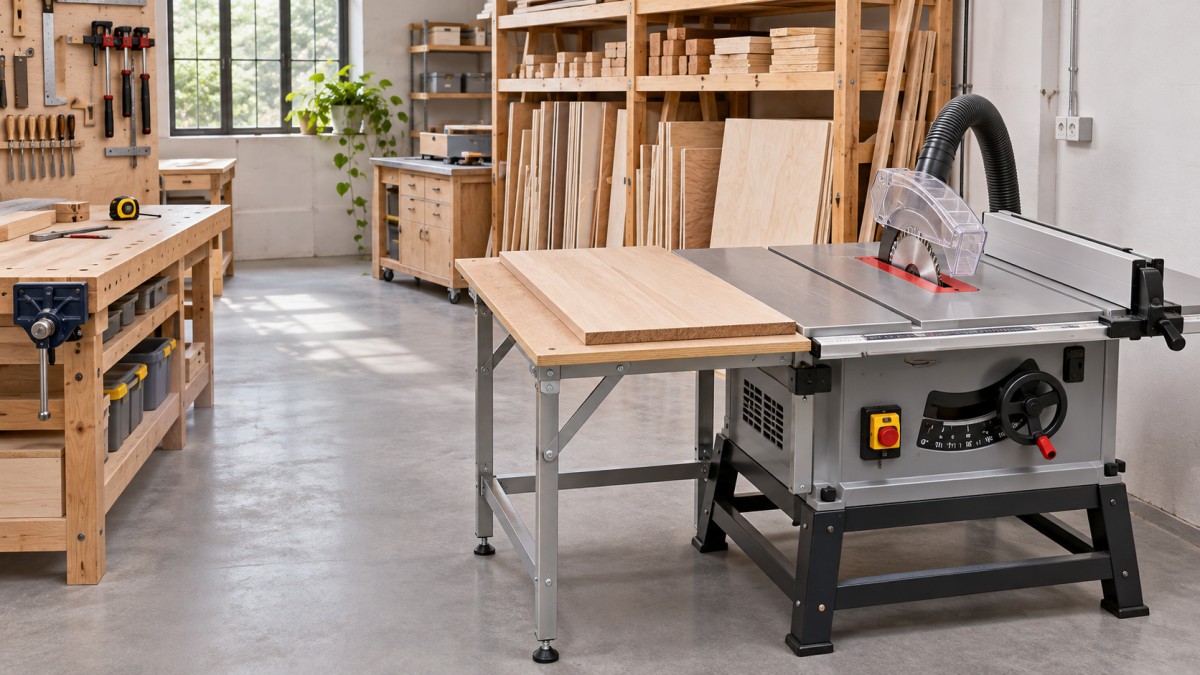
A compact table saw becomes more attractive when the work involves repeated cuts in smaller panels, strips, or solid-wood components. A reliable fence and a flat, stable table matter as much as motor size. Look closely at how the fence locks, whether it remains parallel to the blade, and how readily the blade and riving knife can be adjusted. Extensions can improve support, but they also enlarge the operating footprint.
A small sliding table saw can make crosscutting panels easier, particularly when squareness is important. Its carriage, however, needs travel space alongside the machine. Compare the usable stroke and panel support with the actual component sizes; the nominal table size alone does not show how much room the sliding assembly occupies during a cut.
For frequent production of full-size panels, compare compact equipment with the space demanded by industrial alternatives. The CNC BEAM SAW ZD280F illustrates that distinction: its stated cutting length and width are up to 2,800 mm, while its machine dimensions are 5,700 × 5,480 × 1,900 mm and its weight is 5,000 kg. Its automatic positioning and feeding suit panel production, but the stated dimensions already occupy a substantial area before access, material movement, and extraction are considered. It is not a compact-workshop substitute merely because it automates cutting.
Planing and shaping: separate operations or one combined machine?
A thickness planer brings the opposite face of a board to a consistent thickness. It does not reliably make a twisted board flat by itself: the feed rollers can press the board down as it passes through, allowing some distortion to return afterward. For solid timber with uneven faces, establish a flat reference first, using a suitable jointer, a supported sled, or another controlled flattening method.
A benchtop planer is attractive where it can be stored and brought out for batches. Include the weight of the machine, the stability of its stand, and chip extraction in that decision. Planers generate a large volume of chips, and a small vacuum setup that works with a handheld sander may not keep up. Board length also matters: the room must accommodate the stock on both sides of the cutter, with support that does not tip or pull it out of alignment.
A combined jointer-thicknesser saves the floor area of two separate machines and gives solid-wood work both operations. Its trade-off is changeover. If a job alternates repeatedly between jointing and thicknessing, the time spent converting and resetting the machine can interrupt the workflow. Examine how tables, guards, fences, and extraction connections move between modes, and whether the settings return accurately after conversion.
Combination machines with sawing, spindle moulding, and other functions require the same scrutiny. A broad feature list is useful only if each function has the capacity and adjustment range needed for the actual work. Also assess whether one long board or panel can be handled at a given station without blocking the next operation.
Where smaller machines earn their place
Bandsaw
A compact bandsaw is well suited to curves and irregular shapes, and it can prepare solid wood for further machining. Cutting height sets the physical limit for stock passing under the guide, but it does not guarantee that the motor, blade, and frame are appropriate for sustained resawing at that height. Narrow blades follow tighter curves; wider blades are generally chosen for straighter cuts within the machine's permitted blade range. Leave room to support long material and to open the wheel doors for blade changes.
Router and router table
A handheld router takes little storage space and handles grooves, edge profiles, and template work. A router table adds support and repeatability for small components, provided the fence and guards suit the cut. Very small pieces need appropriate holding fixtures rather than fingers close to the cutter. Consider where the extraction hose connects: dust produced above the table and material thrown below it do not necessarily reach the same collection point.
Compact CNC router
A small CNC router makes sense when parts share repeated drilling, pocketing, or contour patterns. Compare the usable travel with the finished part and the space needed for clamps or other workholding. A machine advertised by overall size can have a considerably smaller usable cutting area; a fixture occupying that area reduces it further. Confirm that the chosen hold-down method works with the material and part size, especially when cutting through small components that could move as the surrounding sheet is removed.
Allow space for loading, tool changes, dust extraction, and access to the control equipment. Programming, setting the work origin, and securing the material are part of the production cycle, so a CNC router is not automatically the fastest choice for a single simple cut.
Edge bander
For laminated cabinet panels, a compact edge bander can reduce reliance on manual edge application. Match its supported panel thickness, edge material, feed arrangement, and trimming functions to the intended work. A narrow machine still needs a straight route for panels entering and leaving it; large doors may need a second support surface. If the machine applies the band but leaves trimming or finishing as a separate operation, include that bench space in the layout.
Measure the working envelope, not just the base
Draw each machine at its installed size, then add the path of the largest expected workpiece. Include the travel of sliding tables, opening doors, extended fences, extraction hoses, and the space needed to stand in a stable position. A planer placed near a doorway may use the adjoining clear area for long stock, but that route must remain controlled and unobstructed while machining.
Shared space is useful when operations occur at different times. A level assembly bench, for example, can serve as outfeed support if its height and position are suitable for the machine. Mobile bases can also make a layout flexible, but the machine must stand securely during use, and power leads and hoses must not create a trip or snag hazard. Moving equipment for every cut can erase the benefit of a nominally compact layout.
Account for material storage as well. Sheets leaning near a saw reduce the space available to maneuver a panel; long boards stored in the infeed path can obstruct the very machine intended to process them. Plan a route from delivery and storage to cutting and onward to the bench, including a place to put finished pieces without stacking them on machine controls or guards.
Power, extraction, and settings affect the final choice
Confirm the workshop's available voltage, phase, and circuit capacity against each machine's requirements. Do not assume that a compact machine uses a standard household supply or that a stated motor rating describes the complete electrical demand. A dust extractor running at the same time adds to the load. Where compressed air is required for clamping or other functions, the compressor and air lines also occupy space and need suitable capacity.
Extraction connections deserve the same attention as the machine footprint. A small port on a handheld tool does not establish that the same extractor and hose arrangement will serve a planer or saw. Ask for the machine's extraction requirements and plan the hose route without sharp obstructions or interference with moving workpieces. Provision for emptying collected dust and chips belongs in the layout too.
When comparing accuracy claims, distinguish positioning resolution from the accuracy of a finished cut. Blade condition, fence alignment, panel support, material movement, and setup all influence the result. Request the conditions behind quoted tolerances and, where possible, inspect sample cuts in the intended material. A clean edge on laminate also depends on the blade and cutting arrangement, not on a numerical accuracy figure alone.
Deciding which machine comes first
For occasional cabinet work, a track saw and router can handle a wide range of tasks while leaving room for assembly. Add a stationary saw when repeated straight cuts justify the permanent handling area. For solid-wood furniture, prioritize accurate preparation of faces and thickness before adding machines for specialized profiles. A bandsaw becomes valuable when curves, irregular stock, or resawing recur often enough to justify its space.
Before ordering, settle the details that affect installation and continued use: delivery dimensions, access through doors, machine weight, assembly requirements, consumable sizes, and the availability of replacement wear parts. Ask for operating and maintenance information for the exact configuration being considered. A compact machine is a workable choice only when it can be delivered, positioned, adjusted, and maintained in the space it is meant to serve.
Send Your Inquiry
We welcome your cooperation and we will develop with you.