


News & Exhibitions
Latest Factory Updates, Industry Trends & Global Exhibition Information
Woodworking Equipment Cost: Budgeting Beyond the Machine Purchase Price
A competitive machine quote can make a purchasing decision feel straightforward—until the remaining invoices arrive. Freight, customs clearance, electrical work, tooling, installation, and operator training can all change the investment required before the first saleable panel leaves the machine. For procurement teams, understanding woodworking equipment cost means budgeting for production readiness, not simply securing an attractive purchase price.
The harder question is what happens afterward. A machine that costs less initially may require more setup time, consume more tooling, or leave production waiting for replacement parts. A realistic budget connects acquisition costs with everyday operating conditions, giving purchasing, finance, and production teams a common basis for comparison.
Start with the production requirement, not the quotation
Before requesting prices, define what the equipment must produce. “A saw for cabinet production” leaves too much open to interpretation. Panel dimensions, material types, required edge quality, batch sizes, working hours, and changeover frequency all affect which configuration represents good value.
A workshop handling varied custom orders may benefit more from straightforward adjustment and flexible operation than from advanced automation. A factory processing repeat batches may justify a higher initial investment if automated positioning reduces recurring setup labor. Neither approach is inherently cheaper; the right answer depends on the production pattern.
Give suppliers a written requirement covering:
- Materials and dimensions: typical and maximum workpiece sizes, thicknesses, and material combinations.
- Output expectations: required saleable production per shift, including loading, adjustment, and unloading time.
- Quality requirements: dimensional tolerances, surface finish, and acceptable levels of chipping or rework.
- Operating conditions: available power supply, extraction infrastructure, floor space, and operator experience.
This prevents a common budgeting error: comparing a basic machine with a production-ready package as if they were equivalent offers.
Build the woodworking equipment cost budget in three layers
Separating the investment into acquisition, production readiness, and ongoing ownership makes omissions easier to spot. It also clarifies when cash will be needed.
Keep recoverable taxes separate from permanent costs where local rules allow recovery. They may still create a cash-flow requirement even when they are not ultimately an expense. Your finance team or customs adviser should confirm the treatment rather than relying on a supplier’s general estimate.
Delivered price is not necessarily installed price
A quotation described as “including shipping” may stop well before the machine reaches its operating position. Confirm whether the price covers destination terminal charges, customs brokerage, local delivery, unloading, and movement inside the building.
Ask for the applicable Incoterms rule, version, and named place. These define important responsibilities and risk transfers, but they do not replace a detailed installation scope or automatically settle every destination charge.
For imported woodworking machinery, packing dimensions and gross weight matter as much as the machine footprint. They influence freight arrangements, lifting requirements, and site access. Delays caused by missing documents or an unavailable unloading crew can also generate storage or waiting charges.
The factory floor often reveals the missing costs
A machine may fit on a layout drawing yet still be awkward to use. Procurement should review the complete working envelope with production and maintenance staff before approving the order.
Consider the ZDV6 sliding table saw as a practical budgeting example. It has a 3200 × 388 mm sliding table, a 3200 mm gross cut capacity, and 1250 mm between the saw blade and rip fence. Its stated overall dimensions are 3250 × 3150 × 900 mm, with a gross weight of 850 kg. These figures help establish the initial layout and handling plan, but they do not define all the space needed for safe panel loading, table travel, operator movement, and material staging.
Its manual saw-group lifting and 45°–90° tilting arrangement also illustrate why configuration should match workflow. Manual adjustments may suit varied workshop tasks, while frequent angle or height changes should be included in a setup-time assessment. The decision should reflect actual job sequences rather than a general preference for either manual or automated equipment.
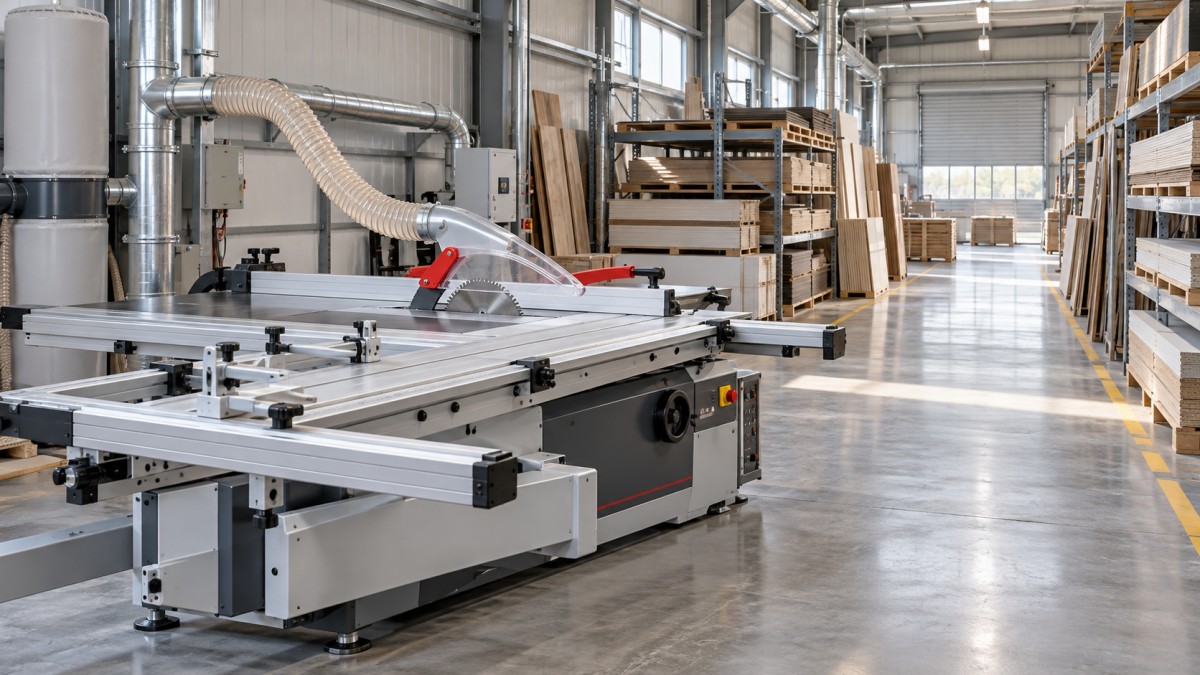
Before delivery, walk the route from the unloading point to the final machine position. Check door openings, turning space, floor condition, and any lifting restrictions. Have qualified personnel confirm floor suitability and handling arrangements; gross weight alone is not enough to select lifting equipment or assess floor loading.
Utilities deserve the same attention. Electrical compatibility includes voltage, phase, frequency, protection, and connection requirements—not just motor power. Dust extraction may require ductwork changes, suitable collection capacity, and measures appropriate to local fire and occupational-safety requirements. Compressed air should be budgeted only where the selected machine or accessories require it.
Turn operating costs into a usable ownership model
A useful starting formula is:
Total ownership cost = acquisition and delivery + production-readiness costs + operating and maintenance costs over the evaluation period + disposal costs − expected resale proceeds.
Choose one evaluation period for every supplier, such as the period used in your company’s capital approval process. Apply the same production hours, labor rates, energy tariffs, and output assumptions. For longer-term comparisons, finance may also require discounted cash-flow analysis.
Energy: distinguish rated power from actual consumption
Motor ratings are useful for checking electrical requirements, but they do not establish the electricity bill. Actual consumption depends on load, idle time, material, cutting conditions, and auxiliary systems.
The sliding table saw described above has a 5.5 kW main saw motor and a 1.1 kW scoring motor. Their combined rated power should not be treated as a measured continuous electrical demand. For budgeting, request operating data or use a clearly identified estimate, then validate it during production trials.
Estimated electricity cost = average measured electrical input in kW × operating hours × applicable electricity tariff.
Add extraction and other required auxiliaries within the same comparison boundary. Where relevant, consider demand charges as well as energy charges.
Tooling and maintenance: small invoices accumulate
Blades, cutters, abrasives, lubricants, belts, and other wear items should have their own budget lines. For panel cutting, material composition, coating, cutting volume, and finish requirements influence blade selection and sharpening frequency.
Confirm which tools are included, whether they suit your materials, and whether replacements are readily available. Purchase enough initial tooling to avoid stopping production whenever a blade is sent for sharpening.
Maintenance estimates should include labor as well as parts. Ask for scheduled tasks, recommended intervals, lubrication requirements, and access arrangements. A low-priced component can still be expensive to replace if the work requires lengthy dismantling or specialist attendance.
Labor, scrap, and downtime determine cost per usable part
Machine speed alone is a weak purchasing metric. Operators still load material, position workpieces, check dimensions, change tools, and move finished parts. Compare the complete production cycle using representative jobs.
Cost per saleable part = relevant production costs ÷ accepted output.
This connects equipment spending with usable results. Better cutting consistency may reduce rework and material loss, but savings should be supported by trials rather than assumed from a feature list.
For downtime, estimate the financial consequence of lost production, emergency freight, overtime, or outsourced work. Avoid counting the same loss twice—for example, combining lost contribution with lost revenue without accounting for costs that were not incurred.
Compare quotations by removing ambiguity
The lowest quoted woodworking equipment cost is meaningful only when the offers cover the same requirement. A short clarification process is usually more valuable than negotiating a discount before the scope is settled.
Send each shortlisted supplier the same questions:
- Which machine options, blades, accessories, guards, and documentation are included?
- What site preparation must the buyer complete before installation?
- Does commissioning include alignment, test cutting, and operator instruction?
- Who pays for technician travel, accommodation, interpretation, and additional attendance?
- What does the warranty cover, what is excluded, and how are claims handled?
- Which spare parts are recommended locally, and what are their current prices and estimated lead times?
- How is technical support delivered across time zones and languages?
Request written acceptance criteria as well. Representative materials, agreed dimensions, finish expectations, safety checks, and the treatment of outstanding issues should be clear before shipment or commissioning. Acceptance should reflect the agreed machine capability, not an informal demonstration using an unusually easy workpiece.
Qingdao Zhongding Machinery Co., Ltd. brings more than 20 years of woodworking machinery experience to these discussions, alongside technical support, spare parts supply, and after-sales service. For buyers, the useful step is to translate those service capabilities into an agreed scope: required documentation, training arrangements, parts recommendations, and support contacts for the selected equipment.
Approve a budget that can withstand a difficult month
A base-case estimate is necessary, but it is not enough. Test what happens if production starts later than planned, utilization is lower, tooling wears faster, or a critical replacement part takes longer to arrive. These scenarios reveal whether the investment remains manageable when conditions are less favorable.
Keep contingency separate from known costs. It should cover identifiable uncertainty, not hide missing quotations. Obtain firm estimates for major items such as electrical work and inland transport, then explain which remaining risks justify a reserve.
Also separate the payment schedule from the ownership-cost model. Deposits, pre-shipment balances, import payments, installation charges, and initial consumables can create a cash requirement before the machine generates revenue. A reasonable long-term investment can still put pressure on working capital if these dates are overlooked.
The strongest purchasing recommendation is not simply “this supplier is cheaper.” It explains which machine fits the workload, what it takes to make it production-ready, and how operating assumptions affect the final cost. When those points are documented, woodworking equipment cost becomes a manageable investment decision rather than a series of surprises after delivery.
Send Your Inquiry
We welcome your cooperation and we will develop with you.