


News & Exhibitions
Latest Factory Updates, Industry Trends & Global Exhibition Information
Sourcing Woodworking Equipment from China: How to Verify an Exporter
A low quotation becomes expensive when the machine arrives with the wrong configuration, cannot pass acceptance testing, or needs replacement parts that nobody can identify. Before paying a deposit to a woodworking equipment exporter in China, establish three things: which legal entity is responsible for the order, whether the specified machine can perform the required work, and how faults will be resolved after delivery. Each answer should be supported by evidence that connects directly to the contract.
Catalogs and factory photographs are useful starting points. Stronger evidence includes a verifiable business registration, a live demonstration of the relevant machine, documented acceptance criteria, and service terms with clear responsibilities. The depth of verification should reflect the purchase: a standard standalone machine requires a different assessment from a rear-loading panel saw integrated into an existing production line.
Establish who will sign, manufacture, and receive payment
Request the exporter’s full registered Chinese name, business license, Unified Social Credit Code, registered address, and proposed contracting entity. Use the official Chinese enterprise registration system to compare the supplied details with the public record. An English trading name alone is insufficient because it does not reliably identify the legal entity behind a quotation.
Compare the contract name with the invoice issuer and bank beneficiary. If an affiliated export company will receive payment while another company manufactures the machine, request a written explanation of that relationship and an agreement identifying responsibility for quality, warranty, and refunds. A different beneficiary deserves investigation; a personal account or an unexplained last-minute account change is grounds to pause payment.
Verify bank-detail changes through an established contact using a separately confirmed communication channel. A convincing email thread does not establish that new payment instructions are genuine.
Also clarify whether the supplier manufactures the entire machine, assembles purchased components, or trades equipment from another factory. These arrangements require different questions. A trading exporter needs demonstrable access to factory engineers, technical records, and warranty parts. A manufacturer needs evidence that the quoted model is within its actual production capability. Neither a business license nor an impressive workshop establishes those capabilities on its own.
Use the factory visit to trace the quoted machine
A physical inspection or live video visit should follow the proposed order through relevant production and testing areas. Start with the machine model, then examine assembly, electrical work, final adjustment, and finished-machine identification. Ask for close views of nameplates, control cabinets, drive components, and the mechanisms that determine performance.
During a remote visit, request specific views in real time. For a beam saw, that could mean opening the saw carriage enclosure, showing the scoring unit, and demonstrating the loading sequence. An uninterrupted walkthrough gives better context than edited footage, although it still does not prove ownership of the premises or establish the condition of a future shipment.
If the quoted machine is unavailable, establish what is being demonstrated. A larger model, an older control system, or a machine with different feeding equipment cannot validate every feature of the proposed configuration. Record these differences and require further evidence before treating the demonstration as technical approval.
For a customized machine or connected line, an independent factory inspection is useful when it includes technical review. Define the inspection scope beforehand. Counting machines and photographing packaging will not establish cutting performance, interface compatibility, or readiness for installation.
Turn catalog specifications into a testable purchase description
A specification becomes useful when its meaning is tied to material, operating conditions, and a measurement method. “High precision” leaves too much open. Even a numerical accuracy claim needs clarification: does it describe positioning repeatability, finished-part dimensions, or another measurement? Those results are related, but they are not interchangeable.
For example, the CNC Beam Saw (Rear-Loading Model) ZD330 lists cutting length and width up to 3,350 mm, cutting thickness up to 120 mm, an 18.5 kW main saw motor, and stated sawing accuracy of ±0.1 mm. Its listed sawing speed is 0–120 m/min. These figures provide a starting point for verification; they do not establish that maximum thickness, maximum travel speed, and the stated accuracy are achieved together on every panel material.
Translate the intended workload into a sample cutting program. Specify panel type, thickness, stack arrangement, part dimensions, and acceptable edge quality. Laminated boards expose scoring and chipping problems that an unfinished board demonstration can conceal. Long, narrow parts also test different aspects of support and alignment from large rectangular pieces.
Attach the approved configuration to the contract, including component substitutions that require written approval. A photograph of a branded servo drive in a demonstration machine does not guarantee that the shipped machine will contain the same component.
Make acceptance evidence traceable to the shipment
Agree on the factory acceptance test before production or final preparation begins. It should define the test material, cutting program, measurements, acceptable results, and treatment of failures. Include a complete operating cycle so that feeding faults, control interruptions, and handling delays remain visible.
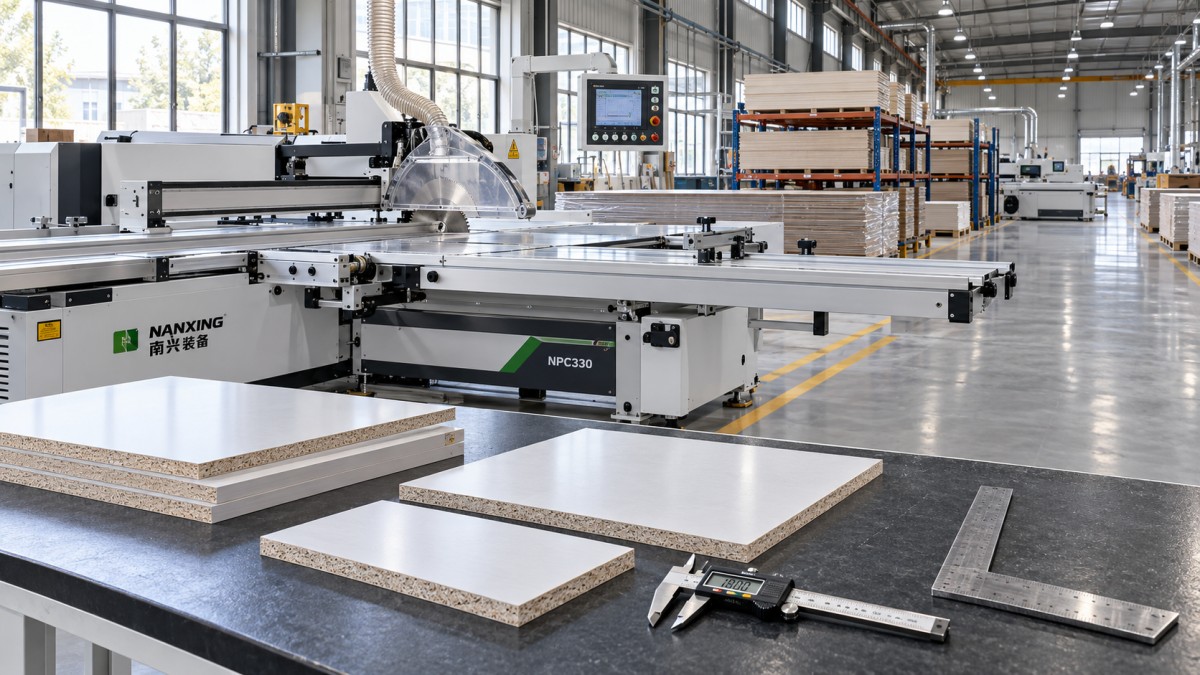
During the test, connect the evidence to the actual machine through its serial number or other agreed identification. Record the configuration, relevant settings, and measuring instruments. For panel cutting, assess dimensional accuracy, squareness, and edge condition separately. A part can have the correct length while remaining out of square, and an accurate cut can still have unacceptable surface chipping.
Repeat representative cuts to establish consistency. If a result fails, document the adjustment and repeat the affected test. A single successful piece after several undocumented attempts provides weak evidence of stable performance.
Separate factory acceptance from commissioning at the destination. Shipping, reassembly, leveling, utilities, and extraction connections can affect operation. The contract should explain which results must be demonstrated before dispatch and which will be verified after installation, together with the process for resolving outstanding items.
Verify documents against the destination and machine configuration
Request a sample manual, electrical schematic, maintenance schedule, and spare-parts list before the deposit. They need enough detail to support installation and fault finding. A generic brochure labeled “manual” offers little protection when a sensor fails or a control alarm stops production.
Any compliance claim should be tied to the destination market and the exact machine configuration. Ask what the supplied declaration, certificate, or test report covers, who issued it, and whether its model identification matches the order. Confirm unfamiliar documents with the issuing organization where possible. A logo on a catalog is insufficient evidence.
Site compatibility also needs written confirmation. Establish electrical supply requirements, compressed-air pressure and demand, dust extraction connections, access clearances, and floor requirements. An operating pressure figure alone does not establish the compressor capacity needed during repeated cycles. Likewise, overall dimensions do not define the full space required for loading panels, opening service doors, and maintaining the saw unit.
Test the service arrangement before a breakdown
Ask the exporter to explain how it would diagnose a realistic fault, such as a positioning error, a failed loading sensor, or damage to a scoring spindle. The response should identify the technical contact, information required, available diagnostic access, and route to obtaining replacement parts. Specific answers reveal more than a general promise of lifetime support.
A useful parts list connects descriptions and part numbers to the installed machine. Confirm whether purchased electrical components are available locally and whether mechanical wear parts require factory manufacture. For controls, establish who holds parameter backups and what access is available for restoration or troubleshooting.
Read the warranty as an allocation of costs. Clarify parts coverage, freight, remote assistance, site labor, travel expenses, exclusions, and the event that starts the warranty period. If commissioning requires a visiting technician, record the arrangements and prerequisites. An undefined installation promise can leave the machine waiting while travel, tools, or utilities are arranged.
Compare quotations on the same delivery and acceptance basis
Normalize the commercial scope before comparing totals. One offer may include export packing, installation assistance, and essential accessories, while another excludes them. Identify the named delivery place or port and the agreed trade term, then establish responsibility for inland transport, loading, freight, insurance, destination handling, and unloading as applicable.
Heavy machinery also needs a workable handling plan. Confirm packed dimensions, shipping weight, lifting points, and any dismantling required for transport. If the rear-loading equipment travels separately, establish who will reassemble and align it. Site access and unloading arrangements should be settled before shipment booking.
Link payment milestones to evidence that can be reviewed: the agreed configuration, completed acceptance records, closure of identified defects, and shipping documents appropriate to the transaction. Payment structure alone cannot compensate for vague technical obligations. The contract must state what constitutes completion and what happens when the machine fails the agreed test.
Unresolved discrepancies should remain visible in the purchasing decision. An unexplained payee, an unavailable configuration, or a refusal to document acceptance criteria is a reason to hold the order until the missing evidence is supplied. A credible exporter can connect its quotation to an identifiable machine, measurable performance, and enforceable responsibilities.
Send Your Inquiry
We welcome your cooperation and we will develop with you.