


News & Exhibitions
Latest Factory Updates, Industry Trends & Global Exhibition Information
Choosing Door Production Equipment for Solid Wood vs. Flush Doors
Choose woodworking equipment for door production around the door’s construction and the operations that determine its final quality. Solid wood doors require accurate preparation of stiles, rails, panels, and joints. Flush doors depend on flat skins, consistent core and frame thickness, controlled adhesive application, and a suitable pressing cycle. Both routes need sizing, sanding, and hardware machining, but their main production constraints differ.
Start with a defined door specification: material construction, finished dimensions, surface finish, hardware preparation, and required output per shift. A machine that delivers excellent component accuracy can still be unsuitable if its working envelope excludes the largest door or its cycle disrupts assembly. Establishing the process route first makes individual equipment specifications easier to judge.
Construction determines where precision matters
For this comparison, solid wood doors primarily mean frame-and-panel designs assembled from solid timber components. Flush doors have flat faces bonded over a perimeter frame and an internal core. That core might be lightweight honeycomb, timber strips, or an engineered board material. These alternatives place different demands on handling, adhesive application, and pressing.
Construction labels alone are insufficient. A flush door with timber blocking and solid wood lippings still needs component machining. A solid wood door with a veneered engineered panel introduces panel handling and bonding requirements. Equipment selection should follow the actual bill of materials and joint drawings.
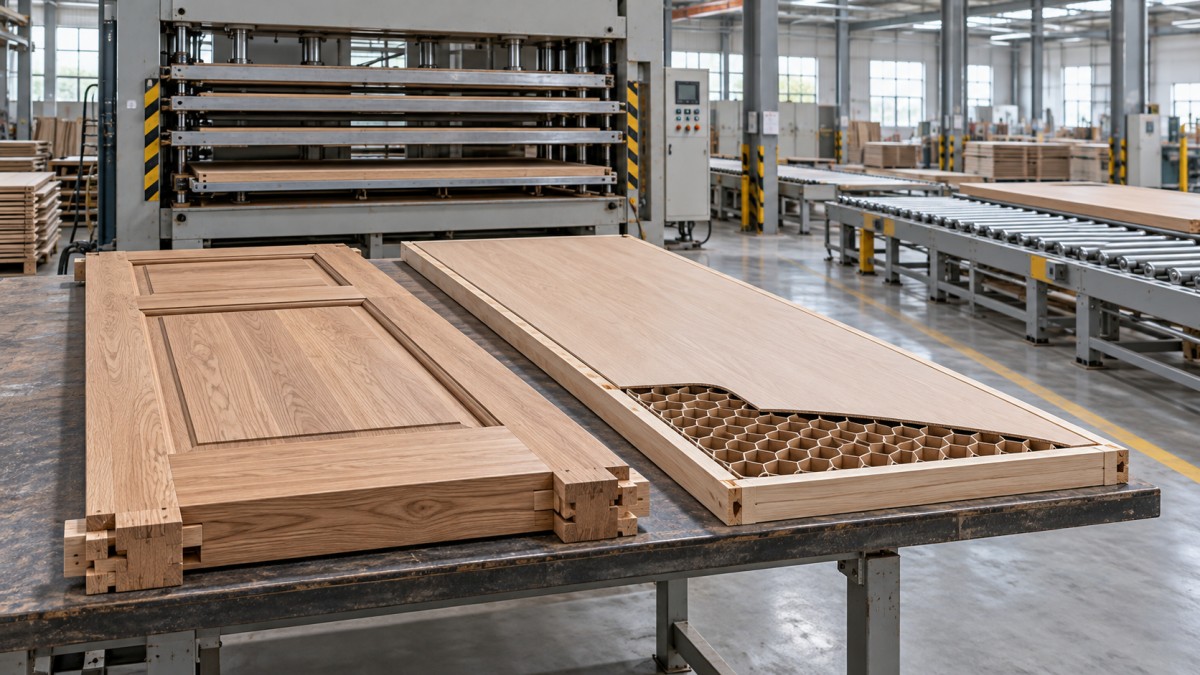
Build the solid wood route around stable reference surfaces
Accurate joints begin with prepared stock. Ripping establishes component widths, while surfacing and thicknessing create the reference faces used by downstream machines. Feeding bowed or twisted timber directly into profiling transfers material instability into the finished component. Extra machining allowance must accommodate straightening without leaving undersized rails or stiles.
A multi-rip saw is relevant when repeated strip widths justify simultaneous longitudinal cuts. The Multi Blades Rip Saw, offered in ZDF-120-300 and ZDF-150-300 versions, lists a maximum processing width of 300 mm and processing-height ranges of 50–120 mm and 60–150 mm, respectively. Its function is to cut one piece into several strips during a pass. These dimensions describe a timber-preparation stage; they do not establish suitability for full-width door blanks.
Before selecting that stage, confirm the permitted stock dimensions, blade arrangement, cutting allowance, and feed behavior with representative timber. Multiple cuts introduce multiple kerfs, so material yield depends on strip layout, defects, and required finished sections. High feed speed has limited value if downstream planing cannot accept the resulting volume.
After stock preparation, the machine choice depends on joint geometry. Mortise-and-tenon construction requires compatible positioning and tooling across mating parts. Profile-and-scribe designs require matching cutters and controlled reference faces. A CNC machining center offers flexibility for varied designs, while dedicated machines suit repeat work with stable component families. Compare complete component cycles, including clamping and repositioning, rather than cutting time alone.
Panel movement also affects assembly equipment. Where a solid timber panel is designed to float within grooves, clamping must close frame joints without unintentionally locking the panel across its width. A stronger clamp cannot correct incompatible joint geometry or excess moisture variation.
Flush door equipment must control the entire bonded assembly
Flush door production shifts attention from individual joints to thickness consistency across a broad surface. The frame, internal blocking, and core must support the skins at the intended level. A high frame section or proud lock block creates local pressure concentrations; an undersized core leaves unsupported areas. Pressing harder does not resolve either condition reliably.
Panel saws or nesting equipment should be assessed against skin material, incoming sheet sizes, edge quality, and handling requirements. Thin skins require adequate support during cutting and transfer. Decorative faces also need protection from sliding contact, trapped debris, and poorly supported stacking.
Match adhesive application to the layup sequence
A roller spreader suits compatible flat materials and adhesives, but its adjustment range and cleaning requirements matter as much as nominal application width. Confirm that the intended adhesive can be applied evenly at the required rate without damaging thin skins. Where the process uses beads or another application pattern, bonding trials must establish adequate contact and support.
The useful production window begins when adhesive is applied. Skin preparation, core placement, frame alignment, and transfer into the press must fit within the adhesive’s specified assembly conditions. Adding a faster spreader can increase waste if layup remains slow and coated parts wait too long.
Select the press from the bond and core requirements
Cold and hot pressing routes require different adhesive systems and cycle planning. A heated press introduces temperature control and heat-transfer considerations through the assembly. A cold press avoids heated platens but can require longer occupancy, according to the adhesive and process conditions. Neither route should be selected from cycle-time claims without a compatible bonding specification.
Press force must be interpreted alongside the loaded area. The same total force produces different average pressure across different door sizes or loading patterns. For a specified average pressure, required force equals pressure multiplied by loaded area, using consistent units. Platen stiffness and parallelism still determine how evenly that force reaches the assembly.
Lightweight cores introduce a further limit: pressure sufficient for bonding must remain compatible with core compression strength. Confirm the approved pressure window using the actual skin, core, frame, and adhesive combination. Where different door thicknesses share a platen, the loading arrangement needs explicit validation; uneven stack heights prevent consistent contact.
Shared finishing machines need different capabilities
Both constructions require final sizing and hardware preparation, but the machining conditions differ. Solid wood profiles can present changing grain direction and tearout at corners. Flush door trimming passes through a combination of skin, adhesive, and edge material. Tool selection, support, and cutting direction should be demonstrated on the intended construction.
Edge treatment deserves separate attention. Solid wood lippings on flush doors require attachment and subsequent trimming or profiling. An edge banding machine intended for thin edging does not automatically handle thick timber lippings. Establish the edge material, joint method, trimming allowance, and required corner geometry before specifying this station.
For lock pockets, hinge recesses, and other hardware features, compare machining access with the complete hardware schedule. A machine that drills faces accurately may still require a separate setup for deep edge pockets. Consistent locating references are essential when door handing changes or when hardware positions are measured from the finished edge.
Sanding capacity should reflect the finish allowance. Solid timber components require control of profile preservation and cross-grain marks. Veneered or thin-faced flush doors have limited material available for removal. A wide-belt sander cannot safely compensate for substantial assembly thickness errors when doing so would cut through the face layer.
Calculate throughput from the constraining operation
Machine feed speed is only one part of production capacity. Solid wood preparation produces multiple components per door, often with different machining routes. Flush door assembly consumes press area and time. Comparing these routes using doors per minute at a single station conceals the work required elsewhere.
For a press, a useful starting estimate is:
Theoretical doors per hour = doors per load × 60 ÷ total cycle time in minutes.
Include loading, closing, pressing, opening, and unloading in that cycle. Where several openings are available, count only positions that can actually be loaded and processed under the proposed operating arrangement. Then account for changeovers, interruptions, and downstream handling when setting an achievable shift target.
For component machining, convert the door schedule into quantities of rails, stiles, and panels. Separate cutting time from setup time, especially where different widths or profiles require tool changes. A flexible machine with a slower cutting cycle can outperform a dedicated arrangement on short, varied batches if it removes repeated setups and transfers.
Buffer space also needs a purpose. Prepared timber must remain organized by section and condition. Adhesive-coated assemblies have a time limit, while newly pressed doors need handling appropriate to their bond development. Unplanned stacks between machines can turn a balanced capacity calculation into surface damage, distortion, or delayed assembly.
Use production trials to resolve specification gaps
Acceptance trials should represent the difficult end of the intended production range. Include the largest required format, demanding timber grain, the thinnest face material, and the hardware geometry that requires the most machining access. Trial materials should match the proposed production specification closely enough to make the results meaningful.
Record outcomes that connect directly to door quality:
- Component geometry: section consistency, straightness, squareness, and mating-joint fit after normal handling.
- On pressed doors, measure thickness distribution and flatness after the defined conditioning period. Inspect the face for core patterns or local depressions, and assess bonding using an agreed method appropriate to the construction.
- Finished machining: edge damage, hardware location, pocket depth, and the repeatability of locating references after a changeover.
- Observed output should include ordinary loading, unloading, tool adjustment, and cleaning activities.
Agree on tolerances and measurement methods before the trial. A door measured immediately after pressing is not directly comparable with one measured after cooling and conditioning. Likewise, measurements taken from different reference edges can conceal positioning errors.
Installation requirements belong in the final equipment comparison because they affect whether demonstrated performance transfers to production. Confirm extraction demand at the proposed cutting load, electrical and compressed-air requirements, maintenance access, and space for full-length material movement. For presses, include platen access, adhesive cleanup, and loading clearance.
A mixed solid wood and flush door workshop can share selected sizing, sanding, and hardware operations when their capacity and workholding suit both constructions. Keep separate process requirements for timber preparation and bonded assembly wherever the materials demand different controls. The final equipment specification should tie each machine to a defined operation, accepted material range, measurable quality requirement, and demonstrated cycle.
Send Your Inquiry
We welcome your cooperation and we will develop with you.