


News & Exhibitions
Latest Factory Updates, Industry Trends & Global Exhibition Information
Buying Woodworking Machinery from China: Factory Audits and Acceptance Tests
Buying woodworking machinery from China can make financial sense when the purchase price leaves room for inspection, installation, tooling, and production support. The saving becomes much less attractive if a machine arrives with the wrong configuration or cannot process your materials at the required quality and output. Before placing an order, procurement teams need evidence that the supplier can build the specified equipment and that the machine being shipped can perform the agreed work.
A factory audit and a factory acceptance test answer different questions. The audit examines whether the supplier has the facilities, controls, and technical capability to deliver consistently. The acceptance test checks the completed machine against your purchase requirements. For standard equipment, these checks may be relatively focused. A customized CNC router, automatic edge bander, or connected production line deserves closer scrutiny because configuration errors can be expensive to correct after delivery.
Define what you are buying before assessing the factory
A useful inspection starts with a purchase specification. Without one, the supplier and buyer may interpret “high precision,” “heavy duty,” or “production ready” differently. A machine can match its brochure while still being unsuitable for your workload.
Describe the work the machine must perform: materials, part dimensions, thickness range, required finish, acceptable dimensional variation, and expected output. Include the difficult parts of the production mix. Thin panels, small components, coated surfaces, and demanding edge finishes may expose limitations that a straightforward demonstration will miss.
Then separate machine capability from operating assumptions. A stated feed speed does not establish how many acceptable components an operator can produce per shift. Loading, positioning, tool changes, adjustments, unloading, and cleaning all affect usable capacity. If output matters to the investment case, define a representative production sequence and agree how it will be timed.
The specification should also identify the supplied configuration. Record the agreed spindle or motor arrangement, tooling interfaces, control system, software functions, working dimensions, electrical supply, extraction connections, and compressed-air requirements where applicable. Identify critical component makes and models when they materially affect performance, maintenance, or compatibility. Require written approval for substitutions.
For a woodworking machinery supplier in China, the ability to discuss these details clearly is useful early evidence. A supplier that asks about panel construction, cutting patterns, adhesive requirements, or workshop utilities is helping establish whether its proposed machine fits the application. A quotation that leaves those questions unresolved should remain provisional.
Use the factory audit to trace how quality is controlled
A factory visit should follow the path from incoming parts to finished equipment. A showroom demonstration can establish that a machine operates, but it reveals little about how the next machine will be assembled, checked, and released.
First establish who will manufacture the equipment and where. Confirm the relationship between the contracting company, the production facility, and any subcontractors responsible for important assemblies. Export businesses may combine their own manufacturing with externally sourced components or machines. Procurement needs a clear allocation of responsibility for quality, warranty work, and technical support.
During the audit, concentrate on evidence that connects production activity to a particular machine:
- Incoming inspection: How are purchased components checked, and how are incorrect or damaged items prevented from entering assembly?
- Assembly control: Are there documented checks for alignment, lubrication, wiring, fastening, and other steps that affect operation?
- Measurement: Are suitable measuring instruments available, with records showing that their accuracy is controlled?
- Final inspection: Can completed check sheets, fault records, and corrective actions be traced to machine serial numbers?
- Technical support: Can the supplier retrieve the drawings, component details, and control information needed to support the supplied configuration?
Ask to examine a small sample of records and compare them with equipment on the floor. A signed inspection form carries more weight when it identifies the machine, the measurement taken, the acceptance limit, and the person responsible. Generic checklists with every box marked “pass” provide limited evidence.
Pay attention to how defects are handled. A controlled process should make it possible to identify a failed check, assign a correction, and verify the result before release. Finding an issue during assembly is not automatically a reason to reject a supplier; losing track of that issue is a more serious concern.
The audit should also test service readiness. Ask how a replacement component would be identified from a serial number, which parts require configuration, and what information is needed for remote diagnosis. For programmable equipment, clarify access to parameter backups, software licenses, and recovery procedures. Dependence on an undocumented controller setup can turn a repairable fault into prolonged downtime.
A remote audit can help verify documents and inspect selected activities when travel is impractical. Its scope is narrower because the camera operator controls what is visible. For equipment whose failure would interrupt a production line, an independent on-site inspection may justify its cost. Give the inspector a defined scope and relevant technical competence; a general shipment inspection will not necessarily assess machining performance.
Make the acceptance test resemble your production
The factory acceptance test, or FAT, should use the machine allocated to your order, in its final agreed configuration. Record its serial number and configuration before testing. If essential tooling, software, or assemblies change afterward, specify which checks must be repeated.
Agree the test plan before the machine is completed. It should identify the materials, drawings, tooling, operating settings, measurement methods, acceptance limits, and evidence to be retained. This prevents a last-minute demonstration from becoming the practical definition of acceptance.
Representative material is particularly important in woodworking. Differences in panel composition, coating, moisture condition, adhesive, and solid-wood characteristics can influence results. Where practical, send your own material or agree a documented equivalent. Record any differences that could affect how the results apply to your production.
Choose checks that expose the machine’s likely limitations
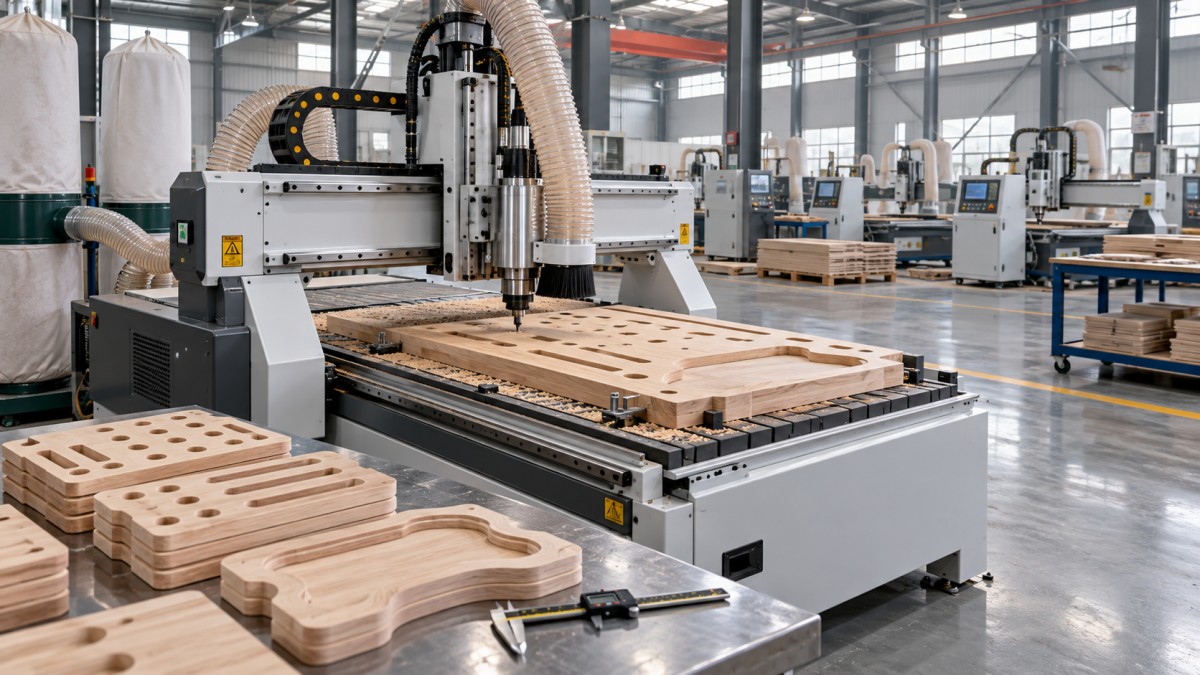
For a CNC router, a useful test can combine dimensional checks with features that challenge positioning, workholding, and finish. Include suitable holes, pockets, contours, and repeated features across the working area. Examine edge quality as well as measured dimensions. A part may measure correctly while requiring excessive sanding or showing damage that makes it unsuitable for the next operation.
For an edge bander, use the panel and edging combinations that matter to your order book. Assess adhesion, trimming, scraping, corner finishing, and visible marking where those functions are included. Test relevant thickness changes and setup adjustments. A clean result on one easy panel does not establish performance across the machine’s advertised range.
For a panel saw, assess cut dimensions, squareness, and edge condition on representative sheet sizes and thicknesses. If stacked cutting is part of the intended workload, include it in the agreed test. For sanding equipment, evaluate thickness consistency and surface quality under the specified processing conditions.
These are starting points for a machine-specific protocol. The supplier and buyer should agree measurable limits appropriate to the finished product and the processes that follow. Furniture components requiring precise assembly may need different acceptance criteria from rough-cut blanks destined for further machining.
Test repeatability and usable output
One successful component demonstrates a result at one moment. Require repeated parts and a continuous run long enough to assess the intended operating condition. There is no single test duration suitable for every machine; base it on the process, expected loading, and consequences of unstable performance.
Define the timing boundary for capacity tests. State whether the recorded cycle includes loading, positioning, machining, unloading, and necessary adjustments. Count acceptable finished parts and document rejects, stoppages, manual intervention, and changes made during the run. Otherwise, a reported production rate may describe only the fastest portion of the cycle.
Include checks of guards, interlocks, emergency stops, alarms, and restart behavior by competent personnel using appropriate procedures. A successful FAT does not, by itself, establish compliance with every destination-market requirement. Agree the applicable safety documentation and conformity responsibilities separately, before ordering.
Keep the evidence usable. Retain measured results, identified sample parts where practical, photographs, relevant settings, and video showing the test sequence. A short edited clip may illustrate the outcome, but it cannot explain what happened between the selected moments.
Connect acceptance results to payment and shipment
Inspection has limited commercial value if the purchase agreement does not explain what happens after a failure. Before paying a deposit, agree the test protocol, access arrangements, responsibility for inspection costs, and the conditions for shipment release. Include a process for resolving disputed measurements.
Distinguish defects by their effect on operation. A safety-related fault, missing contracted function, or inability to meet agreed performance should prevent acceptance until corrected and retested. A minor cosmetic issue may be handled through a written outstanding-work list if both parties accept the remedy and timing. Avoid signing an unconditional acceptance document while significant items remain open.
Payment milestones can support this process when they are agreed during negotiation. The amount and timing depend on the transaction, but the contract should identify which evidence is needed before each relevant payment becomes due. Clarify how changes requested by the buyer affect price, schedule, and retesting.
Shipment release should also cover machine identity, accessories, documentation, and packing. Check the delivered tooling and spare parts against the agreed list. Confirm that manuals, electrical drawings, maintenance instructions, and any agreed software or parameter backups correspond to the actual machine. Packing arrangements should address corrosion protection, movement restraint, vulnerable assemblies, and handling requirements appropriate to the shipment.
Factory acceptance cannot reproduce every condition at the buyer’s premises. Electrical supply, extraction, compressed air, foundations, installation, and operator preparation can affect performance. Define a site acceptance test where installation or integration materially influences the result, and allocate responsibility for providing the required site conditions.
The buying decision should ultimately reflect the cost of achieving reliable production. Add inspection, travel or third-party testing, tooling, commissioning, training, and essential spares to the equipment price when comparing offers. A lower quotation with unresolved specifications may carry a larger completion cost than a more detailed offer.
Before authorizing shipment, procurement should be able to trace each important requirement to evidence: the agreed configuration, the measured production result, the disposition of defects, and the support information needed after arrival. If that chain is incomplete, the remaining uncertainty should be resolved while the machine is still accessible at the factory.
Send Your Inquiry
We welcome your cooperation and we will develop with you.