


News & Exhibitions
Latest Factory Updates, Industry Trends & Global Exhibition Information
Why Software Integration and Structural Rigidity Matter in 3300mm CNC Beam Saw Procurement Decisions
Time:Sep 15, 2026
Author:Zhongding Buying Guide Editors
Number of views:
Structural Rigidity Directly Affects Cut Accuracy Over 3300mm Spans
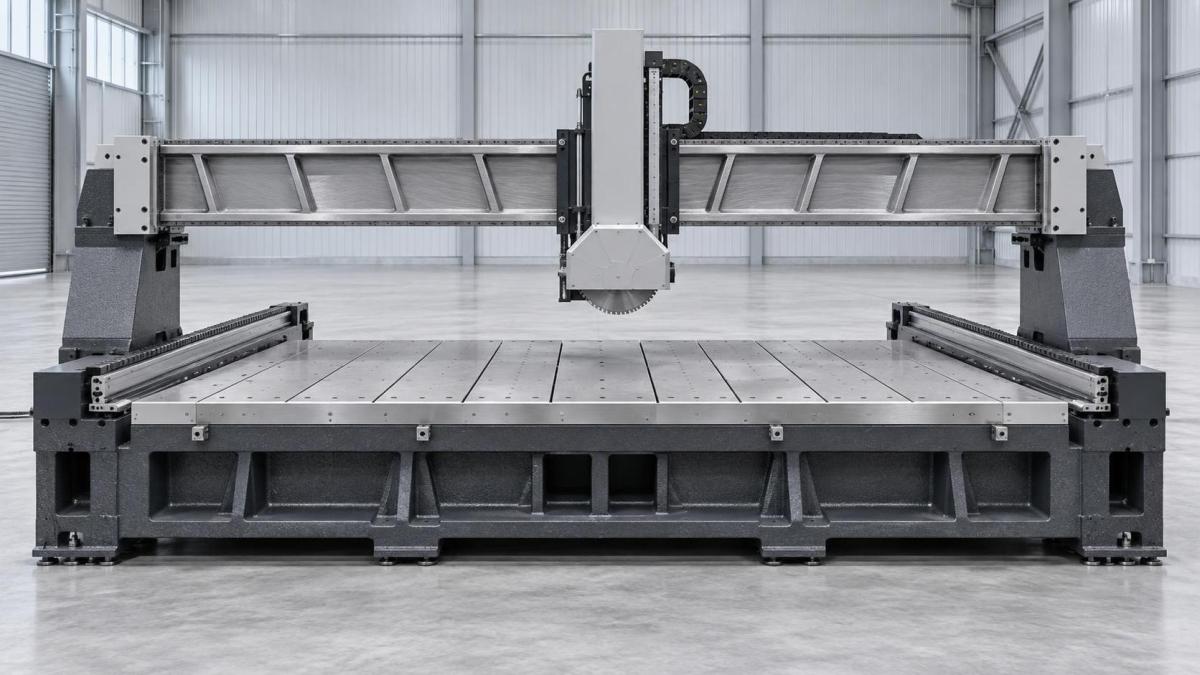
A 3300mm CNC beam saw operates across a wide working envelope—often cutting panels up to 3300mm in width, with beam travel exceeding 3500mm to accommodate tooling and overtravel. At this scale, mechanical deflection is not theoretical—it’s measurable, repeatable, and consequential. When the beam sags under load during high-speed feed or heavy-duty cutting of dense materials like laminated MDF, solid wood, or multi-layer composites, the cutting head deviates from its programmed path. Even 0.08mm of vertical deflection at mid-span translates to angular error in the cut plane, accumulating across long cuts and compromising edge squareness, especially critical for nested parts requiring tight fit-up in cabinetry or modular furniture assembly.
Rigidity isn’t just about frame thickness or material grade—it’s about how mass, geometry, and stress distribution interact. A cast-iron base offers higher damping than welded steel but adds weight (typically 4,200–4,800 kg for a full-size 3300mm unit), affecting floor loading requirements and transport logistics. Some manufacturers use hybrid structures: steel beams reinforced with internal ribbing and cross-bracing, paired with granite or polymer-concrete beds for thermal stability. These designs reduce resonance frequencies below operational spindle speeds, minimizing vibration-induced surface ripple on machined edges.
Precision isn’t defined solely by linear encoder resolution (commonly ±0.02mm). It’s sustained precision—how consistently that tolerance holds across the full X-axis travel, under varying ambient temperatures, after hours of continuous operation, and when cutting asymmetric loads (e.g., a 2440 × 1220 mm panel offset to one side of the beam). Structural rigidity determines whether positional repeatability remains within ±0.03mm over 3000 cycles—or drifts beyond ±0.1mm due to accumulated thermal expansion in poorly constrained joints.
Software Integration Determines How Well That Rigidity Is Utilized
Hardware alone doesn’t guarantee output quality. A rigid machine with poor software integration becomes a bottleneck—not a productivity asset. Consider nesting efficiency: a 3300mm cnc beam saw must process complex part layouts generated by third-party nesting software (e.g., OptiNest, TopSolid Wood, or Cabinet Vision). If the saw’s native controller lacks direct API access or standardized import protocols (like DXF v2000+, XML-based job definitions, or NC-code preprocessing hooks), operators fall back on manual file conversion, layer mapping, and coordinate system alignment—introducing latency, human error, and version mismatches.
More critically, real-time feedback loops matter. When the saw detects abnormal motor current draw—indicating blade binding in dense material—the control software must decide whether to pause, retract, adjust feed rate, or log the event for later analysis. This requires tight coupling between motion control firmware, I/O modules, and the HMI application layer. Machines with proprietary, closed-loop software stacks often lack logging granularity or export options needed for root-cause analysis of recurring cut failures. In contrast, platforms supporting OPC UA or MQTT enable seamless data flow into MES or CMMS systems—linking mechanical performance to production KPIs like first-pass yield or scheduled maintenance intervals.
Material-specific compensation routines also depend on integration depth. Hardwood species vary in density and grain direction; aluminum composite panels require different feed/speed profiles than melamine-faced chipboard. Without software that allows parameter libraries tied to material ID tags—or that auto-applies feed-rate adjustments based on real-time load sensing—the operator bears responsibility for selecting correct settings. That shifts risk from engineering validation to shop-floor judgment—a known source of variance in high-mix, low-volume environments.
Procurement Teams Must Evaluate Both Domains Simultaneously
Purchasing decisions often treat structure and software as separate line items—frame cost versus license fee. But their interaction defines total cost of ownership. A lower-cost machine with marginal rigidity may require more frequent recalibration, generate higher scrap rates on wide-format cuts, and demand skilled operators to compensate for inconsistent behavior. Meanwhile, a robust frame paired with inflexible software forces workarounds: exporting jobs as G-code only to reprocess them through external post-processors, maintaining parallel CAD/CAM licenses, or accepting longer setup times per job batch.
When evaluating proposals, procurement personnel should request:
- Deflection test reports under static and dynamic loading conditions (not just “designed for” claims);
- Documentation of thermal expansion coefficients for major structural components;
- Evidence of software compatibility testing with the buyer’s existing nesting and ERP systems;
- Sample job files processed end-to-end—from nesting output to completed cut sequence—with timestamps and error logs;
- Verification that material libraries include at least three common substrates used in-house (e.g., 18mm birch plywood, 25mm MDF, 4mm ACM) and allow user-defined additions.
Weight and footprint differences reflect underlying design trade-offs. One model lists dry weight at 4,320 kg with overall dimensions of 4,820 × 2,650 × 2,380 mm; another weighs 4,690 kg but measures 4,950 × 2,720 × 2,410 mm—suggesting heavier reinforcement and larger support bases. Neither is objectively superior—each suits different facility constraints. A tighter footprint matters where floor space is premium; higher mass improves vibration resistance where adjacent machinery generates ground-borne noise.
Accuracy specifications also vary meaningfully. One unit states positioning accuracy of ±0.02mm over full travel; another cites ±0.03mm *at 20°C*, with a note that deviation increases by 0.002mm per °C deviation. That second specification acknowledges environmental reality—something procurement teams can verify during site assessment.
Where Integration and Rigidity Converge in Practice
In a recent evaluation involving three suppliers offering a 3300mm cnc beam saw, one vendor provided both ISO 230-2 test reports showing beam deflection under 0.05mm at 2,500mm span—and a live demo processing a Cabinet Vision-generated job without intermediate file translation. The nesting software triggered automatic tool-change sequences and adjusted feed rates based on material thickness flags embedded in the job header. No manual intervention occurred between job load and first cut.
Another supplier met rigidity benchmarks but required manual mapping of layer names to tool assignments—a step that added seven minutes per job and introduced inconsistency when operators skipped verification steps under schedule pressure. A third offered open software architecture but exhibited measurable beam flex (>0.12mm) during rapid traverse tests on unbalanced loads, causing visible taper on 3000mm-long cuts of 19mm particleboard.
These outcomes weren’t isolated to lab conditions. They appeared in daily operation: scrap rates averaged 2.1% on the integrated, rigid platform versus 4.7% and 5.3% on the other two—directly impacting raw material spend, labor time per good part, and delivery reliability.
For procurement professionals, the takeaway isn’t “choose rigidity *or* integration.” It’s assessing how each manufacturer resolves the tension between them—whether structural choices enable consistent software execution, and whether software design respects mechanical limits. That convergence point determines whether a 3300mm CNC beam saw functions as a precision tool—or merely a large, expensive cutter.
Send Your Inquiry
We welcome your cooperation and we will develop with you.