


News & Exhibitions
Latest Factory Updates, Industry Trends & Global Exhibition Information
What woodworking machinery shipment support should be confirmed before dispatch?
What Woodworking Machinery Shipment Support Should Be Confirmed Before Dispatch?
Before dispatching woodworking equipment, procurement teams should confirm that Woodworking Machinery Shipment Support covers packaging, loading, export documents, installation guidance, spare parts, and after-sales response.
Clear pre-shipment coordination helps prevent delivery delays, transport damage, customs issues, and costly production interruptions after the machine reaches the buyer's facility.
For buyers sourcing panel saws, edge banders, CNC routers, sanding machines, or production lines, shipment support is not a minor logistics detail.
It is part of the machine purchase decision because incomplete preparation can reduce the value of an otherwise reliable woodworking machine.
With more than 20 years of manufacturing experience, Qingdao Zhongding Machinery helps global buyers receive equipment prepared for efficient installation and stable operation.
Confirm the Shipment Scope Before the Machine Leaves the Factory
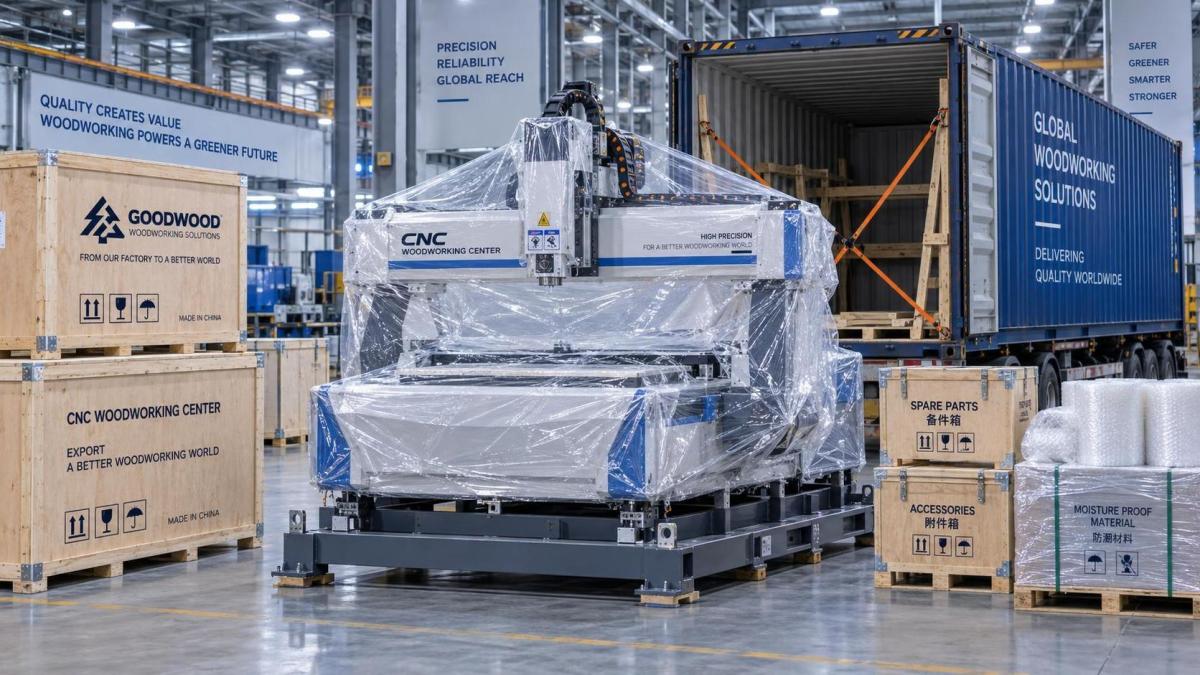
The first procurement question should be simple: what exactly is included in the shipment, and what responsibilities remain with the buyer?
A quotation may list the main machine, but a complete shipment can also include auxiliary units, tooling, electrical components, manuals, and installation materials.
Buyers should request a final packing list before dispatch rather than relying only on the original quotation or a general product description.
The final list should identify every machine module, optional accessory, spare-parts package, electrical cabinet, control pendant, and loose assembly component.
This is especially important for larger CNC nesting lines, automatic edge banding lines, and multi-machine furniture production systems shipped in separate sections.
Procurement teams should also confirm whether items such as dust-extraction interfaces, air hoses, cable trays, conveyors, and safety guards are included.
Small omitted components can delay commissioning even when the main woodworking machine arrives in good condition and passes an initial visual inspection.
Ask the supplier to clarify which site-preparation items are outside the supply scope, including compressed-air systems, dust collectors, foundations, and power-distribution equipment.
This distinction prevents a common misunderstanding: buyers may expect a turnkey operating solution while suppliers only provide the specified machine configuration.
Woodworking Machinery Shipment Support should define delivery terms clearly, including the agreed Incoterm, destination port or location, insurance arrangement, and unloading responsibility.
Under FOB terms, the supplier normally handles export clearance and loading at the departure port, while the buyer manages sea freight and destination procedures.
Under CIF or CFR arrangements, buyers should still verify who purchases insurance, which risks are covered, and when responsibility transfers.
For DAP or DDP deliveries, confirm whether local unloading, customs duties, inland transport restrictions, and site-access limitations affect the final delivery plan.
Check Export Documents and Customs Information Early
Documents are often the reason a shipment is delayed, not the machine itself, so buyers should review document requirements before container booking.
At minimum, importers commonly need a commercial invoice, packing list, bill of lading, certificate of origin when applicable, and export declaration information.
Depending on the destination, customs authorities may also request fumigation records, wood packaging certificates, conformity documents, or specific product classification details.
Woodworking equipment buyers should confirm the correct HS code with their customs broker, because classifications influence duties, permits, and compliance procedures.
A supplier should provide accurate machine descriptions, model numbers, quantities, values, gross weights, net weights, and package dimensions across all shipping documents.
Inconsistent information between the invoice, packing list, and bill of lading can trigger customs questions or create clearance delays at the destination.
Procurement managers should ask whether the machinery requires a CE declaration, electrical compliance record, or other market-specific documentation before importation.
CE marking may be particularly relevant for equipment entering the European Economic Area, but buyers should verify their own local legal requirements.
For machines containing electrical drives, laser components, computerized controls, or special safety systems, documentation needs can vary by market and configuration.
Request draft copies of key documents before shipment when possible, allowing the freight forwarder or customs broker to check details in advance.
This review is valuable when payment terms require original documents, because corrections after vessel departure may cause bank or clearance complications.
Buyers should also confirm the expected document release method, such as original bill of lading, telex release, sea waybill, or couriered originals.
A practical shipment support plan identifies the document owner, approval deadline, and communication channel for every document required between factory dispatch and clearance.
Verify Packaging Standards for Heavy and Sensitive Equipment
Woodworking machinery can be heavy, precision-built, and vulnerable to moisture, vibration, or impact during inland transport, port handling, and ocean freight.
Packaging should therefore be reviewed as a risk-control measure, especially for machines with electronic controls, polished tables, spindles, and precision guide systems.
Ask whether the machine will be fixed to pallets, steel bases, or container flooring using methods suitable for its weight and center of gravity.
Proper securing prevents shifting during transit, which can damage frames, fences, electrical cabinets, pneumatic connections, and finished machine surfaces.
For sea freight, confirm whether metal parts receive anti-rust treatment and whether sensitive components use vacuum packaging, moisture barriers, or desiccants.
Long shipping routes and humid port conditions can create condensation inside containers, sometimes called container rain, which may affect exposed metal and electronics.
Wooden crates should meet destination-country phytosanitary rules where necessary, including ISPM 15 treatment and legible markings on solid wood packaging.
Buyers should request crate dimensions and weights early, because this information affects container selection, freight quotations, lifting equipment, and warehouse receiving plans.
Oversized machinery may require open-top containers, flat racks, breakbulk handling, or special road permits after arrival, increasing logistics complexity and cost.
Packaging photographs taken before sealing provide useful evidence of machine condition, accessory placement, labels, and container lashing arrangements.
It is also sensible to confirm whether the supplier marks each crate with package numbers matching the packing list and installation documentation.
Clear labeling makes receiving easier when a woodworking production line arrives in multiple packages and must be assembled in the correct sequence.
Procurement teams should avoid accepting vague statements such as “standard export packing” without understanding the actual protective measures for their machine type.
Plan Container Loading, Loading Supervision, and Arrival Handling
Loading quality matters because a machine can leave the factory undamaged yet suffer harm through incorrect forklift handling or insufficient container restraint.
Before dispatch, buyers should confirm the planned loading method, including forklift capacity, crane requirements, lifting points, and protection for fragile machine sections.
Machines with gantries, long worktables, automatic feeders, or external electrical cabinets may require a defined loading sequence to prevent deformation or impact.
The supplier should confirm whether all packages fit within the selected container and whether door clearance, internal height, and weight distribution have been checked.
Weight distribution is particularly important for heavy panel saws and CNC routers because unbalanced cargo can complicate transport safety and container handling.
Ask whether the factory provides loading photographs or videos showing package condition, container number, seal number, lashing, and final door closure.
These records support insurance claims if cargo damage is discovered later and help buyers verify that loading followed the agreed shipment plan.
For high-value equipment, an independent pre-shipment inspection can verify machine identity, quantity, visible condition, and packaging before the container is sealed.
Inspection should not replace factory testing, but it can provide procurement teams with an additional control point before final payment or release authorization.
Arrival planning should begin before dispatch as well, because the buyer must arrange unloading equipment matched to the heaviest package and expected delivery vehicle.
Confirm forklift tonnage, fork length, doorway dimensions, route clearance, warehouse floor capacity, and whether a crane is needed for indoor positioning.
Unexpected site constraints can lead to storage charges, redelivery costs, or unsafe unloading attempts when the container reaches the factory or workshop.
Make Installation Support a Pre-Shipment Requirement
Shipment support should continue beyond transportation, because the real commercial objective is not delivery alone but productive use of the woodworking machinery.
Before dispatch, buyers should know how the machine will be installed, calibrated, tested, and accepted after it reaches the production site.
Ask whether the supplier provides an installation manual, foundation drawing, electrical schematic, pneumatic diagram, lubrication instructions, and recommended maintenance schedule.
Documentation should be supplied in a language the local technical team can use reliably, especially where safety instructions and wiring procedures are concerned.
Confirm voltage, frequency, phase configuration, plug or terminal requirements, air pressure, dust-extraction connections, and required environmental operating conditions before shipping.
A machine built for the wrong voltage or control standard can create expensive conversion work, commissioning delays, and avoidable technical risk after arrival.
For more complex machinery, determine whether remote video guidance is sufficient or whether on-site installation support is required under the purchase agreement.
Remote support works well for experienced maintenance teams and standard equipment, provided the supplier shares clear drawings, videos, and responsive engineering assistance.
On-site service may be more appropriate for automated lines, integrated CNC systems, unfamiliar machine types, or facilities without qualified installation personnel.
Buyers should clarify who pays for travel, visas, local accommodation, translation, overtime, and extra service days if on-site technicians are involved.
Acceptance criteria should also be agreed before dispatch, including machine functions, sample processing requirements, accuracy standards, throughput expectations, and training scope.
This gives procurement and production teams a practical basis for confirming that the delivered machine meets the specified configuration and operating performance.
Confirm Spare Parts, Consumables, and After-Sales Response
A shipment is better prepared when it includes the parts most likely to be needed during installation, early operation, and routine maintenance.
Buyers should request a recommended commissioning spare-parts list based on the machine model, expected operating hours, local service capability, and shipping distance.
Useful initial spares may include sensors, switches, belts, bearings, pneumatic fittings, relays, contactors, fuses, lubrication components, and selected cutting-tool accessories.
The correct list depends on the equipment, so buyers should avoid buying generic spare kits that do not match the actual electrical or mechanical configuration.
For CNC machines, confirm the availability of controller backups, parameter files, software versions, alarm references, and procedures for restoring settings after replacement.
For edge banders and panel-processing equipment, consumables such as glue-related parts, trimming cutters, pressure rollers, and chain components may deserve special attention.
Procurement teams should ask where future spare parts are stocked, how quickly they can be dispatched, and whether part identification uses clear codes.
Part availability is especially important for factories that cannot tolerate long downtime because a single machine may be a bottleneck in furniture production.
After-sales support should have a defined contact route rather than an informal promise that someone will respond when problems occur after delivery.
Confirm technical support hours, expected first-response time, available communication methods, remote diagnostic capabilities, and escalation procedures for urgent production issues.
Qingdao Zhongding Machinery supports customers with machinery expertise, spare-parts supply, and responsive technical assistance aimed at reducing operational interruptions over the machine lifecycle.
However, buyers should ensure that the support commitment is recorded in the contract, order confirmation, or service agreement instead of relying only on sales discussions.
Use a Pre-Dispatch Checklist to Protect the Purchase
The most effective approach is to convert shipment support into a documented checklist reviewed by procurement, logistics, technical, and finance stakeholders before dispatch approval.
Start with machine identification: confirm model, serial number, quantity, configuration, optional equipment, and approved technical specifications against the purchase order.
Then verify factory testing records, inspection results, packing list, crate dimensions, gross weights, shipping marks, and photographs of completed packaging.
Review the Incoterm, forwarder details, container plan, loading date, insurance coverage, estimated arrival date, and responsibility for destination handling.
Check document drafts for accurate buyer information, machine values, descriptions, HS codes, country-of-origin details, and any destination-specific compliance references.
Confirm that the receiving site has adequate power, compressed air, dust extraction, floor space, access routes, lifting equipment, and trained installation personnel.
Finally, verify that manuals, drawings, spare parts, warranty terms, service contacts, and acceptance requirements are available before the machine departs the factory.
When these points are confirmed in advance, Woodworking Machinery Shipment Support becomes a practical risk-management process rather than a last-minute logistics conversation.
For procurement teams, the right question is not only whether the supplier can ship the machine, but whether the shipment enables a controlled start-up.
A well-supported dispatch protects delivery schedules, reduces damage exposure, improves customs readiness, and helps production teams begin using the equipment sooner.
Buyers should choose suppliers that combine reliable woodworking machinery with clear packaging, documentation, installation guidance, spare-parts planning, and accountable after-sales service.
That level of preparation creates stronger purchasing outcomes: fewer surprises at arrival, faster commissioning, lower downtime risk, and better long-term value from the investment.
Send Your Inquiry
We welcome your cooperation and we will develop with you.