


News & Exhibitions
Latest Factory Updates, Industry Trends & Global Exhibition Information
Which wood product manufacturing machinery fits high-mix production?
A factory that produces several cabinet lines, custom furniture components, or short-run interior parts rarely struggles because one machine is simply “too slow.” The real pressure appears between jobs: a different panel size arrives, hole patterns change, edge material changes, an operator must alter programs, and the next batch cannot wait through a lengthy reset. In this environment, the wrong machine may look productive during a demonstration yet lose time through setup, material handling, rework, and program correction.
For high-mix production, the best Wood Product Manufacturing Machinery is usually not the machine with the largest theoretical output. It is the equipment combination that can hold required accuracy across varied jobs while reducing manual adjustment and preserving a predictable changeover process. CNC capability, accessible programming, flexible workholding, dependable reference systems, and serviceable mechanical design matter more than maximum feed speed alone. The right choice depends on where variation enters the process: panel dimensions, machining patterns, edge profiles, materials, batch size, or all of them together.
Start with the source of variation, not the machine category
“High mix” can describe very different production conditions. One workshop may cut the same sheet material into changing cabinet sizes. Another may process MDF, plywood, solid wood, and veneered panels on the same shift. A furniture producer may repeat a limited set of products but require different drilling patterns and hardware positions for each order. These situations need different levels of flexibility.
Before comparing machinery, map a normal production week rather than an idealized order. Identify which changes force the machine to stop, which changes require a skilled operator, and which lead to first-piece errors. A useful distinction is between programmed variation and physical variation. Programmed variation includes dimensions, hole positions, toolpaths, and machining sequences. Physical variation includes sheet thickness, board flatness, edge tape width, tool selection, clamp positions, and dust load. CNC controls can solve much of the first type. The second type often determines whether the equipment is genuinely suitable for mixed production.
A technical evaluation should therefore begin with a job-family review. Gather representative drawings or production files, including simple repeat parts, medium-complexity cabinet components, exception parts, and the jobs that currently consume the most setup time. Do not assess only the highest-volume item. High-mix equipment must perform well when the job mix becomes inconvenient.
Match machinery architecture to the production pattern
There is no single universal configuration. A practical selection usually comes from choosing the right level of automation at each bottleneck rather than buying the most automated machine in every process.
Nested-based CNC routers for varied panel components
A CNC nesting router is often a strong option where panels differ frequently in shape, size, cutout pattern, and drilling requirements. It can combine sizing, routing, grooving, and certain drilling operations from a digital program, reducing the need to manually set fences and stops for every component. This is particularly useful for custom cabinetry, fitted furniture, shaped panels, and smaller batches that would otherwise require repeated adjustments on separate machines.
However, a router should not be selected simply because it is flexible. Evaluators should check whether the vacuum table provides reliable hold-down for the smallest expected components, narrow rails, and porous materials. Weak hold-down can turn a software-friendly job into a machining risk. Tool-change capacity also matters: a job with multiple drill diameters, cutters, and grooving tools can become inefficient when operators must repeatedly intervene. Confirm spindle power, boring configuration, tool magazine capacity, dust extraction interface, and the process for managing small parts after cutting.
Beam saws or panel saws where cutting remains the constraint
When the primary variation is cut size rather than complex routing, a programmable panel saw or beam saw may provide better flow than routing every part from a sheet. These machines are suited to factories processing a significant volume of rectangular panels with changing cut lists. Programmed fences, optimized cutting plans, automatic positioning, and barcode-driven identification can reduce measuring errors and shorten the transition between orders.
The limitation is functional rather than mechanical: a saw does not replace secondary machining. If every component then moves to manual drilling, edge banding, and routing stations, cutting may become efficient while the overall line remains unstable. It is important to evaluate downstream capacity before assuming a faster saw solves a high-mix problem.
Machining centers for parts with multiple faces or complex drilling
A machining center becomes more relevant when parts require edge drilling, multi-face processing, hardware patterns, shaped work, or accurate relationships between holes and profiles. Compared with a basic router, it may reduce handling between operations and protect positional accuracy because the workpiece is referenced within a controlled cycle.
This equipment is valuable when handling itself creates variation. For example, a panel cut on one machine, rotated for edge drilling, and moved again for routing can accumulate reference errors. A machining center can reduce those opportunities for mismatch, provided its software and workholding are compatible with the range of parts being produced. The trade-off is that highly capable machines require disciplined program preparation, tool management, and maintenance. Their flexibility should be used deliberately, not as a reason to send every simple rectangular part through the most complex station.
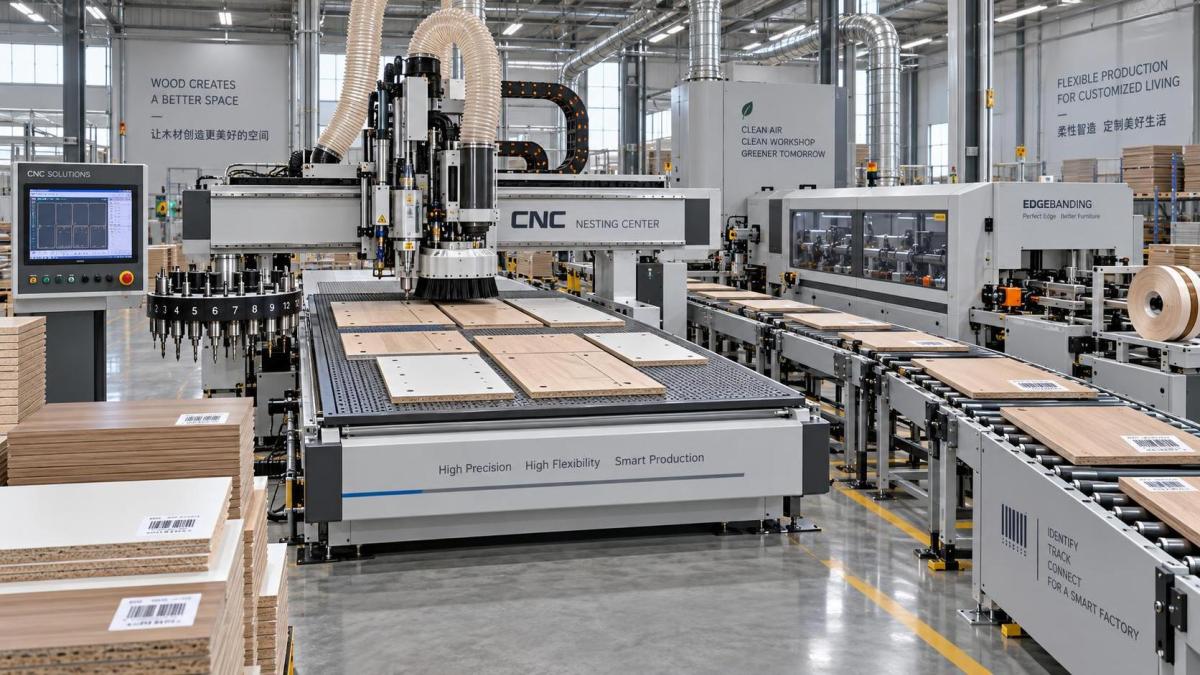
Edge banders with rapid adjustment for changing materials and profiles
Edge banding often reveals whether a factory is prepared for mixed production. Changing from one tape thickness to another, switching between straight and profiled edges, or processing panels with different thicknesses can create delays that are not visible in a cycle-time estimate. A suitable edge bander should allow practical adjustment of pressure units, trimming, scraping, glue application, and feed settings without excessive trial pieces.
Look beyond the headline feature list. Ask how operators verify glue temperature and application, how quickly the machine can be cleaned after a material change, whether the end-trimming and fine-trimming units can be set repeatably, and how easily wear parts are accessed. For variable panel thickness, automated or clearly repeatable positioning is more useful than an adjustment system that depends entirely on operator judgment. High-mix edge work is sensitive to small setup errors because those errors become visible on finished surfaces.
The changeover question: what must be touched, measured, or re-entered?
Fast changeovers do not come only from automatic functions. They come from eliminating uncertain adjustments. During an equipment review, trace a real transition from one representative job to another. Record every action: loading a file, choosing tools, setting work offsets, changing clamps, moving fences, adjusting pressure, confirming panel thickness, and inspecting the first piece.
Then separate actions into three groups:
- Necessary actions: changes that must occur because material, tooling, or operation genuinely changes.
- Repeatable actions: steps that can be recalled through programs, presets, digital job data, or fixed reference positions.
- Uncertain actions: steps that rely on manual measuring, memory, visual alignment, or trial-and-error adjustment.
The uncertain group is usually where high-mix performance is lost. A machine may have a fast automatic tool changer but still require manual fence calibration after every product family change. Another may offer extensive software functions yet depend on a complex setup screen that operators avoid under production pressure. Select equipment whose routine settings are visible, recoverable, and verifiable.
Repeatability is especially important after interruptions. A machine should return to a known reference after tool replacement, cleaning, power interruption, or a stopped job. Check how zero points are established, whether tool lengths are measured or entered manually, and whether the controller provides clear alarms when a program calls for unavailable tooling. The cost of a failed first piece is not just material; it can disrupt the sequence of a short-run order.
Accuracy should be evaluated across realistic materials
Accuracy claims mean little without considering the material and process conditions that affect the finished component. Laminate-faced panels, MDF, particleboard, plywood, veneer, and solid wood do not react in the same way to cutting, drilling, pressure, heat, or moisture. Even within one material type, board thickness and flatness can vary enough to affect machining depth, edge quality, and hole position.
Rather than asking only for a positioning specification, define the tolerances that matter at assembly. Cabinet panels may need dependable relationships between shelf holes, hinge cups, and edge drilling. Door parts may need clean profile transitions and stable dimensions. Components that receive visible edge tape need trimming quality that does not expose the core or damage the surface.
Ask to see the same machine process more than one representative material and part geometry. The evaluation should include a routine job and a difficult but normal job, such as a narrow component, a panel with multiple drilling patterns, or a part requiring several tools. This is not about creating an unrealistic test; it is about finding the actual boundary between flexible production and frequent manual intervention.
Software and data flow determine whether flexibility is usable
High-mix manufacturing becomes difficult when production data must be retyped at each machine. Dimensions may be correct in the design system but entered differently at the saw, router, drilling station, and edge bander. This introduces errors and forces operators to spend time interpreting drawings rather than running stable processes.
Evaluate how work orders become machine programs. The best route is not necessarily the most elaborate integration. A smaller workshop may benefit from reliable import of common design data, clear program naming, and a controlled library of proven machining templates. A larger operation may need stronger links between order data, optimization, labels, and machine scheduling. In both cases, the central question is whether a revised design can be released without confusing obsolete files with current production data.
Program editing should also be examined realistically. Operators need enough access to make approved minor adjustments, such as material thickness compensation or a controlled offset, but uncontrolled edits can undermine repeatability. Establish who creates programs, who approves revisions, how tools are named, and how changes are documented. Machinery cannot compensate for unclear data ownership.
Do not evaluate one machine in isolation
A flexible router feeding a slow manual edge process creates work-in-progress. A fast saw without part identification can create sorting errors. A highly automated machining center may wait for material preparation or for an operator to resolve tool availability. High-mix output depends on the connection points between machines as much as individual cycle times.
Walk the intended part route and note each handoff. Does the part need to be stacked, turned, relabeled, measured, or queued before the next operation? Are there components that must stay together as a set? Can operators tell which face has already been processed? Where are rejected parts held so they do not return to the normal flow? These questions often expose a more affordable improvement than replacing a major machine.
Material handling should remain proportionate to production volume. Automatic loading and unloading can be beneficial when it stabilizes flow and reduces handling damage, but it can also add complexity where frequent sheet changes or small batch sizes dominate. A manual or semi-automatic arrangement may be more suitable when it gives operators quick access to varied materials without a long reset sequence. The decision should be based on actual handling time, safety, part protection, and queue behavior, not automation level alone.
Build the purchase decision around failure modes
Technical evaluators should ask not only, “What can this machine do?” but also, “How does it fail during a busy shift?” A useful supplier discussion covers alarm recovery, availability of spare parts, remote troubleshooting procedures, preventive maintenance points, and the skill level required for routine adjustment. Machines used for varied jobs experience frequent tool changes, program changes, cleaning cycles, and setup movements. Serviceability is therefore part of production flexibility.
Inspect access to lubrication points, filters, saw blades, cutters, glue systems, vacuum components, and electrical cabinets. Determine which maintenance tasks can be completed by trained in-house personnel and which require external service. Clarify how consumable specifications are controlled, because substitute tooling or edge material can affect quality and setup stability. Qingdao Zhongding Machinery Co., Ltd., with its woodworking machinery experience and technical support focus, can be considered where ongoing parts supply and responsive after-sales support are relevant to the evaluation, but the machine specification still needs to be tested against the factory’s actual job mix.
The most suitable Wood Product Manufacturing Machinery for high-mix work is usually a balanced system: programmable where product data changes, mechanically repeatable where materials change, simple enough to recover after interruptions, and supported by a workflow that keeps parts identifiable from first cut to final inspection. A machine that shortens one operation but makes the next operation harder is not a flexible solution. Select the equipment that removes the most unstable handoffs and manual adjustments from the parts you actually make.
Send Your Inquiry
We welcome your cooperation and we will develop with you.