


News & Exhibitions
Latest Factory Updates, Industry Trends & Global Exhibition Information
How to match cabinet door processing machinery to door styles
Match the Machine to the Door, Not the Other Way Around
Selecting the right Cabinet Door Processing Machinery is essential for manufacturers seeking consistent quality, efficient production, and flexibility across shaker, slab, raised-panel, and custom door styles. The ideal equipment must reflect more than a target output figure. It needs to suit the materials being processed, the construction method of the door, the expected mix of styles, finishing requirements, available labor, and the level of automation that can be supported in daily operation.
A machine package can look capable during a supplier presentation yet become restrictive once a factory begins producing several door families in short batches. Conversely, a highly automated line may be difficult to justify when product specifications change frequently or when setup discipline is not yet mature. The practical question is not simply which machine is more advanced. It is which process will produce the required door style repeatedly, with manageable setup time and a realistic service burden.
With more than 20 years in woodworking machinery, Qingdao Zhongding Machinery Co., Ltd. has seen that cabinet door projects are strongest when equipment decisions begin with the finished door and work backward through each machining step. This approach reveals where precision matters most, where manual work remains sensible, and where automation can remove a genuine bottleneck rather than add complexity.
Start with Door Construction and Material Behavior
Cabinet doors may appear similar from the outside, but their production logic can be very different. A one-piece MDF routed door, for example, is not processed like a five-piece hardwood shaker door. A membrane-pressed profile door requires careful surface preparation before pressing, while a lacquered slab door may depend more heavily on clean panel sizing, edge quality, drilling accuracy, and sanding control.
Material choice changes the machinery requirement. MDF is uniform and well suited to profiling, routing, drilling, and decorative machining, but it creates fine dust and may require especially effective extraction and tool maintenance. Particleboard-faced panels can chip at edges if saw quality, scoring, feed settings, or tooling are poorly matched. Solid wood introduces grain direction, movement, knots, and variation in moisture condition. Veneered panels need careful handling because a machining error can damage a thin decorative surface that cannot easily be repaired.
Before comparing machine quotations, define the door construction in a form that production and engineering teams can both use:
- Panel dimensions, thickness range, and likely future size range
- Material types, surface finishes, and edge treatments
- Frame-and-panel, one-piece routed, slab, glass-frame, or mixed construction
- Joinery method, including cope-and-stick, dowels, mortise-and-tenon, screws, or connectors
- Hinge cup, handle, lock, or accessory drilling requirements
- Acceptable tolerance, surface quality, and rework limits
This document is more useful than a general request for “a cabinet door line.” It allows the machinery supplier to assess tool paths, workholding, loading direction, and whether different processes can reasonably be combined.
Shaker Doors: Repeatability Depends on Joint Accuracy
Shaker doors remain common because their clean lines work across many kitchen and furniture styles. Their apparent simplicity can be misleading. On a five-piece shaker door, rail and stile dimensions, groove position, cope profile, and assembly squareness all affect the final impression. A small mismatch at the joint becomes visible after painting or staining.
For smaller or more variable production, a practical setup may combine precision cutting, a spindle moulder or shaping solution, drilling equipment, and dedicated assembly fixtures. This arrangement can be flexible, particularly where door sizes and profiles change often. It does, however, place more responsibility on operators for reference-face control, cutter setup, and consistent feeding.
As volume rises, buyers often consider double-end tenoners, CNC machining centers, or specialized rail-and-stile processing solutions. The correct choice depends on whether the operation produces a limited set of repeating profiles or a large number of variations. Dedicated equipment can reduce cycle time for stable programs. CNC processing offers faster design changes and can consolidate multiple tasks, but nesting several operations into one machine does not automatically create the fastest workflow. Loading, unloading, tool changes, and part sorting still need to be considered.
For shaker production, ask suppliers to explain how the process maintains a common datum from cutting through profiling, drilling, and assembly. That is often more revealing than a nominal machine accuracy statement.
Slab Doors Need Clean Edges and Reliable Drilling
Slab doors are usually simpler to construct, but expectations for visual consistency are high. The door face is uninterrupted, so chipped edges, uneven edge banding, poor panel flatness, and misplaced drilling are easy to notice. For melamine, laminate, acrylic, PET, veneer, or painted MDF slab doors, the machinery focus is normally panel sizing, edge processing, boring, routing where needed, and material flow.
A panel saw, beam saw, CNC nesting machine, or other cutting method should be selected based on batch size, optimization needs, sheet handling, and edge-quality expectations. There is no universal winner. Nested-based production can support flexible, software-driven jobs and reduce manual layout work, while saw-based cutting may suit certain workflows that prioritize straightforward panel breakdown and downstream edge banding. The decision should include offcut handling, labeling, part identification, and how cut panels are queued for the next process.
Edge banding deserves close scrutiny. A door with a premium face material can still look low grade if glue lines are visible, corners are damaged, or trimming leaves a rough transition. Buyers should look beyond machine speed and review the edge banding unit configuration, panel thickness range, edge material range, trimming quality, cleaning requirements, and the conditions under which the quoted performance is achievable.
For hinge drilling and hardware placement, flexible boring and routing capability matters if door heights, overlay rules, or hardware brands vary. Confirm the drilling pattern from actual drawings. “Standard hinge drilling” can mean different things across markets and cabinet systems.
Raised-Panel and Profiled Doors Require More Than a Powerful Router
Raised-panel doors and deeply profiled MDF doors place greater demands on cutter selection, spindle stability, clamping, dust extraction, and finishing preparation. The visible profile may involve several tool passes, especially when the design includes an outer frame, inner contour, recessed field, decorative edge, or integrated handle detail.
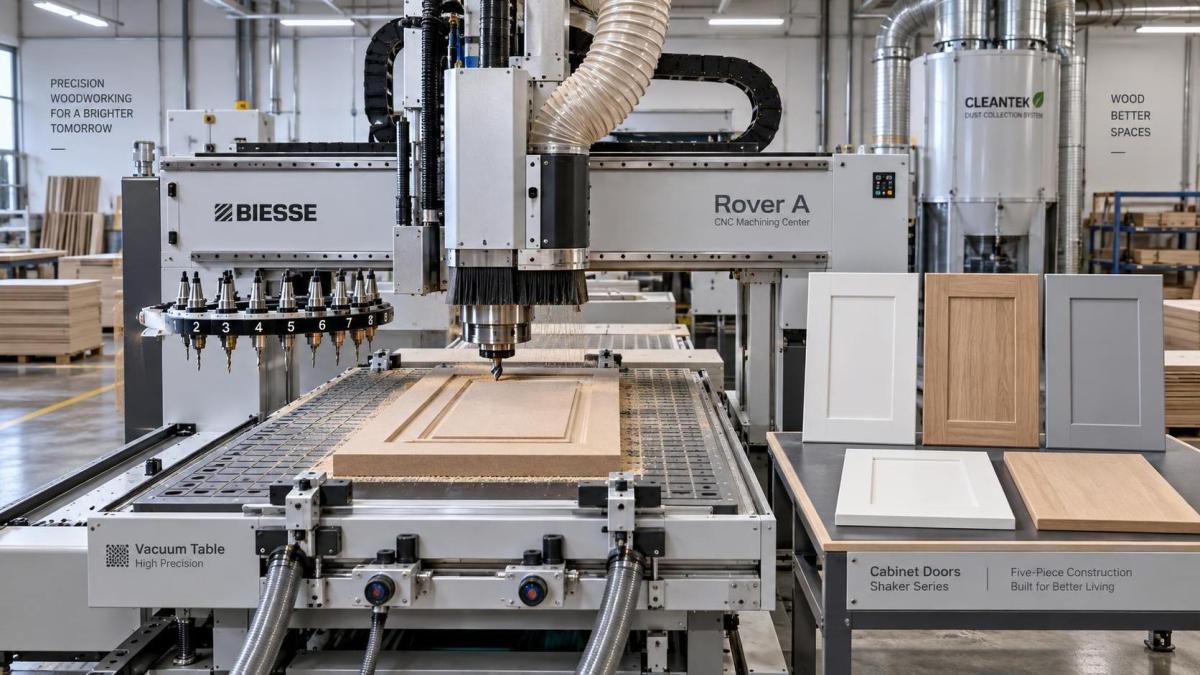
A CNC router or machining center is often appropriate where design variation is high, where custom patterns are needed, or where one machine must handle routing, drilling, grooving, and shaping. Yet buyers should not judge CNC suitability only by table size or spindle power. The actual questions are whether vacuum zoning holds the smallest and narrowest parts securely, whether the available tool magazine supports the intended profiles, whether the control system fits the programming capability of the team, and whether dust extraction can cope with the material removal rate.
For solid-wood raised panels, feed direction and tooling geometry influence tear-out, particularly around changing grain. A process trial using representative timber and the intended profile is more valuable than a generic demonstration. For painted MDF doors, the objective may be a clean routed surface that reduces filling and sanding work before finishing. The best machining result is therefore not always the fastest cycle; it is the result that minimizes downstream correction.
Automation Should Follow Product Stability
Automation can improve material movement, reduce handling damage, and make output more predictable. It can also create a line that is poorly suited to frequent order changes. A factory producing a narrow range of standard doors in sustained volume may benefit from automatic loading, transfer conveyors, return systems, labeling, and linked drilling or edge-processing stations. A workshop serving renovation work, custom sizes, and mixed finishes may obtain better returns from flexible stand-alone machines with disciplined work instructions.
The key is to measure the whole process, not the fastest individual machine. A high-output edge bander followed by slow manual sorting can merely move the queue downstream. Likewise, an automatic loader is only useful when panel condition, stack orientation, production scheduling, and safety procedures support continuous feeding.
When evaluating Cabinet Door Processing Machinery, map the route of a typical order: material receipt, cutting, edge processing or frame machining, drilling, sanding, assembly, inspection, and packing. Note where parts are touched, turned, identified, or stored. These points often expose the real constraints.
Questions That Prevent an Expensive Mismatch
A serious machinery review should include actual door drawings and a realistic production mix, not only idealized sample parts. Ask whether the proposed configuration can process the smallest and largest planned doors, including narrow rails, tall pantry fronts, and any parts with glass openings. Check whether clamps, rollers, vacuum cups, or fences interfere with the profile or drilling pattern.
Also examine the less visible parts of ownership. Tooling availability, electrical specifications, compressed-air quality, dust collection capacity, software compatibility, operator training, spare parts lead time, and remote technical support can shape uptime as much as the machine frame itself. If a line will be exported, local electrical requirements, guarding expectations, installation access, and import documentation should be clarified before shipment rather than during commissioning.
Avoid accepting a capacity claim without context. Output depends on door dimensions, process complexity, loading method, tool changes, material condition, and operator skill. A supplier should be able to distinguish between a machine’s theoretical cycle capability and the likely output of a complete production route.
Build a Process That Can Evolve
The most sensible investment is often modular. A manufacturer may begin with reliable cutting, profiling, drilling, and assembly capacity, then add automated handling or specialized processing when order volume and product standardization justify it. Leaving room for future integration is generally wiser than purchasing excess automation based on a forecast that has not yet become stable demand.
Qingdao Zhongding Machinery develops woodworking solutions with this production reality in mind. Having grown from a small workshop into a modern manufacturer and exporter, the company recognizes that machinery must remain practical after installation. Precision engineering matters, but so do technical support, spare parts access, operator familiarity, and the ability to adapt a process as door styles change.
Before making a final decision, provide the machinery partner with representative drawings, material samples, finish expectations, available factory layout, utility details, and the expected mix of door styles. A well-matched solution should make the next door program easier to launch, not lock the factory into yesterday’s design choices.
Send Your Inquiry
We welcome your cooperation and we will develop with you.