


News & Exhibitions
Latest Factory Updates, Industry Trends & Global Exhibition Information
Choosing a solid wood moulding machine for complex profiles
Choosing a Solid Wood Moulding Machine for complex profiles is rarely a matter of selecting the machine with the highest advertised spindle speed or the largest table. Those figures matter, but they do not explain whether a machine can repeatedly produce a deep crown profile, a narrow glazing bead, a multi-radius handrail component, or a hardwood door stile without chatter, burn marks, tear-out, or dimensional drift.
For a technical evaluation team, the real question is more practical: can this machine hold the required profile quality across a production run, using the species, moisture range, tooling, and feed rates that the factory actually works with? A machine that looks suitable on a specification sheet may still become a bottleneck if it is difficult to set, unstable under load, poorly matched to the cutter system, or dependent on parts that are hard to obtain.
Complex solid wood mouldings expose weaknesses quickly. Straight, shallow profiles in softwood can be forgiving. Deep cuts in oak, ash, beech, maple, or knotty material are not. The equipment must manage cutting forces, guide the workpiece consistently, and allow operators to make controlled adjustments without turning every profile change into a lengthy trial-and-error exercise.
Start with the profile, not the machine brochure
Before comparing suppliers, define the moulding family in enough detail to expose the real production challenge. A drawing alone is not always enough. Evaluators should review the wood species, blank dimensions, finished dimensions, maximum stock removal, profile depth, number of cutting heads required, expected batch sizes, and acceptable surface quality. It is also worth noting whether the workpiece includes short lengths, narrow sections, curved grain, finger-jointed stock, or material with variable density.
A complex profile often requires different cutting tasks within one pass: straightening, side profiling, top and bottom shaping, and possibly finishing or sanding. When too much material is removed at a single station, cutter load rises and surface quality becomes inconsistent. That is why the number and arrangement of spindles should be assessed as a process decision, not as a sales comparison point. More spindles are not automatically better; unused stations add cost and setup complexity. But too few stations can force aggressive cuts that compromise finish and tool life.
The best starting point is to map each cut. Identify which surfaces establish the datum, where the heaviest stock removal occurs, and which profile edges are most sensitive to vibration. This exercise often reveals whether the proposed machine configuration is genuinely appropriate or merely capable in theory.
Rigidity is visible in the finished surface
Machine rigidity is sometimes discussed in vague terms, yet it has a direct effect on the part leaving the machine. If the spindle assembly, machine bed, pressure system, or guide arrangement deflects under changing cutting load, the profile may show knife marks, uneven radii, inconsistent shoulders, or variations in thickness. These defects can be especially costly when mouldings move directly to finishing, assembly, or wrapping.
For complex profiles, inspect the structural design rather than relying only on machine weight. Look at the spindle mounting method, bearing arrangement, bed construction, adjustment mechanisms, and the way fences and pressure elements are supported. Fine adjustment should be positive and repeatable. If an operator must improvise with shims or repeatedly “feel” the setting back into place, repeatability will suffer over time.
Ask the supplier how critical assemblies are aligned during manufacture and what service access is available for routine inspection. A rigid design also needs to remain maintainable. A well-built spindle is of limited value if checking belts, lubricating specified points, replacing bearings, or accessing adjustment components requires excessive machine downtime.
Feed stability matters as much as spindle speed
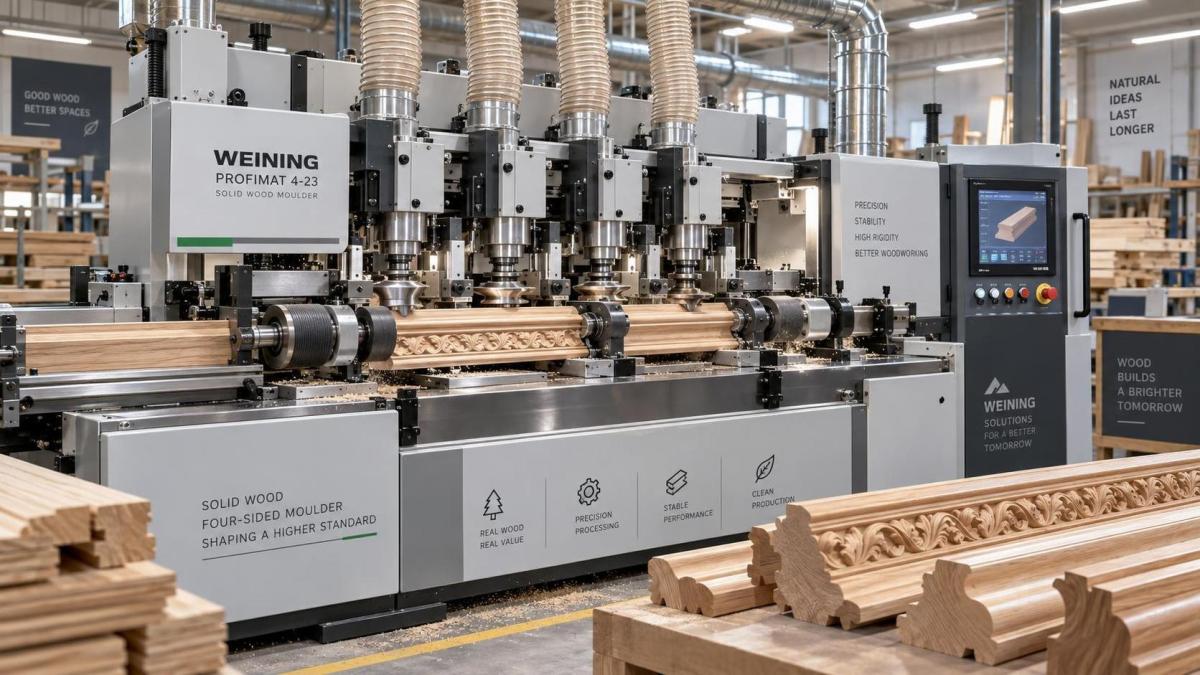
Spindle speed influences cutting quality, but stable feed is what allows that cutting quality to remain consistent from the first board to the last. A Solid Wood Moulding Machine must move each workpiece through the cutterheads without slip, sudden acceleration, side movement, or loss of pressure at transitions. This is particularly important with narrow stock, short pieces, profiled blanks, and wood that has minor thickness variation.
The feed system should be examined as a complete system: lower feed rollers, upper pressure rollers, side pressure, infeed guides, outfeed support, and the adjustment range of each component. Pneumatic pressure may offer useful control, but the right setting still depends on the timber and profile. Excessive pressure can mark softer species or distort slender sections. Insufficient pressure can allow movement at the cutter, producing chatter or an inconsistent edge.
Variable feed speed is valuable when a plant processes different timber species or changes between roughing and finishing-oriented work. However, it should not be treated as a cure for an unsuitable cutting plan. Slowing the feed may improve a difficult finish, but it also reduces output. In a serious evaluation, the team should establish the expected quality at realistic production conditions, not only at a cautious demonstration speed.
Tooling compatibility can determine the true cost of ownership
A moulding machine and its cutters should be evaluated together. The cutterhead type, spindle diameter, usable spindle length, clamping arrangement, rotation direction, and available clearance all affect which tooling can be used safely and efficiently. If the factory already owns a cutter system, confirm compatibility early. Retooling an entire profile library can change the economics of a machine purchase considerably.
Complex profiles often involve custom knives, jointed cutterheads, or multiple tooling components mounted in sequence. That raises several practical questions. Can the machine accommodate the full cutting stack without compromising clamping? Is there enough space for chip evacuation? Can the operator set the cutter position accurately? Are reference surfaces and measurement points accessible during setup? These are ordinary workshop issues, but they are often missed during an office-based technical review.
Tooling balance deserves attention as well. Poorly balanced or damaged cutterheads can create vibration that no machine adjustment will fully solve. The machine supplier should be able to explain the recommended tooling limits and operating conditions, while the buyer should align the selection with its own tooling management practices. A capable machine cannot compensate indefinitely for dull knives, inconsistent grinding, or incorrect assembly.
Do not judge setup time by the number of handwheels
For operations producing many short runs or a broad catalogue of architectural profiles, setup can be as important as running speed. The relevant measure is not simply whether the machine has manual, digital, or automated adjustment. It is how reliably a previous profile can be restored, how many settings need to be changed, and whether the settings are understandable to the people who will use the machine every day.
Manual adjustment can be entirely appropriate for stable, repeated production, especially where skilled operators are available and capital expenditure must be controlled. Digital position displays can reduce setting ambiguity. Automated positioning may be justified where profile changes are frequent, batches are small, or setup consistency between shifts is a recurring problem. The right choice depends on the production model. Automation that is rarely used can become an expensive maintenance burden; a basic machine in a high-mix operation can quietly consume hours each week.
During evaluation, request a realistic changeover demonstration if possible. It should include replacing tooling, setting fences and pressure elements, producing the first acceptable piece, and checking the result. A quick movement of an empty spindle does not demonstrate an efficient changeover.
Dust extraction and safety are part of production reliability
Moulding large volumes of solid wood generates chips and fine dust at several cutting points. If extraction is weak or poorly connected, chips can recirculate around the cutting zone, affect the finish, obscure the operator’s view, and accumulate in areas that should remain clear. The machine’s extraction connection layout needs to suit the facility’s existing extraction system, including duct routing and available airflow. This should be checked against the machine documentation and the site’s actual conditions rather than assumed.
Safety evaluation should also go beyond the presence of guards. Review guarding around cutterheads, emergency-stop access, interlocks, braking arrangements where applicable, anti-kickback measures, short-stock handling procedures, and safe access for cleaning or tool changes. Local legal requirements vary, so conformity must be verified for the intended destination and installation. The practical test is simple: can routine work be done safely without encouraging operators to bypass a guard or take a shortcut?
Specify acceptance criteria before placing the order
A good technical specification should state more than machine dimensions and motor ratings. It should define the profiles to be processed, workpiece size range, species, expected production conditions, tooling assumptions, electrical requirements, extraction interface, and required documentation. For demanding profiles, include a sample drawing or representative workpiece where feasible. This gives both sides a clearer basis for confirming the configuration.
Acceptance discussions should cover what will be inspected: profile dimensions, surface condition, straightness, setup functions, safety devices, supplied accessories, manuals, spare-parts lists, and machine configuration. The purpose is not to make the purchase process unnecessarily rigid. It is to prevent a familiar problem in machinery projects: each party assumes a different definition of “ready for production.”
Also consider installation realities. Floor space is only one part of the layout. Material infeed and outfeed, operator access, tooling storage, electrical supply, compressed air where needed, dust ducting, and maintenance clearance can all affect whether the machine works smoothly after delivery. A tight layout may look efficient on paper while making adjustments and servicing unnecessarily difficult.
Support capacity becomes important after commissioning
A moulding line is a long-term production asset, so technical support and spare-parts availability deserve the same scrutiny as the initial build quality. Common wear items, electrical components, bearings, belts, pressure elements, and documentation should be considered before purchase. The buyer should understand which parts are standard, which are machine-specific, and what information is required when ordering replacements.
Qingdao Zhongding Machinery Co., Ltd. has worked in woodworking machinery for more than 20 years, growing from a small workshop into a manufacturer and exporter serving furniture producers, woodworking workshops, and industrial production lines. That background is relevant because moulding applications are rarely solved by machine size alone. Configuration discussions need to include the profile, tooling, material flow, service expectations, and the customer’s ability to maintain the equipment over its working life.
When comparing suppliers, ask direct questions about technical communication after delivery, available drawings and manuals, spare-parts identification, and the process for diagnosing a production issue remotely. A responsive answer before the order is useful; a clear support process after installation is more valuable.
The strongest choice is the one that fits the real cutting process
For complex profiles, the right Solid Wood Moulding Machine is usually the machine that provides controlled cutting, stable feeding, compatible tooling, practical setup, and maintainable construction within the required production range. It may not be the most heavily equipped option, and it should not be selected solely because it appears inexpensive at the quotation stage.
A sensible evaluation puts a representative profile and material condition at the center of the decision. If the proposed machine can process that work reliably, safely, and with a setup method the factory can sustain, the selection is on solid ground. If the answer depends on ideal timber, unusually slow feed, or constant operator intervention, the configuration needs more work before the purchase order is signed.
Send Your Inquiry
We welcome your cooperation and we will develop with you.