


News & Exhibitions
Latest Factory Updates, Industry Trends & Global Exhibition Information
Why Line Scoring Integration Matters When Selecting a Beam Saw for Melamine Board Processing
Time:Sep 15, 2026
Author:Zhongding Buying Guide Editors
Number of views:
Line Scoring Isn’t Optional — It’s a Structural Requirement for Melamine Board Processing
Melamine-faced particleboard and MDF are not just “standard panels.” Their layered construction — a brittle, low-tensile-strength decorative surface bonded to a softer core — creates a specific failure mode during cutting: chipping at the cut edge, especially on the top face. This isn’t cosmetic. For project managers overseeing cabinet fabrication, interior fit-outs, or modular furniture production, edge quality directly affects assembly time, hardware tolerance, final finish acceptance, and rework rates. A beam saw that cuts cleanly *through* the panel but fails to control surface fracture along the kerf line delivers parts that require manual touch-up, slow downstream operations, and increase scrap risk — particularly when tight tolerances or visible edges are specified.
Conventional beam saws rely solely on blade geometry, feed speed, and vacuum hold-down to minimize chipping. In practice, this works inconsistently across panel batches, ambient humidity variations, and even minor resin formulation differences between suppliers. The root issue is mechanical: the blade’s lateral force initiates micro-fractures ahead of the cut path, and once initiated, those fractures propagate unpredictably into the melamine layer. Line scoring addresses this at the source — by creating a controlled, shallow groove (typically 0.3–0.6 mm deep) *before* the main cut, directly aligned with the intended cut line. This groove acts as a stress relief channel. When the main blade engages, the material fractures preferentially along this pre-defined path, not randomly across the surface.
Why Integration — Not Add-On — Makes the Difference
Some manufacturers offer line scoring as an optional retrofit or separate module. That approach introduces critical timing and alignment risks. If the scoring head isn’t mechanically synchronized with the main saw carriage — if its position drifts even 0.1 mm relative to the cut line due to thermal expansion, bearing wear, or calibration error — the score line misses its target. The result? A visible offset between the scored groove and the cut edge, which defeats the purpose and can actually worsen edge quality by introducing dual fracture zones.
True integration means the scoring unit shares the same rigid beam structure, linear guide system, and CNC motion controller as the main saw. Both tools move in unison, with positional feedback from a single encoder system. This eliminates cumulative error and ensures sub-millimeter repeatability across thousands of cuts. It also simplifies setup: operators define one cut path in the nesting software, and the machine automatically sequences scoring then cutting without manual intervention or secondary alignment steps. For project managers managing multiple job files with varying panel thicknesses and grain directions, this consistency reduces programming time and operator dependency.
Real-World Implications for Procurement Decisions
When evaluating a beam saw for melamine board, line scoring integration isn’t a feature to check off a list — it’s a functional prerequisite tied directly to output quality and process reliability. Here’s what procurement teams should verify beyond marketing claims:
- Tool mounting rigidity: Is the scoring unit bolted directly to the main beam frame, or mounted on a separate sub-structure that may flex under load?
- Drive synchronization: Do both the scoring wheel and main blade use the same servo motor and drive electronics, or separate controllers that could desynchronize over time?
- Calibration protocol: Does the machine support automated zero-point calibration for the scoring depth and lateral offset, or does it require manual micrometer adjustment and test cuts?
- Depth control resolution: Can scoring depth be adjusted in increments finer than 0.05 mm? Melamine layers vary in thickness; too shallow fails to control fracture, too deep risks compromising structural integrity near the edge.
A common oversight is assuming all “CNC beam saws” handle melamine equally well. In reality, machines designed primarily for solid wood or thick plywood often lack the fine-tuned motion control and tool rigidity needed for consistent scoring. Their acceleration profiles may be too aggressive for delicate surface scoring, causing vibration-induced wander. Project managers should request sample cuts — not just on standard 18 mm panels, but on thinner 9 mm boards and high-gloss finishes where edge integrity is most vulnerable.
The Role of Working Width: Why 2600 mm Matters Beyond Capacity
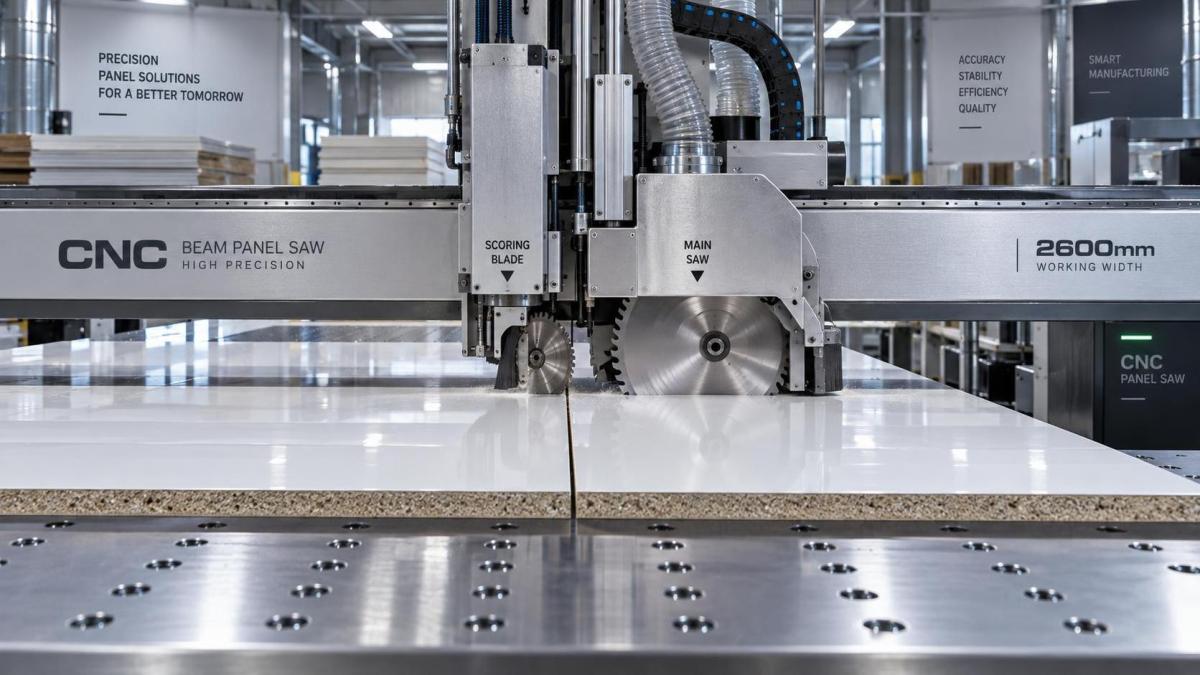
Working width isn’t just about fitting large sheets. For melamine processing, a 2600 mm beam saw offers tangible advantages in stability and precision. A longer beam increases torsional rigidity, reducing deflection during high-speed traverses — critical when maintaining micron-level alignment between scoring and cutting paths. It also allows wider spacing between vacuum pods, improving hold-down force distribution across large-format panels without excessive suction points that distort thin substrates.
More importantly, 2600 mm accommodates full-size European-standard melamine sheets (2800 × 2070 mm) with sufficient overhang for clamping and safe operation. Machines with narrower beams force users to either rotate sheets (introducing angular misalignment risks) or trim oversize sheets before processing — adding a non-value-adding step that increases handling time and potential for damage. For projects involving repetitive layouts — such as standardized kitchen cabinet carcasses or office partition systems — this working width translates directly into fewer sheet rotations, less operator fatigue, and tighter nesting efficiency.
Material Handling and Edge Quality Are Interdependent
Line scoring’s effectiveness depends on how the panel is presented to the machine. Vacuum hold-down must be uniform and sufficient to prevent lifting or vibration during scoring — a light, high-speed pass that generates minimal force but requires absolute stability. Panels with warped edges or uneven backing layers can lift slightly under vacuum, causing inconsistent scoring depth. This is where integrated material handling becomes part of the solution: feed rollers with adjustable pressure, segmented vacuum zones that activate only under supported areas, and real-time tension monitoring help maintain flatness throughout the cycle.
Also overlooked is the interaction between scoring and post-processing. If panels are destined for edge banding, the scored line must align precisely with the banding machine’s reference edge. A misaligned score creates a visible step or gap after banding, requiring sanding or rework. Integrated beam saws with synchronized tool positioning eliminate this variable — the same datum point defines both the cut line and the score line, ensuring dimensional continuity across the entire workflow.
Operational Risk vs. Upfront Cost
The upfront cost premium for integrated line scoring is often justified not by faster cycle times alone, but by reduced downstream risk. Rework costs for edge chipping aren’t isolated to labor — they include material waste (a single rejected cabinet side panel wastes 1.5 m² of melamine), delayed handover to installers, and potential contractual penalties for non-conforming deliveries. In high-volume residential fit-out projects, even a 0.5% reduction in edge-related rejection rate can offset the equipment premium within 12–18 months.
Procurement decisions should weigh total cost of ownership, not just capital expenditure. Ask suppliers for documented evidence — not just lab tests, but field data from similar applications — showing edge quality consistency across shifts, panel suppliers, and environmental conditions. Request validation protocols: How is scoring depth verified daily? What maintenance intervals apply to scoring wheels? How is alignment between scoring and cutting paths checked and corrected?
Selecting a System That Delivers Consistent Output
For project managers responsible for delivering finished interiors on schedule and specification, line scoring integration isn’t a technical detail — it’s a built-in quality assurance mechanism. It shifts edge quality control from a reactive inspection step to a proactive, repeatable part of the cutting process. When evaluating options, focus on mechanical integration, calibration transparency, and real-world performance under variable conditions — not just nominal specifications.
A beam saw for melamine board like the MJ6226 demonstrates how these principles translate into physical design: rigid monoblock beam construction, shared motion control architecture, and dedicated vacuum zoning calibrated for thin-faced panels. Its 2600 mm working width supports standard sheet formats while maintaining beam stiffness, and its scoring unit mounts directly to the primary structural frame — eliminating independent motion variables. These are not incremental improvements. They reflect a design philosophy centered on eliminating variability at the point where material meets tool — where edge quality is decided, not inspected.
Send Your Inquiry
We welcome your cooperation and we will develop with you.