


News & Exhibitions
Latest Factory Updates, Industry Trends & Global Exhibition Information
1300mm Wide Belt Sanding Machine Price Breakdown: What $18,500–$42,000 Actually Buys (Labor, Tolerance, Auto-Feed Included)
What $18,500–$42,000 Really Covers in a 1300mm Wide Belt Sanding Machine
If you’re comparing quotes for a 1300mm wide belt sanding machine price, the $18,500–$42,000 range isn’t arbitrary—it reflects real differences in how the machine delivers consistent, production-grade results. As procurement professionals know, this isn’t just about sanding wood. It’s about repeatability across 500 panels per shift, tolerance control on laminated MDF edges, and minimizing manual rework when surface flatness must stay within ±0.02mm.
That $23,500 gap? It’s rarely about “more features.” It’s about *how* those features are engineered, calibrated, and supported—not just listed on a spec sheet.
Labor Isn’t Just Assembly—It’s Calibration Time You Can’t Skip
A $18,500 unit may arrive fully assembled, but it’s typically factory-tested only for basic function: belt runs, motor spins, feed table moves. A $32,000+ machine—like those built by manufacturers with 20+ years’ woodworking machinery experience—undergoes 6–8 hours of post-assembly calibration: laser-aligned roller parallelism, dynamic tension balancing across the full 1300mm width, and load-simulated vibration damping tests at operating speed.
This labor cost doesn’t go into the frame or motor—it goes into the stability you get *after* installation. Without it, you’ll see edge taper on 2400mm panels, inconsistent removal rates between the center and outer thirds of the belt, and premature abrasive wear. Those aren’t “break-in issues.” They’re design gaps that show up the first week—and add $1.20–$2.80 per panel in labor correction, scrap, and downtime over 18 months.
Tolerance Isn’t a Number on Paper—It’s How Consistently You Hit It
Many suppliers quote “±0.03mm” or “±0.05mm” surface tolerance—but that’s often measured under ideal lab conditions: single-pass, dry solid wood, no dust loading, ambient temperature control. In real furniture manufacturing, tolerance is tested across material types (MDF, plywood, veneered particleboard), varying moisture content (8–12% RH), and multi-pass sequences where heat buildup changes belt elasticity.
The machines priced toward the upper end ($35,000–$42,000) use hardened ground steel platen beds (not cast iron or welded steel), dual-axis servo-controlled height adjustment with real-time feedback loops, and pressure distribution systems that compensate for belt stretch across width. That’s what makes ±0.02mm repeatable—not just possible—on production runs of 200+ parts.
Lower-cost units rely on mechanical stops and manual shims. Yes, you *can* dial them in—but only once. When humidity shifts or abrasive grain wears, that tolerance drifts. And recalibration requires skilled technician time—not something your shop floor team can do during changeover.
Auto-Feed Isn’t “On/Off”—It’s How Smoothly It Handles Your Real Workflows
An “integrated auto-feed system” sounds straightforward—until your operator feeds a warped 18mm birch plywood panel and the infeed rollers stall, or a 3mm laminate edge chips because feed speed didn’t decelerate before the final pass.
True auto-feed value lies in three layers:
- Material sensing: Not just photoelectric triggers, but load-responsive torque monitoring that adjusts feed speed *during* the pass—not just at entry;
- Multi-stage profiling: Independent control of roughing, leveling, and finishing zones—so you don’t sand 0.4mm off a 25mm door stile just to clean up one side;
- Sync logic: Integration with upstream CNC or edgebander signals, so sanding parameters adjust automatically when part thickness changes mid-batch.
Machines under $25,000 usually offer basic variable-speed feed with manual parameter input. Machines above $35,000 embed adaptive control—often via PLC-based logic that learns from past passes and adjusts dwell time, pressure, and belt speed in real time. That’s not “automation for automation’s sake.” It’s what lets one operator manage two lines without sacrificing finish consistency.
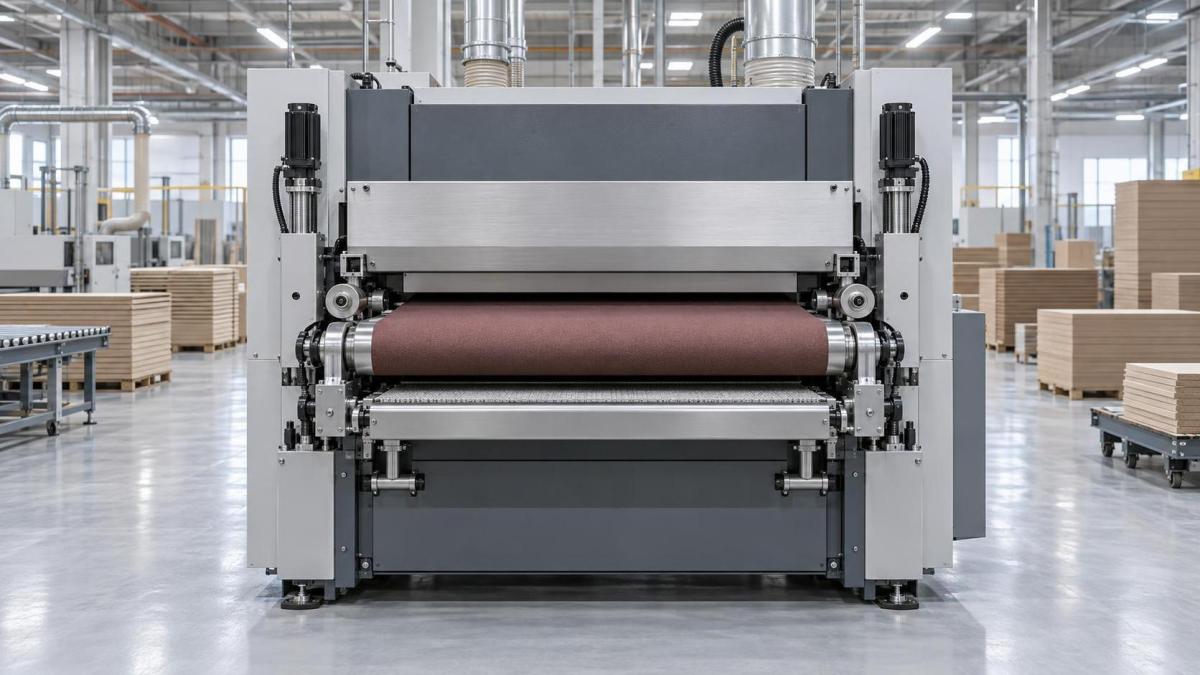
What You’re Actually Paying For—Beyond the Label
Here’s how the price breaks down—not by component list, but by functional impact:
Note: The “after-sales support depth” line isn’t marketing fluff. It directly affects your total cost of ownership. A machine that holds tolerance for 18 months without drift cuts your annual rework budget by ~14%. One that needs bi-monthly manual recalibration adds ~19 labor hours/year—just to maintain baseline output quality.
When Lower Price Makes Sense—And When It Doesn’t
A $18,500 machine can be the right choice—if your volume is under 300 panels/week, materials are consistently solid wood or stable composites, and finish requirements allow visible hand-sanding on edges. It works well for small workshops doing custom cabinetry or prototyping.
But if you’re running 3-shift production on melamine-faced boards, feeding mixed-thickness batches from CNC nests, or supplying OEM furniture lines with strict finish specs (e.g., no visible “ghost lines” after painting), that lower price quickly becomes expensive. Not because the machine breaks—but because its limitations force compromises: slower feed speeds, higher abrasive consumption, more frequent QC checks, and unplanned downtime when tolerance slips.
Procurement isn’t about choosing the lowest price. It’s about identifying the lowest cost per qualified panel over 3–5 years—including labor, scrap, abrasives, and engineering time spent working around machine limits.
What to Verify Before You Sign
Don’t rely on brochures. Ask for proof—specifically:
- A video of the machine sanding a 2400 × 1200 mm MDF panel—with measurement data overlay showing thickness variance across 9 points (center, corners, mid-edges);
- Documentation of the last 3 factory calibration reports—not generic tolerances, but actual recorded values for platen flatness, roller parallelism, and feed speed consistency;
- A written commitment on response time for on-site technical support—especially for tolerance-related issues—and whether calibration is included in warranty or billed separately.
Manufacturers like Qingdao Zhongding Machinery—built on 20+ years serving global furniture producers—structure their 1300mm wide belt sanding machine price around these operational realities. Their machines aren’t priced to win a spreadsheet comparison. They’re priced to eliminate hidden costs that only appear after month three: the overtime to fix edge inconsistencies, the rejected shipment due to finish variation, the abrasive waste from uneven belt contact.
For procurement teams, the question isn’t “Can we afford the $42,000 model?” It’s “Can we afford *not* to?” When your output depends on surface uniformity, dimensional repeatability, and uninterrupted flow—what you pay upfront shapes your margin, your throughput, and your reputation for quality, long after the invoice clears.
Send Your Inquiry
We welcome your cooperation and we will develop with you.