


News & Exhibitions
Latest Factory Updates, Industry Trends & Global Exhibition Information
Which solid wood furniture machines suit short production runs?
A batch of dining tables may be followed by custom cabinet doors, then a small order of chairs with a different timber species and joint design. In this environment, the fastest machine on paper is not necessarily the most productive machine on the workshop floor. Setup, tooling changes, trial pieces, and material handling can consume more time than cutting.
For manufacturers evaluating solid wood working machinery for furniture, the strongest starting point is usually a flexible group of saws, surface planers, thickness planers, spindle moulders, and joint-making equipment. CNC machining becomes attractive when part complexity, recurring designs, or demanding positioning requirements justify programming and workholding costs. The decision should follow the product mix—not a general preference for either manual machines or automation.
Start with the batch, not the machine specification
“Short production run” describes more than a small quantity. Twenty identical table legs repeated every month present a different investment case from twenty unique components that will never be ordered again. Before comparing machines, separate your work into three categories:
- Recurring small batches: repeat designs where stored settings, reusable fixtures, and saved CNC programs reduce future preparation.
- Product families: components with common thicknesses, profiles, or joints that can share tooling and setup references.
- One-off custom work: irregular jobs where straightforward adjustment and operator access may matter more than automatic cycling.
Then identify the operation causing delays. Is it preparing rough timber, changing profiles, locating mortises, or sanding away machining defects? Buying additional cutting capacity will accomplish little if parts spend most of their time waiting for a skilled operator to reset another machine.
Which machines deserve a place on the shortlist?
The following comparison shows where common solid wood furniture machines fit. These are selection guidelines rather than a prescription for every factory.
Saws: buy repeatability before headline cutting speed
For varied furniture orders, a well-specified sliding table saw can offer useful flexibility for dimensioning prepared stock and cutting components. Rough solid timber may also require dedicated ripping and crosscutting equipment, depending on board condition and workflow. A panel-processing configuration should not automatically be assumed suitable for every rough-timber operation.
Look closely at fence adjustment, stop positioning, blade access, and safe support for the longest pieces you process. Digital position displays or programmable stops can reduce measuring errors, particularly when operators frequently return to previous dimensions. Their value lies in repeatable setup rather than automation alone.
An optimizing crosscut system is worth considering when cutting volume and material recovery justify its preparation and handling requirements. For occasional, highly variable cutting lists, a simpler arrangement may be easier to keep productive.
Planers: consistent blanks make every later setup easier
A surface planer establishes a flat face and a straight reference edge; a thickness planer brings stock to a consistent thickness relative to the prepared face. The distinction matters. Feeding distorted boards through a thickness planer alone does not reliably create properly referenced furniture blanks.
Separate machines allow preparation stages to operate independently. A combination machine can conserve floor space in a smaller workshop, but conversion between functions may interrupt work. Compare those changeover minutes against available space, staffing, and how often timber preparation occurs.
Evaluate cutterhead options using your actual species, grain patterns, and finish requirements. Insert cutterheads may offer maintenance or surface-quality advantages in some applications, but they do not eliminate tear-out. Stock condition, cutting direction, feed settings, and sharp tooling remain important.
Spindle moulders and joint-making machines: flexible, with the right references
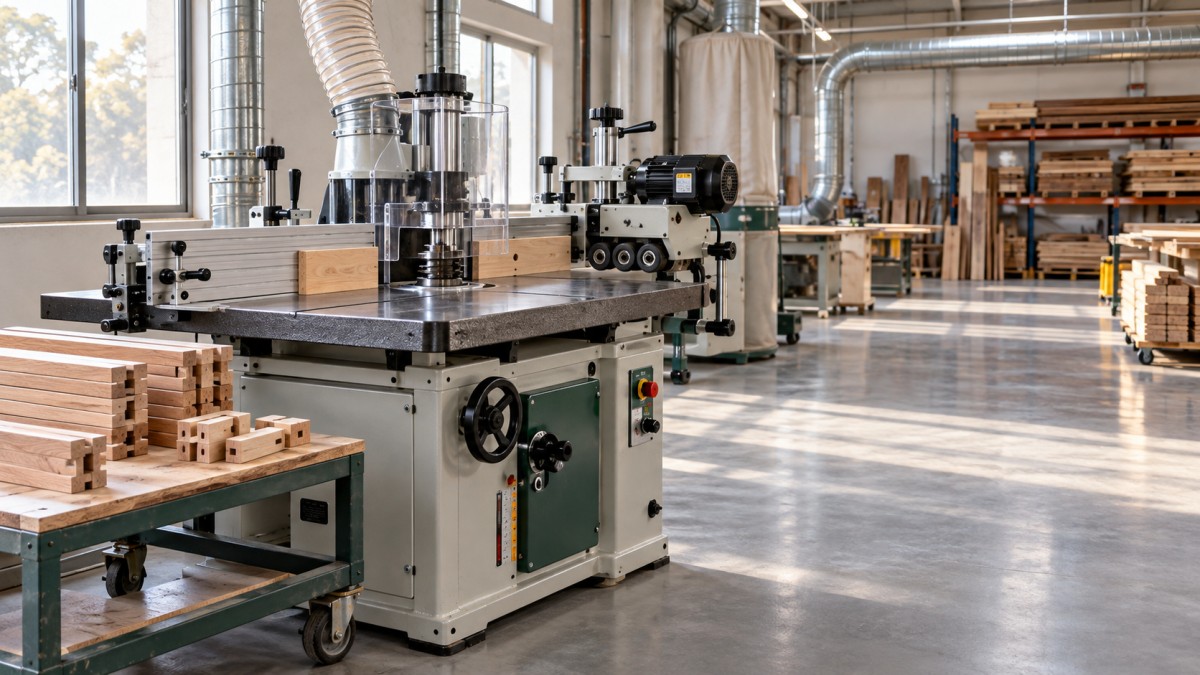
A spindle moulder is often valuable for short runs because one machine can perform several profiling and edge-machining tasks with suitable tooling. However, this flexibility only translates into productivity when operators can restore spindle height, fence position, and feed settings without lengthy trial-and-error adjustment.
Assess power-feed compatibility, spindle arrangements, tooling access, and the guarding required for each intended operation. Tenoning should only be considered with an appropriate machine configuration, tooling, support, and safety provisions—not as an assumed capability of every spindle moulder.
For mortise-and-tenon construction, a dedicated mortiser or tenoner can outperform a more versatile machine when joints repeat across product families. The deciding question is whether the equipment removes a recurring bottleneck or merely adds another setup station.
Where CNC earns its place—and where it does not
CNC equipment is especially useful when a component combines several machining features: curved outlines, pockets, drilled holes, and accurately located joints. Completing compatible operations in one controlled setup can reduce repeated measuring and repositioning.
That does not make CNC the automatic answer to every small batch. A straightforward rebate on a few rails may be quicker on a prepared spindle moulder than on a CNC machine requiring a new program and fixture. Conversely, a recurring chair component with multiple angled features may strongly favor CNC, even at modest quantities.
Workholding deserves as much attention as spindle power. Solid wood parts may be narrow, curved, uneven, or too small for straightforward vacuum holding. Pod-and-rail arrangements, mechanical clamps, vacuum fixtures, or dedicated jigs may be appropriate depending on the component. Each introduces access, collision-clearance, and preparation considerations.
Before selecting a machine, establish:
- Whether the proposed configuration can reach every required feature without excessive reclamping.
- How small and narrow components will be secured against machining forces.
- Whether software supports the intended designs and connects reliably with the machine controller.
- Who will create programs, maintain tool data, and recover production after an error.
- How saved programs and fixtures will be identified when repeat orders arrive.
A four-sided planer or moulder also deserves attention when recurring orders share standard sections. It can combine several operations into one pass. Yet frequent profile changes, numerous short components, or very small quantities may weaken the case. Test the complete changeover, including cutter preparation and first-piece inspection.
Judge solid wood working machinery for furniture by changeover performance
Ask suppliers to demonstrate a transition between two representative jobs rather than showing one machine running continuously on an easy component. The transition reveals what the production brochure cannot.
Measure the route to the first acceptable part
Start timing when the previous job ends. Include tooling removal, cleaning, adjustments, program loading, fixture installation, trial machining, and inspection. Stop only when an acceptable part is ready for production. This is a more useful short-run measure than cutting speed alone.
Also observe who performs the work. A changeover that depends entirely on one highly experienced technician may become a scheduling constraint. Clear setting references, documented procedures, and practical operator training reduce that dependence.
Check accuracy after resetting—not just during a stable run
Ask for the same dimension or profile to be produced again after the machine has been changed to another job. For small-batch furniture production, returning reliably to a previous setting is often more valuable than holding a dimension during a long uninterrupted run.
Inspect assembled joints as well as individual parts. A mortise and tenon can each appear acceptable separately yet fit poorly together. Agree on tolerances from the product drawing and assembly requirements rather than relying on a generic machine accuracy claim.
Use your timber and realistic component sizes
Trial material should reflect the species, moisture condition, grain variation, and dimensions used in production. Small furniture parts can expose feeding and clamping limitations that remain hidden during demonstrations on large blanks. Confirm the manufacturer’s minimum workpiece dimensions and required support arrangements.
Compare cost per accepted batch, not purchase price alone
A lower-priced machine can become expensive if every order needs prolonged adjustment or extensive hand finishing. Equally, expensive automation may remain underused when programming and fixture preparation outweigh the time saved.
Build the comparison around a representative mix of orders. Include machine purchase or financing, tooling, fixtures, software, installation, extraction, electrical requirements, training, maintenance, and expected spare-parts needs. Add operator time for preparation, machining, handling, inspection, and rework.
A practical calculation is:
Cost per accepted part = total allocated batch cost ÷ number of acceptable parts produced.
Keep the costing basis consistent between alternatives. Test it against several batch sizes and realistic utilization levels. This exposes whether an investment remains sensible when orders are smaller than expected or the product mix changes.
Do not overlook supporting systems. Dust extraction, compressed air where required, safe handling space, and accessible tool storage affect daily output. A capable machine squeezed into an awkward layout can create queues instead of removing them.
Choose a supplier who can explain the complete workflow
For enterprise buyers, machine selection also involves implementation risk. Ask who handles commissioning, what training covers, how replacement parts are identified, and how technical problems are diagnosed. For imported equipment, confirm documentation, electrical compatibility, applicable safety requirements, and service arrangements before ordering.
Qingdao Zhongding Machinery Co., Ltd. manufactures and exports woodworking machinery, drawing on more than 20 years of industry experience. Its focus on woodworking solutions, technical support, spare parts supply, and after-sales service is relevant to buyers evaluating both individual machines and coordinated workshop investments.
The most useful supplier discussion begins with component drawings, timber specifications, batch quantities, and a description of current delays. Request an application-based recommendation and a representative trial, rather than choosing from a machine list alone.
A practical investment sequence
For a workshop producing varied tables, cabinets, and occasional custom pieces, reliable stock preparation, accurate sawing, flexible profiling, and appropriate joint-making equipment usually form the foundation. Add CNC when recurring complexity or positioning demands create a clear return. Consider dedicated or multi-operation equipment when common sections and repeat orders provide enough work to support it.
The best machine for short production runs is not necessarily the most versatile or the most automated. It is the one that moves your actual components from setup to accepted production with less uncertainty—and still makes sense when the next order looks different.
Send Your Inquiry
We welcome your cooperation and we will develop with you.