


Two ATC CNC routers may look similar yet carry very different price tags, and spindle specifications can explain a meaningful part of that gap.
For procurement teams comparing ATC CNC router price, rated power alone is insufficient. Torque, speed range, cooling, tooling interface, and service support also affect value.
A spindle upgrade can add modest cost or require wider system changes. Its value depends on your materials, cutting requirements, operating hours, and production constraints.
This guide explains which specifications justify higher spending, how to compare quotations fairly, and what evidence helps prevent unnecessary upgrades or costly under-specification.
How much of the price difference actually comes from the spindle?
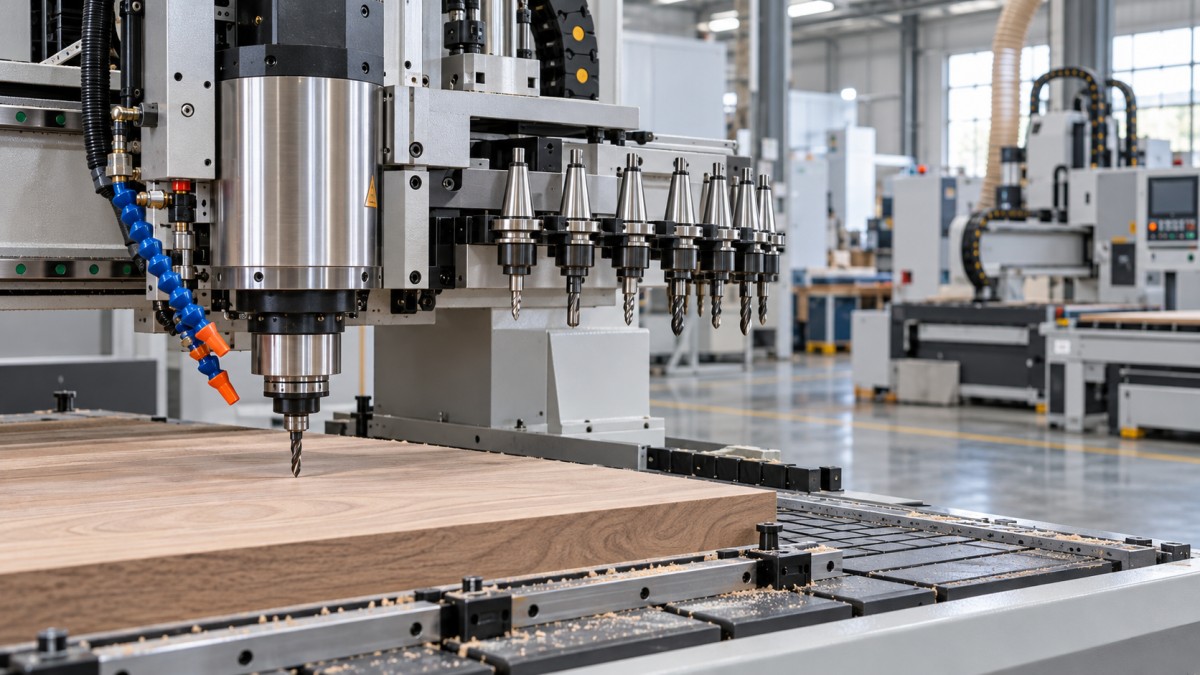
There is no dependable universal percentage. The spindle’s contribution varies with the machine configuration, supplier pricing, accessory package, and components needed to support it.
A spindle upgrade may also require a larger inverter, different electrical components, additional cooling equipment, or changes to the spindle mounting and toolholding arrangement.
Consequently, the useful purchasing question is the incremental cost of a complete, usable upgrade, including any supporting equipment and commissioning included in the quotation.
For illustration, assume an otherwise identical router costs $30,000, while its upgraded spindle package adds $3,000. The upgrade increases the machine price by 10%.
If that package instead adds $6,000, the increase becomes 20%. These hypothetical figures explain the calculation; they are not market benchmarks or supplier quotations.
Ask each supplier to quote the same base machine with two spindle options. Require an itemized explanation of every component that changes between configurations.
This comparison separates spindle spending from differences in table design, vacuum equipment, servo systems, controllers, or tool magazines that can otherwise distort the apparent premium.
Which spindle specifications deserve a higher budget?
Specifications deserve additional investment when they support a measurable production requirement. Start with the workpiece and cutting process, then assess the spindle features below.
Power matters most when the process can use it
Higher rated power can help with demanding cuts, but it does not automatically increase output. Tooling, machine rigidity, workholding, and feed capability also set limits.
For sheet processing, compare configurations such as 9 kW and 12 kW only after defining board material, thickness, cutter diameter, cutting depth, and target feed.
When cycle time is dominated by drilling, handling, or tool changes, extra spindle power may produce little improvement in the number of finished parts.
Torque at cutting speed matters more than the headline rating
Two spindles with the same power rating may behave differently at lower speeds. Larger cutters and certain hardwood operations can expose this difference quickly.
Request the torque-speed curve and identify whether quoted power is continuous output or a short-duration maximum. Compare ratings under equivalent operating conditions and duty definitions.
Speed range should match the tools you actually use
A high maximum speed can suit small cutters, but it offers limited value when your regular tooling operates below that speed for most jobs.
Ask suppliers to confirm permitted tool speeds and recommended cutting parameters. The spindle, toolholder, collet, and cutter must all support the proposed operating conditions.
Does air cooling or liquid cooling offer better value?
Neither cooling method is automatically the better purchase. Compare the complete installation, expected workload, workshop environment, and maintenance resources available at your production site.
Air-cooled designs can simplify installation by avoiding a separate coolant circuit. However, fan noise, airflow requirements, and exposure to workshop dust still need consideration.
Liquid-cooled designs require a properly specified cooling circuit. Depending on the package, buyers may need a chiller, hoses, coolant, filtration, and additional installation work.
Evaluate total noise under cutting conditions, because extraction equipment and cutting action can dominate workshop noise even when the spindle itself operates relatively quietly.
For either design, request permitted ambient temperatures, required maintenance, and the response to cooling failure. These details matter particularly during sustained operation or hot weather.
Check whether the quoted package includes every cooling component needed for your site. A lower machine price can lose its advantage after installation extras.
How much do the tooling interface and spindle brand matter?
The tooling interface affects more than spindle purchase cost. It influences holder availability, tooling investment, maintenance practices, and compatibility with the automatic tool changer.
ISO30 and HSK-F63 are examples encountered on woodworking equipment. Their suitability depends on the exact spindle design, machining demands, tooling ecosystem, and machine configuration.
An interface change may require new holders and tool-change hardware, making the complete upgrade substantially more expensive than the difference between two spindle units.
Ask about maximum tool weight, diameter, length, and any restrictions on adjacent magazine positions. These limits can affect aggregate tools and larger profile cutters.
Brand premiums should be assessed through documented performance and support. A familiar name alone does not establish the suitability of a particular spindle model.
Request the exact model designation, warranty coverage, repair options, and replacement lead time. Confirm whether local technicians can diagnose faults and perform authorized repairs.
For a heavily utilized router, faster service access may justify higher initial spending. For lighter workloads, a lower-cost option may provide sufficient documented performance.
Which spindle package fits your production workload?
Start with representative jobs rather than the most demanding theoretical application. A purchase specification should reflect recurring production and realistic growth over the ownership period.
Furniture panels and cabinet components
For MDF, particleboard, and plywood nesting, evaluate achievable feed rates alongside vacuum holding, extraction, cutter geometry, and edge quality on your actual board grades.
Thin parts and small components may lose holding force before spindle power becomes limiting. In that situation, improving workholding can deliver greater practical value.
Solid wood and larger profile cutters
Hardwood profiling and larger-diameter tools deserve closer attention to available torque, permitted speeds, holder stiffness, and cutting stability at the required depth of cut.
Request a demonstration using comparable material and tooling. Listen for unstable cutting, inspect the finished surface, and confirm that operating loads remain within limits.
Long shifts and mixed production
For extended operation, prioritize continuous-duty capability, thermal behavior, maintenance access, and support response. Short demonstrations cannot fully establish suitability for sustained daily production demands.
For varied batches, tool-change reliability and usable tooling capacity may affect output more than additional spindle power. Evaluate the complete cycle for representative parts.
Record current bottlenecks before choosing upgrades. This prevents procurement teams from paying to increase cutting capacity when loading, unloading, or downstream processes constrain output.
Will the spindle upgrade pay for itself?
Evaluate the upgrade against usable business benefits: additional saleable output, lower outsourcing costs, reduced rework, or fewer production interruptions supported by credible operating evidence.
Use contribution margin for additional output, rather than sales revenue. Deduct incremental tooling, electricity, maintenance, and labor costs when estimating the net annual benefit.
For example, assume a spindle package costs an additional $4,000 and generates $2,500 in annual net benefit. Its simple payback period is approximately 1.6 years.
If the same upgrade delivers only $800 annually, simple payback extends to five years. Both examples are illustrative and depend on verified production assumptions.
Capacity improvements have financial value only when demand exists and subsequent processes can absorb the output. Include expected utilization when estimating additional production benefits.
Do not assume a higher-power spindle continuously consumes its rated output. Compare energy use through representative cutting cycles, including cooling equipment and other changed auxiliaries.
Also consider downtime exposure. Confirm replacement availability and repair arrangements, then assess potential disruption against your production schedule, spare capacity, and alternative machining options.
What should procurement teams require before approving the quotation?
A useful quotation should connect every proposed spindle feature to a production requirement. General claims such as “high performance” provide little basis for purchasing decisions.
Use the following checklist to compare suppliers consistently and capture costs that may otherwise appear only after the purchase order has already been issued.
- Exact spindle manufacturer, model, rated output, duty definition, speed range, torque data, and inverter specification.
- Cooling equipment, electrical requirements, installation scope, and any site preparation excluded from the quoted price.
- Toolholder interface, included holders, collets, balancing requirements, and maximum permitted tool dimensions and weight.
- Tool-release air requirements, filtration needs, and compatibility with the supplied automatic tool changer.
- Warranty exclusions, service responsibilities, spare-part availability, repair arrangements, and replacement lead times.
- Sample-cut conditions, agreed quality criteria, cycle-time measurement, and documentation supplied at acceptance.
Keep material, cutter, toolpath, feed rate, and cut depth consistent during comparisons. Record finished-part quality and cycle time together so speed claims remain meaningful.
For sustained workloads, agree on a representative run duration and operating conditions. Record alarms, thermal behavior, tool changes, and any adjustment required during testing.
Ask suppliers to document deviations from your requested configuration. This makes commercial comparisons clearer and helps prevent specification substitutions from passing unnoticed during purchasing.
Choose the spindle that earns its price premium
Spindle specifications can materially affect ATC CNC router price, especially when upgrades require supporting equipment. The right premium depends on the production value delivered.
Prioritize usable torque, continuous performance, tooling compatibility, and dependable support. Approve higher specifications when representative machining evidence shows a worthwhile benefit for your operation.
Qingdao Zhongding Machinery Co., Ltd. manufactures and exports woodworking machinery, drawing on more than 20 years of industry experience serving workshops and industrial production customers.
When requesting a quotation, share your materials, tooling, working hours, and target output. Ask for comparable spindle options, complete package pricing, and relevant machining evidence.
A well-supported purchasing decision connects the spindle specification to measurable requirements, a complete installed cost, and an acceptable payback period for your actual production workload.