


News & Exhibitions
Latest Factory Updates, Industry Trends & Global Exhibition Information
Which Professional Woodworking Machine Specifications Matter for Cabinet Shops?
Which Professional Woodworking Machine Specifications Matter for Cabinet Shops?
For cabinet shops, selecting a machine bois professionnel requires more than comparing prices or basic functions. Technical evaluation should begin with the work the machine must actually support: panel sizing, drilling patterns, edge preparation, solid-wood components, custom work, repeat orders, or a mixture of all of them. Cutting accuracy, spindle power, automation compatibility, dust extraction, safety systems, and maintenance access all affect finished panel quality, throughput, labor requirements, and operating cost.
The difficult part is that a specification sheet can make very different machines appear similar. Two panel saws may list comparable motor ratings, yet differ substantially in frame rigidity, guide design, software usability, support for delicate laminated boards, and the consistency of their results over a long production day. A sound evaluation therefore looks beyond the headline specification and asks how the machine behaves in the shop’s real material mix and workflow.
Start with the Production Bottleneck, Not the Machine Category
Cabinet production is a chain of dependent operations. A high-capacity CNC nesting machine does not solve an edge-banding bottleneck. A fast panel saw cannot compensate for inaccurate drilling or poor part identification. Before comparing equipment, map the route from incoming sheet material to packed cabinet components. Note where parts queue, where operators remeasure, where rework occurs, and which operations depend on one highly skilled person.
This exercise often changes the buying decision. A shop processing mostly standard carcass panels may gain more from reliable cutting, barcode-based part flow, and repeatable drilling than from an overly complex machining center. A shop producing varied bespoke kitchens may need flexible setup, compact footprints, and quick program changes rather than maximum feed speed. In both cases, capacity should be assessed across the line, not at a single station.
It is also worth separating planned output from peak demand. A machine sized only for average weekly volume may be adequate on paper but create delays whenever a large project, material change, or rework batch enters the schedule. Conversely, buying for an unlikely peak without considering utilization can leave capital tied up in equipment that does not improve day-to-day production.
Accuracy Is a System Specification
Cabinet parts must fit not only when they leave the cutting station, but also after edging, drilling, assembly, transport, and installation. That is why stated positioning precision is only one part of the accuracy question. Evaluators should examine the machine frame, linear guides, rack or ball-screw arrangement, clamping method, workpiece support, calibration process, and the effect of vibration on the cut.
For panel saws, practical questions include whether the rear support and pusher maintain panel stability, how the pressure beam controls movement, and whether the scoring arrangement is suited to the boards being used. For CNC routers, vacuum zoning, spoilboard condition, tool runout, hold-down performance, and nesting strategy can influence part size as much as commanded coordinates. On drilling equipment, fence reference, boring-head alignment, and repeatable panel locating deserve close inspection.
Ask suppliers how accuracy is checked during assembly, commissioning, and routine service. More importantly, ask what checks the shop can perform later without specialized intervention. A machine that is straightforward to verify and recalibrate is generally easier to keep productive than one whose precision depends on infrequent outside support.
Cutting Capacity: Power Must Match Material and Tooling
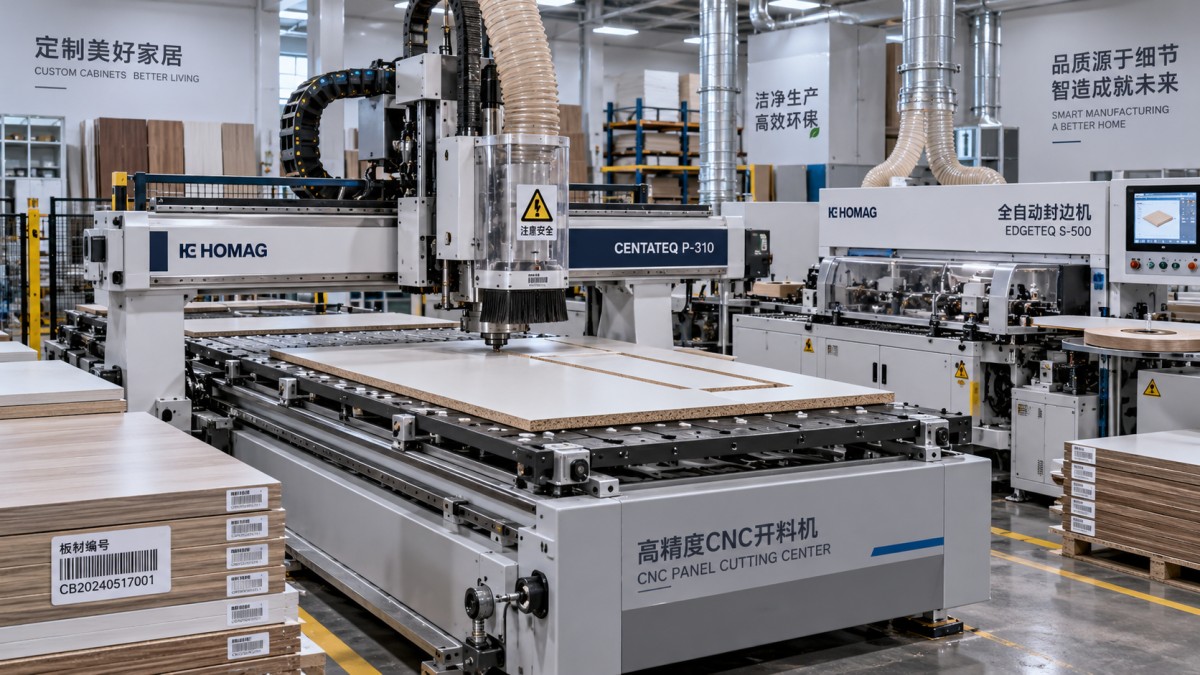
Spindle or main-saw motor power is often treated as a simple measure of machine quality. It is not. The relevant issue is whether the power, torque characteristics, tooling, and feed capability match the intended workload. Melamine-faced particleboard, MDF, plywood, compact laminate, veneered board, and hardwood components do not place identical demands on a cutting system.
An undersized drive can force conservative feed rates, increase heat, and shorten tool life when difficult materials are processed. Excessive power without appropriate tooling, extraction, or workholding does not automatically produce cleaner edges. Evaluate the complete cutting arrangement: spindle interface, available tool diameters, collet or arbor quality, scoring capability where relevant, feed control, and accessibility for safe blade or cutter changes.
For nested-based manufacturing, consider how many tools must be carried for a normal job and how tool changes affect cycle time. A tool changer should be assessed for reliability and recovery procedures, not only its number of positions. For beam or sliding-table saws, kerf quality at the planned production feed rate is more meaningful than a demonstration cut made slowly on an easy board.
Useful questions during a cutting evaluation
- Which board types, thicknesses, coatings, and panel sizes will be processed most often?
- Can the supplier demonstrate those materials with the proposed blade, cutter, scoring setup, or nesting tool?
- What happens to cut quality as tools wear, and how is tool life monitored?
- Does the machine retain acceptable results on narrow strips, small parts, or parts with limited vacuum contact?
- How easily can operators correct a setup error without losing an entire batch?
Automation Should Remove Repeatable Work, Not Add Fragility
Automation is valuable when it reduces repeated handling, prevents transcription mistakes, or stabilizes a process that is otherwise difficult to control manually. It is less valuable when it introduces a complicated dependency that the shop cannot diagnose. The best level of automation differs between a small custom operation and a factory making repeatable cabinet ranges.
Review the path from design data to machine program. Can cut lists, nesting files, drilling data, and labels move into production without repeated manual entry? Is the software compatible with the shop’s current design or production system, or will an operator need to rebuild jobs at the machine? The answer affects both labor and error risk. It is useful to request a walkthrough using a representative cabinet job, including revisions, offcuts, labels, and a production restart after an interruption.
Barcode identification can be especially useful where parts move between cutting, edging, drilling, and assembly. Yet it only works when labels remain readable, scan points fit the workflow, and the data structure is maintained. Similarly, automatic loading and unloading require attention to panel stack conditions, available floor space, material handling routes, and what happens when the system encounters warped or damaged sheets.
Dust Extraction and Safety Are Design Inputs
Dust extraction is sometimes treated as a facility detail to resolve after the machine arrives. That approach can lead to poor chip evacuation, reduced visibility, dust accumulation, excess cleanup, and inconsistent machining. Machine connection sizes, expected airflow requirements, duct routing, blast gates, filter capacity, and the properties of the materials being cut should be reviewed together with the extraction provider and applicable local requirements.
A woodworking machine also needs to fit the shop’s safe operating pattern. Evaluate emergency-stop locations, guarding, interlocks, access during tool changes, workpiece loading height, manual override procedures, and the clarity of alarms. Safety systems must be compatible with the intended workflow; bypassed guards and improvised handling methods are warning signs that the installation was not designed around actual production.
Electrical requirements require equal care. Voltage, frequency, phase arrangement, installed load, cable sizing, grounding, and air supply are project-specific details that should be confirmed before shipment. If machinery will be supplied across borders, documentation and conformity requirements need early review against the destination market rather than assumption.
Maintenance Access Is Part of the True Machine Cost
A cabinet shop rarely loses time because a machine has no advanced feature. It loses time when a simple issue cannot be found, a wearing component is unavailable, or routine maintenance takes too long to perform. During technical evaluation, inspect lubrication points, electrical cabinet access, pneumatic components, vacuum pumps, belts, chains, sensors, bearings, and areas where dust can accumulate.
Request a clear list of recommended consumables and critical spare parts, along with maintenance intervals and service documentation. There is no universal spare-parts package; the sensible inventory depends on machine configuration, production intensity, location, and the time required to obtain replacements. Still, a supplier should be able to explain which items are likely to be needed and how remote troubleshooting is handled.
Qingdao Zhongding Machinery Co., Ltd. has developed woodworking equipment and complete solutions over more than 20 years, serving furniture production, workshops, and industrial lines in different markets. That experience points to a practical procurement lesson: the machine itself is only one part of a reliable installation. Technical support, commissioning guidance, spare-parts planning, and responsive after-sales communication deserve the same scrutiny as mechanical specifications.
Compare Proposals on a Like-for-Like Basis
When quotations arrive, normalize them before comparing price. One proposal may include tooling, extraction interfaces, installation supervision, training, software modules, safety options, documentation, and spare parts, while another may list only the base machine. A low initial figure can become less favorable once the equipment is made production-ready.
A practical comparison sheet should record the exact machine configuration, major purchased components where specified, work envelope, power supply, required utilities, included accessories, software scope, lead time, packaging method, commissioning responsibilities, warranty terms, and excluded work. Any claim regarding output should be tied to material, part geometry, tooling, operator involvement, and production assumptions. Without those conditions, cycle-time comparisons are rarely meaningful.
The strongest decision is usually not the one with the highest specification in every category. It is the configuration that handles the planned material mix accurately, fits the production flow, can be maintained with confidence, and leaves room for realistic growth. Before placing an order, confirm the layout, utilities, sample-job performance, delivery scope, local compliance needs, and the support path after installation. Those checks turn a machine purchase into an operating solution rather than an expensive assumption.
Send Your Inquiry
We welcome your cooperation and we will develop with you.