


News & Exhibitions
Latest Factory Updates, Industry Trends & Global Exhibition Information
What to verify before choosing Qingdao Zhongding Machinery for a panel line
A panel line should be evaluated as a production system, not as a collection of individual machines. That distinction matters when assessing Qingdao Zhongding Machinery or any supplier offering woodworking equipment for panel processing. A line can look suitably specified on a quotation yet still underperform because its feed logic, handling interfaces, dust extraction allowance, electrical architecture, or service model does not fit the factory that will run it.
For a technical evaluator, the sensible starting point is not “Is this machine capable?” It is “Can this exact configuration process our panel range, at our required output, with the operators, utilities, maintenance discipline, and downstream constraints we actually have?” A supplier with experience in woodworking machinery may be a credible candidate, but the investment decision should rest on documented configuration and operating assumptions rather than on the broad description of a panel line.
Begin with the panel and production definition
“Panel line” can describe very different equipment scopes: a cutting and edge-processing cell, a drilling and routing line, a nesting-based workcell, or a more automated flow connecting loading, machining, labeling, sorting, and unloading. Before comparing machines, define the workpiece and the job mix in terms a machine builder can use.
The panel specification should cover material type, thickness range, minimum and maximum dimensions, face quality, edge materials, required hole patterns, cut accuracy, and the condition of incoming boards. Melamine-faced board, MDF, plywood, particleboard, veneer-faced panels, and laminated sheets do not create the same machining load or dust behavior. A line intended mainly for standard cabinet carcass parts may not be suitable for a mix containing narrow strips, high-gloss surfaces, warped plywood, and frequent custom dimensions.
Ask for the supplier’s written operating range, then compare it with the full production mix rather than the most common board. The practical limits are often found at the edges of the specification:
- Can the line transport the smallest components without skewing, dropping, or requiring manual intervention?
- How does it hold thin, flexible, bowed, or narrow panels during cutting, drilling, or edge processing?
- Which material and thickness combinations require reduced feed speed or special tooling?
- Are coated, high-gloss, or veneer-faced surfaces protected at transfer points and pressure zones?
- What happens when a part falls outside the programmed size range: does the machine reject it safely, stop the flow, or risk damaging the workpiece?
A promising throughput figure is of limited value if it applies only to a narrow band of standard panel sizes. The supplier should be able to translate the evaluator’s cut list or representative part-family data into a proposed layout, machine sequence, and realistic cycle assumptions. If the discussion remains at the level of “high efficiency” or “automatic operation,” the engineering definition is still too loose for a purchase decision.
Separate nameplate capacity from usable line output
Capacity claims need to be examined across the entire material flow. The slowest reliable stage determines output, and that stage may be an infeed station, labeling process, buffer, edge-banding operation, drill station, unloading zone, or manual quality check rather than the primary cutting machine.
A useful review asks the supplier to show the cycle logic for a representative production batch. This should include loading, board alignment, machining time, part transfer, tool changes, barcode or label processing where applicable, rejects, and unloading. It should also state the assumed operator actions. A line that reaches its quoted rate only when an operator pre-sorts every panel, removes offcuts continuously, and intervenes at every exception should be assessed as a labor-dependent cell, not a fully automated line.
Technical teams should test three scenarios during quotation review: a standard high-volume run, a mixed batch with frequent size changes, and a shift containing normal interruptions. The mixed batch is especially revealing. Custom furniture and cabinet production often generates variation in panel dimensions, drill patterns, edge requirements, and hardware preparation. Equipment may machine each part correctly but lose productivity through queueing, repeated setup, label mismatch, or manual routing between stations.
Do not treat every minute of a shift as productive machining time. Board replenishment, tool inspection, adhesive preparation where edge banding is included, cleaning, calibration, material defects, program corrections, and routine stoppages all consume capacity. The important question is whether the proposed configuration leaves enough margin to absorb those events without moving the bottleneck to the next process.
Inspect the configuration below the sales description
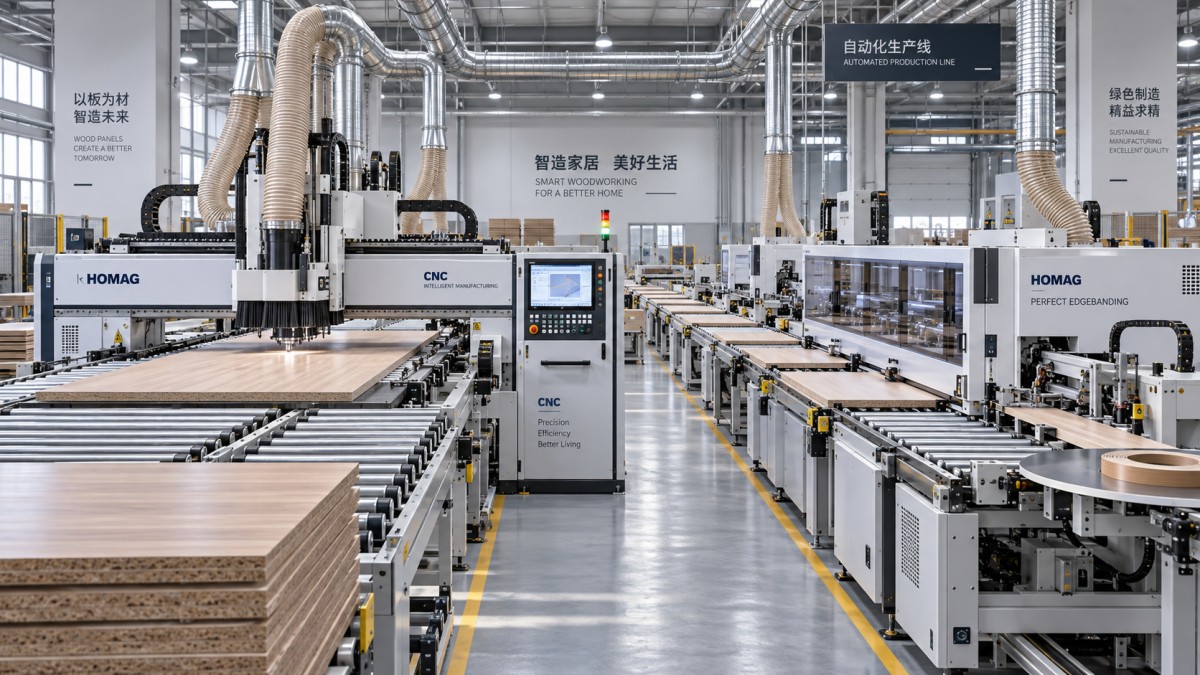
“Automatic,” “CNC,” and “industrial-grade” are descriptions, not technical specifications. The configuration supplied by Qingdao Zhongding Machinery should be examined at component and interface level, with the quotation tied to a clear machine list, model designation, layout drawing, and responsibility boundary.
Start with the mechanical elements that influence panel quality and long-term repeatability: frame construction, reference surfaces, clamping method, guide systems, feed rollers or belts, vacuum zones, saw or spindle arrangement, and the accessibility of alignment points. For cutting equipment, evaluators should understand how squareness, straightness, chip control, and surface finish are maintained as tooling wears. For drilling and routing stations, attention should go to spindle configuration, aggregate compatibility if relevant, tool-change arrangement, dust capture near the cutting point, and the process for verifying hole-position accuracy.
Component origin matters, but a recognizable component brand alone does not prove line quality. The larger issue is whether motors, drives, bearings, pneumatic parts, sensors, controllers, electrical protection devices, and safety hardware have been selected as a coherent system and are supported in the buyer’s region. Request the itemized bill of materials for critical assemblies. It should identify model numbers where practical, especially for control hardware, servo systems, inverters, PLCs, safety devices, vacuum equipment, and high-wear mechanical parts.
That documentation makes later maintenance more manageable. It also exposes configuration gaps early. A proposed line may include a capable main machine but omit essential practical items such as dust extraction connections, offcut handling, chip conveying, compressed-air preparation, voltage adaptation, spare tooling, barcode hardware, or suitable conveyors between stations. Those omissions can materially change total project cost and commissioning time.
Check controls and automation against the factory’s data flow
Automation compatibility should be assessed as an operating question, not a software feature checklist. A panel line may accept files from design or production-planning software, but the evaluator should establish how job data becomes machine-ready programs, how revisions are controlled, and what prevents the wrong panel from being processed with the wrong operation.
Where labels and scanning are part of the intended workflow, ask how identifiers are generated, applied, read, and handled when damaged or unreadable. A barcode system only reduces errors when the line has a defined response to exceptions. Similarly, nesting, optimization, cutting lists, drilling data, and edge information must be aligned. The handoff between office software and machine control should be demonstrated using representative jobs rather than a generic sample file.
For multi-machine installations, clarify whether conveyors are merely physical transfers or are controlled as an integrated line. A machine stopping for a tool change or fault can create panel accumulation upstream and starvation downstream. Buffer capacity, routing rules, stop logic, and manual bypass options determine whether a minor issue becomes a line-wide stoppage.
Technical evaluators should also review access rights, backup procedures, alarm history, remote-service capability, and the availability of electrical and software documentation in a usable language. It is reasonable to ask who can alter parameters, who retains program ownership, and how the factory restores operation after a controller failure or computer replacement. These details are easy to postpone during procurement and difficult to solve once production depends on the line.
Use factory acceptance to verify the promised process
A factory acceptance test should be planned before the equipment is built or dispatched, with agreed samples, acceptance measurements, and test conditions. Waiting until travel arrangements are made to define the test usually produces an inspection focused on whether machines move, rather than whether the line performs the required work.
Provide representative panels and programs where possible, including the material types and component sizes that create the most risk. The test should cover normal parts as well as at least some boundary-condition parts: narrow pieces, panels near maximum size, common drill patterns, visible faces, and the material thicknesses that matter most to the operation. Quality checks may include dimensions, diagonal accuracy, edge quality, hole location, surface damage, and consistency across repeated parts. The acceptance criteria should distinguish cosmetic requirements from functional tolerances so that disagreements do not appear after installation.
Observe more than finished sample panels. Watch loading and reference, panel turning or transfer, chip evacuation, label handling, error recovery, tool changes, and how operators access guarded areas for routine tasks. Ask for a demonstration of an ordinary interruption, such as a sensor error, a program correction, or a missing panel. Recovery time and clarity of alarms can be more meaningful than a smooth demonstration of an uninterrupted cycle.
Evaluate installation, safety, and service as part of the machine scope
A line can be mechanically sound and still be a poor fit if the receiving factory cannot support it. Before committing, compare the installation requirements against the actual site: floor condition and loading, building access, lifting routes, electrical supply, compressed air, dust extraction capacity, fire and dust-control arrangements, network availability, and space for material staging and maintenance access.
Safety should be reviewed against the standards and site obligations applicable where the equipment will operate. The supplier should explain the intended guarding, emergency-stop arrangement, interlocks, isolation points, lockout provisions, safety circuits, and documentation included with the machine. Evaluators should look beyond whether safety devices are present. They need to be positioned so operators are unlikely to bypass them to clear jams, load panels, clean waste, or perform adjustments.
After-sales capability deserves the same specificity as the machine configuration. “Technical support” has little meaning without a response path, documentation set, spare-parts list, recommended stock level, and a clear distinction between remote troubleshooting and on-site work. For Qingdao Zhongding Machinery, request a list of commissioning deliverables: installation guidance, electrical drawings, pneumatic diagrams, maintenance schedules, operating manuals, training scope, recommended consumables, and critical-spares recommendations. Confirm the process for identifying parts by machine serial number and the expected method of support across time zones.
Buyers should separately plan their own maintenance readiness. An automated line generally requires more than operators trained to start and stop equipment. It needs people able to inspect wear points, maintain extraction performance, manage tooling, diagnose common alarms, preserve backups, and know when a fault should be escalated. A supplier cannot eliminate that operational requirement through automation.
Make the decision from a documented gap list
The strongest basis for selection is a short, explicit gap list between the proposed panel line and the target operation. It should identify every requirement that is included, excluded, optional, assumed, or dependent on buyer-provided infrastructure. This list is more useful than a broad comparison of catalog features because it directs negotiation toward the issues that affect commissioning and output.
Qingdao Zhongding Machinery may be suitable when its proposed configuration can be traced to the buyer’s panel range, production mix, site conditions, automation architecture, and service plan. The answer should remain conditional until those links are documented and tested. A panel line is a long-lived production asset; the practical value comes from stable, recoverable daily operation, not from the highest figure shown on the quotation.
Send Your Inquiry
We welcome your cooperation and we will develop with you.