


News & Exhibitions
Latest Factory Updates, Industry Trends & Global Exhibition Information
What to Include in a CNC Drilling Machine Quote for Custom Cabinet Production
A CNC drilling machine quote for custom cabinet production should do more than state a machine price and a delivery date. It should make it possible to judge whether the machine can process the intended cabinet parts, fit the existing workflow, and remain productive after installation. A useful devis perceuse cn separates the base machine from optional equipment, defines technical limits clearly, and shows which costs may appear after the order is placed.
The most expensive quoting mistake is comparing two totals that do not represent the same production capability. One offer may include automatic loading support, cabinet-design software integration, tooling, and remote commissioning, while another covers only the drilling unit. The lower number is not necessarily the lower-cost choice once manual handling, rework, installation, and future upgrades are considered.
For custom cabinet work, the quote should be built around the actual part mix: side panels, shelves, doors, drawer components, back panels, and irregular pieces. Standardized panel production and mixed-order cabinet production place different demands on a CNC drilling solution. The quote should make those differences visible before a purchase decision is made.
Start with the parts, not the machine model
Before requesting a quote, prepare a short production brief. It does not need to be a formal engineering document, but it should include the board materials, common panel sizes, thickness range, hole patterns, edge-banding sequence, and expected production rhythm. A supplier cannot responsibly configure a CNC drilling machine from the phrase “cabinet production” alone.
Custom cabinet shops often process a changing mix of cabinet carcasses, shelves, gables, drawer fronts, and special-size components. In that environment, flexibility in program changes and panel positioning can matter more than headline drilling speed. A factory producing repeated cabinet modules may gain more from higher automation and faster material flow. These are not competing views; they are different cost models.
Ask the supplier to confirm in writing whether the quoted machine handles the largest and smallest practical workpieces, the materials used in normal production, and the hole types required. Horizontal drilling, vertical drilling, shelf-pin holes, hinge cup holes, connector holes, and dowel holes should not be assumed to be covered merely because a machine is described as “CNC drilling.”
What a complete CNC drilling quotation should specify
A workable quote should let a reader compare machine capability line by line. The following items deserve explicit descriptions rather than broad sales language.
Machine travel is not the same as usable panel capacity. Clamps, stop positions, reference edges, and the need for safe tool clearance can reduce the practical range. This is especially relevant for narrow drawer parts and short cabinet components. Request confirmation based on representative drawings or a sample drilling program, rather than relying only on a specification sheet.
Drilling capacity should be described as finished operations
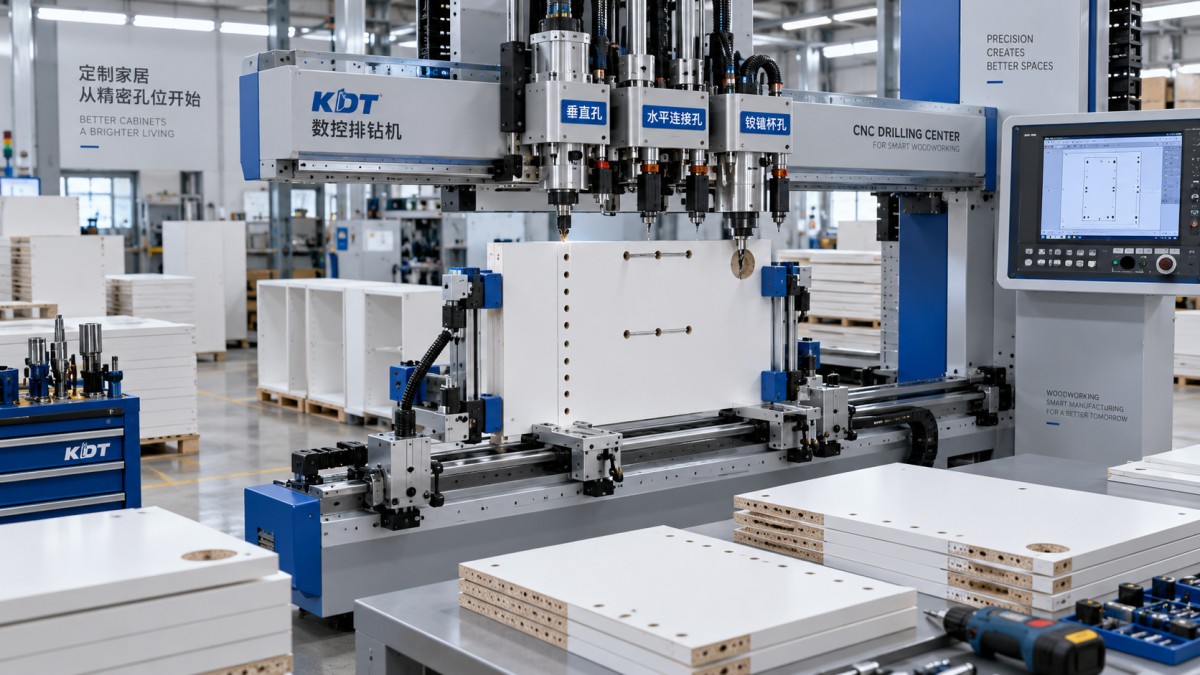
A quote that simply lists the number of spindles does not yet show whether the machine suits the work. The relevant question is whether the required holes can be drilled accurately and efficiently in the expected sequence. For example, a cabinet side may require shelf pins, cam-lock holes, dowel holes, and horizontal connector drilling. If these operations require repeated repositioning or separate manual setups, apparent capacity can turn into lost time.
Specify which holes are processed from the top, bottom, front, rear, and panel edges. Confirm whether the machine can complete left- and right-hand parts without unnecessary program duplication. For work involving both metric and imperial drawings, verify how dimensions are entered and managed within the control system.
Hinge drilling deserves a separate line item when doors are part of the production mix. A standard cabinet drilling pattern may not cover every hinge cup position, mounting-hole arrangement, or door format used in custom projects. The same applies to drawer systems, concealed connectors, and specialty fittings. A quote should state whether the requested operations are included in the programmed scope or require added tooling, fixtures, or manual intervention.
Automation is valuable only when the workflow can use it
Automatic feeding, unloading, labeling, barcode scanning, and return systems can reduce handling between operations. They also increase the initial investment, floor-space demand, commissioning complexity, and dependency on consistent panel flow. The correct question is not whether automation is available, but whether it solves a measurable bottleneck.
If operators spend much of the shift searching for the next program, identifying panels, or turning boards repeatedly, workflow automation may be justified. If production consists mainly of small, varied jobs with frequent material changes, a simpler machine with fast setup and accessible controls may provide better operating value. A quote should therefore separate the core drilling machine from each automation module and explain the interface between them.
Pay attention to the definition of “automatic.” In some configurations, it refers only to automatic axis movement after an operator loads and positions each panel. In others, it includes integrated handling equipment. Neither is inherently better, but the quote must identify where manual work begins and ends. This prevents an incorrect labor-cost assumption during project approval.
Software compatibility is a production issue, not an IT detail
Cabinet production often begins in design or order-processing software, then moves through cutting, edging, drilling, assembly, and packing. A CNC drilling machine can be mechanically capable but still create delays if programs must be rebuilt manually for each order.
The quotation should identify the supported data format and the expected path from design data to machine program. Clarify whether the supplied software imports cabinet drilling data directly, requires conversion, or depends on operator-created programs. Ask who is responsible for post-processing settings, library setup, and initial program verification.
Software ownership should be equally clear. Confirm whether the quoted system includes a perpetual license, a limited module, a machine-bound license, or ongoing paid access. Also establish whether the buyer can edit drilling programs, create new part templates, and back up machine data without relying on the supplier for routine changes.
For a workshop introducing CNC processes for the first time, training should include more than starting and stopping the machine. Operators need to understand tool selection, origin references, program verification, error recovery, and how to recognize a bad hole pattern before a batch is affected. That training scope belongs in the quote.
Price comparisons need a delivered-cost view
The machine price is only one part of the project. A better comparison uses the expected cost to bring the equipment into routine production. Freight, customs handling where applicable, unloading equipment, electrical preparation, compressed air, dust extraction connection, tooling, installation labor, and training can all sit outside a basic offer.
A strong devis perceuse cn identifies what is included, what is optional, and what remains the buyer’s responsibility. Terms such as FOB, CIF, DAP, or other shipping arrangements should be linked to a practical description of the handover point. The goal is not to turn a machine quote into a logistics contract; it is to avoid treating an export price as a ready-to-run factory cost.
Do not assume that a more automated system always has a lower total cost of ownership. Its value depends on output consistency, labor availability, job repetition, and the cost of idle capacity. Conversely, selecting the least expensive configuration can be costly when it cannot process common cabinet formats or requires recurring manual drilling.
Separate essential options from future options
Some options are essential from day one because the target parts cannot be produced correctly without them. Other options improve throughput but can wait until order volume is stable. The quotation should make this distinction easy to see.
- Essential configuration: functions, tools, software connections, and safety equipment needed to produce current cabinet designs.
- Production upgrade: barcode systems, expanded tool capacity, automated panel handling, or integration equipment that improves flow at higher volume.
- Future-ready provision: space, interfaces, or control capability that allow a later upgrade without replacing the machine.
This structure helps protect the budget without under-specifying the initial purchase. It also creates a clear internal record of which savings are genuine and which merely postpone a necessary expense.
Service, spare parts, and acceptance criteria belong in the quote
CNC drilling equipment is a production asset, so the support plan is part of its operating value. The quote should state warranty coverage, remote technical support channels, documentation language, expected spare-parts process, and the availability of wear items such as drills, collets, sensors, belts, or pneumatic components. A vague promise of after-sales service is less useful than a defined support path.
Acceptance should also be discussed before shipment. The buyer should provide representative panel drawings, drilling patterns, and material information early enough for the supplier to confirm the application. The final agreement can then identify the machine configuration and the intended test operations. This reduces disputes caused by an unspoken assumption that a standard machine would perform a special fitting or panel-handling task.
Qingdao Zhongding Machinery Co., Ltd. manufactures and exports woodworking machinery and provides complete woodworking solutions alongside technical support and spare-parts service. When evaluating a supplier with this type of scope, the useful question is whether the proposed drilling configuration, support arrangement, and parts plan are documented for the cabinet application being purchased, rather than presented as general capabilities.
Questions to resolve before approving the order
Before accepting an offer, compare it against a small set of actual production requirements. The answers should be in the quotation, its attachments, or the agreed technical specification.
- Can the machine process the most common panels and the most demanding regular part without manual drilling?
- Which cabinet operations are completed in one setup, and which require turning, re-clamping, or a second machine?
- What tools, holders, software modules, and fixtures are included in the stated price?
- How will data move from cabinet design to the drilling program, and who sets up the initial libraries?
- What site utilities, handling equipment, and installation work must be prepared before delivery?
- Which components are consumables, which spare parts are recommended, and how is technical support accessed?
- What exact evidence will show that the delivered machine matches the agreed application?
The right quote does not need to predict every future cabinet design. It should accurately define the parts and workflow the machine is being purchased to handle now, show the cost of the required configuration, and expose the operational trade-offs behind each option. That is what turns a CNC drilling machine offer from a price sheet into a sound production decision.
Send Your Inquiry
We welcome your cooperation and we will develop with you.