


News & Exhibitions
Latest Factory Updates, Industry Trends & Global Exhibition Information
Is CE Certification Enough to Import Woodworking Machinery into the EU?
For many buyers, the question begins with a reassuring sight: a CE mark on the machine nameplate, a declaration in the supplier’s quotation, and a promise that the equipment is “EU compliant.” It is tempting to believe that this is the end of the compliance journey.
But is CE certification enough to import woodworking machinery into the EU? In most cases, no. CE marking is essential, yet it is only one visible part of a broader legal and practical framework. A panel saw, edge bander, CNC router, wide belt sander, drilling machine, or automated production cell must be properly designed, documented, shipped, declared, and supported before it can be placed on the EU market with confidence.
For importers, furniture manufacturers, and machinery distributors, the risk is not merely a customs delay. Incomplete compliance can lead to a machine being stopped by market-surveillance authorities, documentation requests from customers, unexpected modification costs, or liability concerns after an accident. The good news is that these risks can be managed when the process starts before production and shipment—not after the container reaches the port.
CE Marking Is Necessary, but It Is Not a Standalone Passport
CE marking indicates that a machine manufacturer has assessed the product against applicable EU requirements and declares that it meets them. For most woodworking machinery currently placed on the EU market, the central legal framework remains the Machinery Directive 2006/42/EC. The new EU Machinery Regulation (EU) 2023/1230 will gradually replace that framework, with broad application beginning in January 2027.
However, CE marking is not granted by one universal EU authority, nor is it simply a label that can be added to a machine. It is the outcome of a conformity assessment process. The manufacturer must identify hazards, apply relevant safety requirements, prepare technical documentation, issue an EU Declaration of Conformity, and ensure the machine is supplied with the required information.
For certain higher-risk machine categories listed in the Machinery Directive, involvement of a notified body may be required unless the machine has been fully manufactured in accordance with applicable harmonised standards. Whether this applies depends on the precise machine type, safety design, and standards used. A buyer should never assume that every woodworking machine follows the same route to conformity.
In other words, a CE mark is meaningful only when the work behind it is real, traceable, and relevant to the exact machine being imported.
What an Importer Should Verify Before Ordering
A practical compliance review should start with the configuration, not with the shipping documents. Woodworking equipment can be supplied as a basic machine, a machine with optional automation, or a connected line with feeding, dust extraction interfaces, guarding, and software controls. Every added element may affect the final risk assessment and the documentation required.
Before confirming an order, ask the supplier for a structured compliance package. At a minimum, it should address the points below.
The full technical file does not always need to travel with the machine or be handed to every buyer. Still, it must be available to the appropriate authorities when requested. Importers should clarify who holds it, where it is kept, and how quickly it can be provided. A vague answer such as “we have CE documents” is not enough for a high-value industrial purchase.
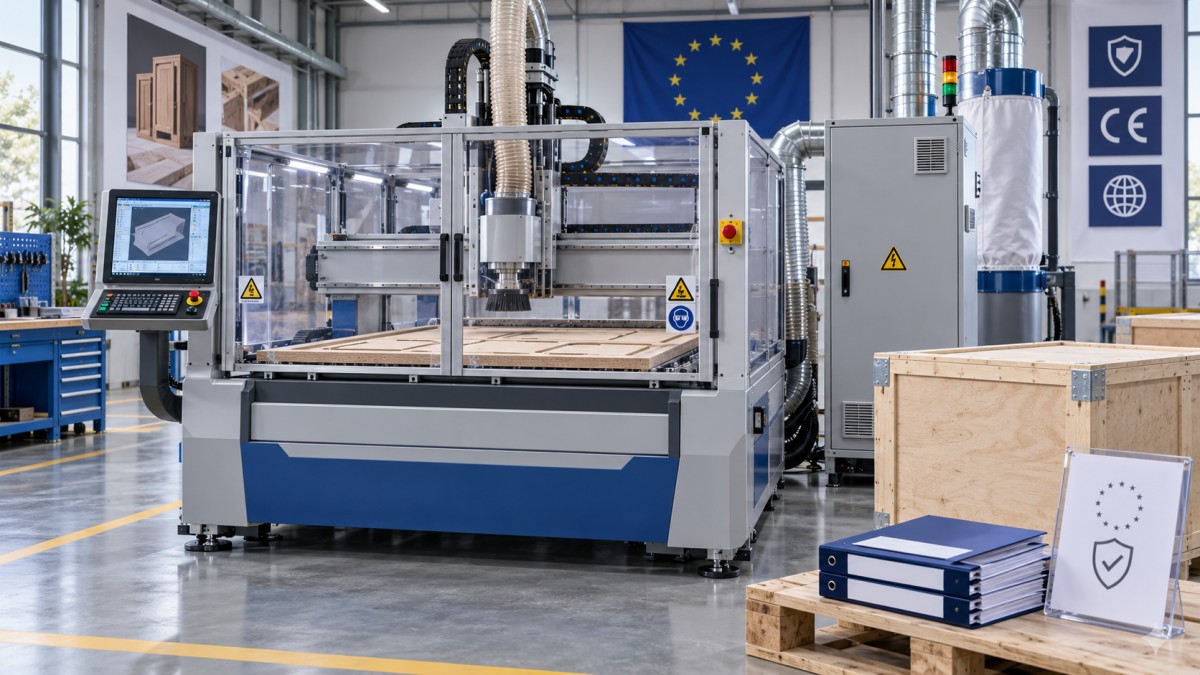
Woodworking Machinery Has Risks That Need More Than Generic CE Paperwork
Woodworking is a demanding application. Timber is not always uniform; knots, warped boards, resin, moisture variation, and unstable offcuts can change how material behaves at the cutting point. A machine that appears safe in a brochure may create serious hazards if its guarding, braking, workpiece holding, emergency-stop system, or dust-management interface has not been considered carefully.
For example, a sliding table saw may require attention to blade guarding, riving knife settings, braking performance, anti-kickback arrangements, and clear instructions for blade replacement. A CNC router requires safe loading procedures, enclosure or guarding logic, emergency-stop access, spindle-tool compatibility, and control-system behavior after a power interruption. For sanding machinery, dust extraction and fire or explosion considerations may become especially important depending on the material, process, and site conditions.
The machine’s intended use must also match the buyer’s real use. A machine supplied for manual loading in a small workshop is different from the same base model integrated with automatic feeding, robotic handling, or a conveyor line. Once equipment is connected into a larger system, responsibility for the overall assembly may change. The final party creating the production line may need to assess the integrated system as a whole rather than treating every individual machine as an isolated item.
Other EU Rules May Apply Alongside the Machinery Requirements
A common mistake is to look only at the machinery rules. Depending on the machine and its equipment, other EU legislation may also be relevant. The Electromagnetic Compatibility Directive can apply to electrical and electronic equipment that may generate or be affected by electromagnetic disturbance. Radio equipment rules may be relevant where wireless controls, Wi-Fi modules, or remote communication functions are included.
Electrical safety must be assessed in the context of the machinery framework and the equipment installed. Components such as motors, control cabinets, inverters, lasers, sensors, and remote-control systems should not be treated as an afterthought. The finished machine must be evaluated as supplied, not merely as a collection of compliant components.
Environmental obligations can also arise. Depending on the product scope and the national market, buyers may need to examine requirements related to electrical and electronic equipment, restricted substances, batteries, packaging waste, or producer-responsibility schemes. These obligations vary by product type and EU Member State. They should be reviewed with a qualified local adviser, particularly where the importer sells machinery under its own brand or distributes it in several countries.
For woodworking operations involving combustible dust, an importer should also consider the customer’s workplace environment. ATEX-related responsibilities may concern the equipment design, the dust collection arrangement, and the employer’s site-specific explosion protection measures. CE marking on the machine does not remove the end user’s responsibility to operate a safe production environment.
Customs Clearance and Product Compliance Are Connected—but Not Identical
Customs authorities focus on import declarations, tariff classification, customs value, origin, import VAT, duties, and trade controls. Product-safety authorities focus on whether the machine can legally be made available on the EU market. In practice, these areas can overlap, and a shipment may face questions if documentation is inconsistent or the product appears non-compliant.
Importers should prepare the commercial side of the transaction early: an EORI number where required, the correct commodity code, invoice and packing list, transport documents, country-of-origin information, and a clear record of the machine description. Customs classification for woodworking machinery should be confirmed based on the actual function of the equipment, rather than copied casually from a previous shipment.
The name on the invoice, the manufacturer name on the declaration, the model on the rating plate, and the machine described in the instruction manual should all align. Small inconsistencies can create unnecessary concern. If a machine is sold through a distributor under a private label, the legal roles of manufacturer, importer, authorised representative, and distributor should be clarified in writing.
The Importer Has Responsibilities After the Machine Arrives
Importing is not a one-time paperwork event. Under EU market-surveillance rules, the importer is expected to act responsibly once the machine enters the supply chain. This includes ensuring that the manufacturer has carried out the appropriate conformity assessment, checking that CE marking and required documentation are present, and keeping relevant documentation available for the required period.
The importer must also make sure that the product bears the required traceability information and that instructions and safety information are provided in a language easily understood by users in the Member State where the machine is sold. A high-quality English manual alone may not be sufficient for every market.
If the importer identifies a safety issue, the correct response is not to continue selling stock while waiting for clarification. The machine may need to be corrected, withdrawn, or recalled, depending on the situation. Authorities and customers may need to be informed. This is why a supplier’s responsiveness, spare-parts capability, and technical communication matter long after the shipment has cleared customs.
Beware of “Certificates” That Do Not Prove Full Compliance
Buyers often receive certificates bearing official-looking logos, stamps, or test-laboratory names. Some may be useful supporting evidence. Yet a certificate by itself does not automatically prove that the final machine complies with all applicable EU requirements.
Be cautious when documents have a different company name from the actual manufacturer, refer to another machine model, cover only a component, cite outdated or unrelated legislation, or contain no clear link to the delivered configuration. A test report for an electrical cabinet, for instance, is not the same as a conformity assessment for a complete CNC nesting machine.
The key question is simple: Does this documentation clearly support the exact machinery being placed on the EU market? If the answer is uncertain, resolve it before shipment.
A Better Buying Process for EU-Bound Machinery
Experienced importers build compliance checks into their procurement schedule. They do not wait until the final payment stage. A sensible process begins by defining the intended application, destination country, operator skill level, voltage requirements, tooling, dust-extraction arrangement, and production-line interfaces.
Next, request draft manuals, draft declarations, machine layout drawings, electrical specifications, and safety details while the machine is still being configured. This gives both sides time to correct labels, adjust language versions, clarify optional equipment, and ensure that the order description matches the final product.
Before dispatch, verify the machine’s nameplate information, CE marking, serial-number format, accessories, documentation pack, and packaging labels. On arrival, inspect the equipment before commissioning. Check guards, interlocks, emergency stops, electrical connections, protective earth continuity where applicable, and damage caused during transport. A professional installation and acceptance record can be valuable for both safety and future service.
Choosing a Supplier Who Understands the Full Lifecycle
Compliance documents matter, but they should be supported by sound engineering and practical service. A woodworking machine will need installation advice, operating guidance, maintenance planning, replacement parts, and sometimes remote technical support. When a safety device needs adjustment or a production line must be modified, the supplier’s ability to respond becomes part of the buyer’s risk management.
Qingdao Zhongding Machinery Co., Ltd. has more than 20 years of experience in woodworking machinery manufacturing and export. From individual workshop machines to equipment used in furniture manufacturing and industrial production lines, the company focuses on reliable machine performance, precision engineering, spare-parts support, and practical communication throughout the ownership cycle.
For EU-bound projects, early discussion is especially valuable. Buyers should share their destination market, required language versions, intended processing tasks, automation level, and any site-specific requirements. This helps ensure that the delivered solution is not only suited to production goals, but also accompanied by the information needed for a more controlled import and commissioning process.
The Short Answer: CE Is the Starting Point, Not the Finish Line
So, is CE certification enough to import woodworking machinery into the EU? CE marking is indispensable, but it is not enough on its own. Importers must verify the conformity assessment behind the mark, obtain accurate documentation, meet customs and traceability obligations, provide correct local-language instructions, and remain prepared to support product safety after the machine enters the market.
A well-prepared import does more than avoid a border problem. It gives the distributor confidence when selling, helps the furniture manufacturer install equipment safely, and creates a stronger foundation for years of productive use. For machinery that sits at the center of a workshop or production line, that preparation is not administrative excess—it is part of buying the right machine.
Send Your Inquiry
We welcome your cooperation and we will develop with you.