


News & Exhibitions
Latest Factory Updates, Industry Trends & Global Exhibition Information
When does a cabinet edge banding machine need corner rounding?
When does a cabinet edge banding machine need corner rounding?
A Cabinet Edge Banding Machine needs corner rounding when edge-banded doors and panels require smooth, radiused transitions at their leading and trailing corners—not simply trimmed edges. The decision depends on edge-band thickness, panel geometry, finish specifications, and production volume. Standard end trimming and top-and-bottom trimming may leave transitions that still require manual finishing. A dedicated corner-rounding unit becomes worthwhile when those unfinished corners create a quality problem or a recurring production bottleneck.
The important question is not whether a machine has more processing stations. It is whether its tooling and movement can reproduce the approved corner finish across your actual panel range, at the required output, without damaging the decorative surface.
Corner rounding does a different job from ordinary trimming
End trimming removes the excess band projecting beyond the front and rear of a panel. Top-and-bottom trimming removes the overhang above and below the panel faces, producing a flush, beveled, or radiused longitudinal edge, depending on the tooling. Neither operation automatically guarantees a blended finish where these surfaces meet at the panel ends.
A corner-rounding unit uses controlled tool movement and panel tracking to machine these end transitions. Its purpose is to blend the edge profile around the relevant corners rather than leave an abrupt intersection between separately trimmed surfaces. The number of motors alone does not establish capability: tracking arrangement, cutter access, control logic, and workpiece limits all matter.
There is also a terminology trap. Corner rounding on a straight-line edge bander generally does not mean turning a square panel outline into a large-radius curved panel. A door with rounded corners in plan view may require contour machining and a suitable contour edge-banding process. Establish which geometry the drawing requires before comparing machine quotations.
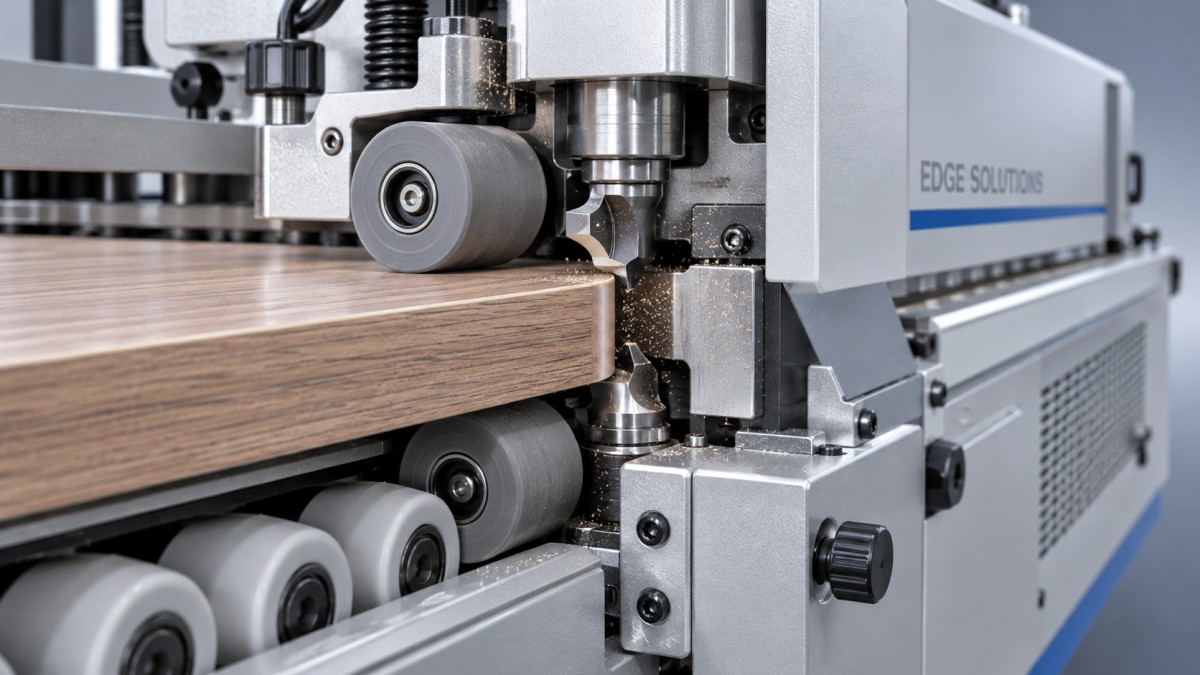
Where the extra unit earns its place
Exposed cabinet doors, drawer fronts, and frequently handled panels are the strongest candidates. People notice these corners visually and by touch. A panel can look acceptable along its straight edge yet feel unfinished where the end trim meets the top or bottom profile.
Thicker plastic edging often makes this transition more apparent because there is more material to shape. However, thickness is not a universal purchasing threshold. Thin edging can still need careful corner finishing, while a thicker band may intentionally retain a different profile. Specify the finished geometry rather than assuming that every band above a particular thickness requires the same operation.
The following distinctions help separate genuine requirements from optional features:
- Repeated exposed components: An integrated unit is worth evaluating when the same corner finish must be reproduced throughout regular cabinet production.
- Concealed internal components: If the approved finish is achieved by ordinary trimming, corner rounding may add little practical value.
- Small, varied batches: A separate finishing station may be sufficient when corner work is infrequent and handling is manageable.
- Deliberately square or beveled details: Automatic rounding can conflict with the design. Confirm that the unit can be bypassed or configured appropriately.
A softer corner can improve handling comfort, but it is not proof of compliance with a furniture safety requirement. Any specified radius, test method, or acceptance criterion still needs to be checked against the applicable project documents.
Match the unit to the material, not just the brochure
ABS, PVC, veneer, and solid-wood edging do not respond identically to cutting. Material stiffness, grain direction where relevant, cutter sharpness, temperature, and support can affect the result. A unit demonstrated successfully on one plastic band should not automatically be accepted for every edging material in your schedule.
The cutter profile must also suit the intended radius and available material. An unsuitable combination can leave a step, remove too much edging, or expose the substrate. Where bands have a decorative surface over a differently colored core, aggressive profiling may reveal a visible color change even when the machining is geometrically consistent.
Check the panel-contact system as carefully as the cutter. Tracing shoes, rollers, and pressure settings must follow the workpiece without marking sensitive faces. High-gloss and textured surfaces deserve separate trials. A demonstration on a forgiving matte panel does not establish performance on a more easily marked finish.
Poor corner quality is not always a corner-rounding problem. Unsquare blanks, chipped substrates, inconsistent band adhesion, and incorrect upstream trimming can all affect the final transition. Adding another machining station will not reliably compensate for unstable panel preparation or a weak glue joint.
Check the operating envelope at production speed
A machine specification may list a broad panel-thickness range while the corner-rounding function has narrower limits. Request the operating envelope for the complete process with corner rounding active, not merely the maximum dimensions that can pass through the conveyor.
The most useful questions concern interacting limits:
- What minimum panel length and width are permitted with this unit engaged?
- Which combinations of panel thickness, band thickness, and cutter radius are supported?
- What feed speed and panel spacing are required for reliable tracking?
- Which leading and trailing corner transitions are processed in each pass?
- Does changing thickness or profile require manual adjustment, tooling replacement, or a stored recipe?
- Can the unit be bypassed without disrupting the remaining finishing operations?
Panel spacing is easy to overlook. A line may have adequate conveyor speed but still require larger gaps so the rounding mechanism can complete its movement and reset. Compare accepted parts per shift rather than relying only on the headline feed-speed figure.
For short components and mixed-size batches, request a representative production sequence. One large panel processed slowly proves much less than a run containing the smallest eligible parts, normal gaps, and routine size changes.
Compare integrated rounding with the real alternative
Manual corner finishing is not automatically an unsuitable process. For occasional work, a trained operator using appropriate equipment may meet the specification economically. A separate corner-rounding machine can also make sense when only part of the product range needs this operation.
Integrated rounding becomes more attractive when secondary handling is continuous. Count the time needed to remove panels from the line, stack them, move them to another station, finish the corners, inspect them, and return them to production. Measuring only tool-contact time understates the existing workload.
For a practical comparison, calculate annual avoidable manual-finishing cost from your own production records, then subtract the additional tooling, maintenance, energy, and setup costs of automatic rounding. Compare the remaining annual saving with the incremental installed investment. Do not assume that every minute saved becomes a cash saving; it may instead release capacity or reduce overtime.
Retrofitting deserves particular caution. An existing Cabinet Edge Banding Machine may lack the bed space, controls, guarding, extraction capacity, or synchronized motion needed for an additional unit. Ask the original manufacturer to confirm feasibility before treating a retrofit as a lower-cost alternative.
Make the acceptance trial difficult enough to be useful
Provide actual production panels, edging, and the intended adhesive system wherever practical. Include the most demanding combinations within the proposed specification, not only the easiest material. An approved reference sample gives both parties a clearer target than a request for “smooth corners.”
Inspect the finished transitions for ridges, uncut projections, gouging, chipped decoration, visible substrate, and inconsistent profiles between leading and trailing ends. Examine panels after all intended edges have been banded: the processing sequence and intersecting bands can affect the final appearance. Keep the acceptance inspection separate from any undocumented hand touch-up.
Ask for repeated parts and a changeover demonstration. Consistency after adjustment is more revealing than a single carefully prepared sample. Record cutter details, settings, feed speed, panel spacing, and any downstream scraping or buffing used to achieve the approved result.
Maintenance access belongs in this trial too. Check how cutters are changed, how tracing components are cleaned, and how settings are restored. Obtain a wear-parts list and clarify which replacements require specialist adjustment. These details influence long-term usability as much as the initial finish.
Keep the specification focused on the complete workflow
Qingdao Zhongding Machinery Co., Ltd. manufactures and exports woodworking machinery, drawing on more than 20 years of industry experience. For an edge-banding evaluation, the relevant discussion should cover the proposed machine configuration, sample testing, technical support, spare-parts supply, and after-sales arrangements—not simply whether corner rounding appears on an options list.
Other woodworking operations should remain clearly separated in that discussion. For example, the Finger joint press machine MH1525A joins short wood pieces into longer components for finger-jointed and laminated-wood production. Its stated maximum working length is 2500 mm. It addresses an upstream material-assembly task, not edge finishing, and does not replace a corner-rounding unit.
Specify corner rounding when the required end transition cannot be achieved consistently and economically by the alternative process. Before approving the machine, confirm the smallest part, most demanding band material, required profile, and realistic production rate in one documented trial. If ordinary trimming already meets the agreed finish without recurring secondary work, omitting the unit can be the more disciplined engineering choice.
Send Your Inquiry
We welcome your cooperation and we will develop with you.