


News & Exhibitions
Latest Factory Updates, Industry Trends & Global Exhibition Information
Six-Sided CNC Drilling Machine ROI: When Does Automation Pay Back?
A six-sided CNC drilling machine pays back when it removes a real production constraint, not simply because it can drill faster. The strongest return usually comes from a combination of fewer manual handling steps, lower dependence on highly skilled drilling operators, fewer panel errors, and a smoother flow from design data to finished cabinet components.
For a shop producing repeat cabinet parts at a stable volume, automation can replace several separate operations: face drilling, edge drilling, groove or connector-hole processing, flipping panels, moving workpieces between machines, and checking hole positions before assembly. When those steps are already consuming labor, floor space, and rework time, the investment can become commercially sensible. When production is highly irregular, panel construction changes constantly, or upstream data is unreliable, the machine may remain underused and the payback period will stretch.
The purchase decision should therefore begin with a production diagnosis. The question is not “How many panels can this machine process?” It is “Which current costs disappear, which costs remain, and how consistently can the machine be fed with correct work?”
Where the return on a six-sided CNC drilling machine actually comes from
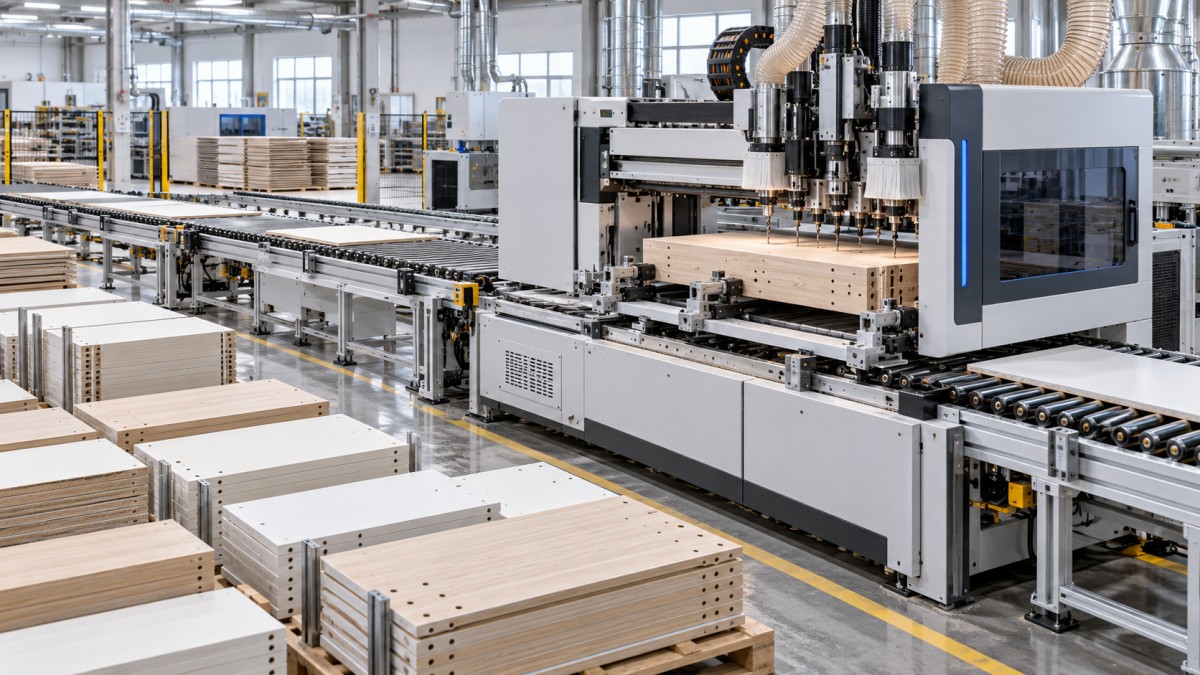
A six-sided CNC drilling machine processes multiple faces and edges of a panel within one automated cycle. Depending on the machine configuration and program, it can handle holes for hinges, dowels, cam locks, shelf pins, connectors, slides, and other cabinet hardware without the repeated repositioning associated with conventional drilling methods.
That capability creates value in several different ways. Speed is visible, but it is rarely the only or even the largest source of savings.
Labor savings should be calculated carefully. A machine does not eliminate all labor. Panels still need to be supplied, inspected, unloaded, sorted, and moved to the next process. Programs must be prepared, tools must be maintained, and exceptions still require attention. The practical comparison is not “one machine versus zero people.” It is the labor hours removed from low-value handling and repeated setup, plus the improved output achieved by the people who remain.
Accuracy has a similar economic effect. A wrongly drilled panel can waste more than the panel itself. It can interrupt assembly, delay an order, consume replacement material, and create confusion when a damaged part is mixed into a batch. Automated drilling is valuable because it makes the result more repeatable, provided that panel dimensions, reference edges, and incoming program data are correct.
Volume matters, but stable workload matters more
High panel volume supports a faster payback, yet volume alone is an incomplete measure. A large order that appears once and then disappears does not justify a capital purchase in the same way as a dependable flow of cabinet work. The machine must have enough regular work to absorb its ownership cost across normal production months, including slower periods.
Consider the difference between two operations. One makes a limited range of standard kitchen and wardrobe cabinets every week. The other handles occasional custom interiors, small repairs, and a wide mix of one-off joinery. The second operation may process panels, but its true bottleneck may be design approval, material sourcing, finishing, or installation. In that case, a sophisticated drilling cell can be impressive but financially premature.
A six-sided drilling solution is usually easier to justify where one or more of these conditions apply:
- Cabinet parts are produced continuously rather than only in short, infrequent bursts.
- Panel drilling is performed on several separate machines or workstations.
- Order variation is high enough that manual templates and repeated setup create delays.
- Assembly depends on accurate hardware and connector locations.
- Recruiting or retaining experienced drilling operators is difficult.
- Delivery performance is constrained by the interval between panel cutting and assembly.
It is less compelling when the expected production volume is low, manual drilling is already quick and controlled, or the shop cannot yet provide consistent digital production data. That does not mean automation is never appropriate for a smaller operation. It means the buyer should place more value on flexibility, future demand, and workflow simplification than on a short-term labor calculation alone.
The calculation should use contribution, not headline capacity
Machine suppliers may discuss cycle time and processing capacity, but a payback estimate should be built from the production that can actually be sold and delivered. A machine cannot create a return from unused theoretical capacity. It must either allow more orders to be completed, lower the cost of existing orders, reduce costly mistakes, or protect output when labor is scarce.
A practical payback model starts with annualized benefits and annualized ownership costs. The basic structure is straightforward:
Payback period = total investment / annual net benefit
The difficulty lies in defining “annual net benefit” honestly. Use the savings and added contribution that can be tied to the new workflow, then subtract the costs introduced by the equipment.
Include these benefits
- Labor hours that can be reassigned from drilling, panel flipping, measuring, and rework to productive work elsewhere.
- Additional completed output when drilling is preventing orders from reaching assembly or shipment.
- Reduced material loss from incorrect hole patterns, edge references, or hardware positions.
- Lower setup time for repeatable product changes.
- Reduced dependence on overtime or subcontracted machining during busy periods.
Include these costs
- Machine purchase, transport, installation, commissioning, and any required site preparation.
- Software integration, programming support, and training time.
- Tooling, consumables, maintenance, electricity, dust extraction, and planned spare parts.
- Operator time that remains necessary for loading, unloading, quality checks, and material flow.
- Financing cost, where the acquisition is funded rather than paid from available capital.
- Lost output during startup, operator learning, or process adjustment.
A common error is treating all saved labor hours as cash savings. If employees remain on payroll and there is no increase in throughput, the immediate financial benefit may be lower than expected. The investment can still make sense if those workers are moved to assembly, finishing, packing, or another constrained area. But the model should identify the resulting output gain rather than counting the same labor saving twice.
Automation only performs as well as the data and material flow behind it
The most expensive surprise after installation is often not a mechanical problem. It is discovering that the existing workflow cannot supply the machine consistently. Six-sided drilling depends on accurate part dimensions, reliable panel orientation, correct hardware libraries, and clean production files. If the design system produces incomplete or inconsistent drilling data, operators will spend time editing programs, checking panels, and resolving exceptions at the machine.
Before purchase, trace one representative order from confirmed design through cutting, edge banding, drilling, assembly, and packing. Identify where part labels are created, how panel orientation is preserved, who releases programs, and how design changes are communicated after production has started. This exercise often reveals whether the proposed machine will eliminate a bottleneck or merely move it upstream.
Edge banding deserves particular attention. A finished panel may have different reference conditions depending on whether one, two, or four edges are banded. Hole positions need to match the final usable dimensions, not only the original cutting dimensions. The drilling program, cutting process, and edging process must therefore follow the same production logic. When those systems are disconnected, repeatability suffers regardless of machine quality.
Material condition also affects results. Warped panels, inconsistent panel thickness, damaged edges, and poor dust control can create handling or machining issues. Procurement should examine the full cell: panel supply, labeling, extraction, offloading, sorting, tooling access, and the route to assembly. The drilling machine is one part of a manufacturing system.
Compare the alternative process, not only competing machines
The relevant comparison may be a six-sided CNC drilling machine against a point-to-point CNC, a drilling and dowel insertion machine, a nesting router, a combination of manual drilling stations, or continued subcontracting. Each route has a different cost profile.
A nesting router can be practical when the same machine must cut shapes, route pockets, and drill panels. It may be less efficient when most work is rectangular cabinet components requiring dense and repeated hole patterns. A point-to-point machine can suit certain drilling tasks well, but may require more handling or repositioning depending on the part and machine layout. Manual stations have a lower purchase cost and can be flexible for low volume, but their labor requirement, setup burden, and risk of variation rise as order complexity grows.
Subcontracting avoids capital expenditure and may be sensible for uncertain demand. Its hidden costs are longer lead times, transport, reduced control over urgent changes, and margin paid to an outside processor. The best choice depends on the share of work that is standard panel drilling, the urgency of delivery, and whether in-house control improves the wider business enough to justify ownership.
When comparing quotations, avoid choosing solely on the number of drilling heads or the maximum dimensions stated on a specification sheet. Ask each supplier to process representative part files or explain the exact workflow for them. Include common cabinet sides, shelves, doors, drawer components, narrow parts, parts with dense hardware patterns, and panels that require edge references from different sides. The objective is to understand routine production behavior, not an ideal demonstration part.
Questions that expose whether the investment is ready
These questions are more useful than a generic ROI promise:
- Which current operation is limiting order completion: drilling capacity, labor availability, setup time, rework, or material movement?
- How many working hours are spent on panel drilling and handling across a normal production period?
- What proportion of panel errors originates in drilling, hardware location, or manual interpretation of drawings?
- Can design software create dependable drilling data, labels, and part orientation instructions?
- What will happen to the labor released by automation: reduce overtime, increase output, improve assembly capacity, or remain idle?
- Can the shop maintain an adequate, repeatable flow of suitable panel work?
- Does the site have the electrical supply, compressed air, extraction capacity, access space, and internal material handling needed for installation?
- Who will support programming, commissioning, routine maintenance, and spare-parts supply after the machine is running?
The final question has a direct financial effect. A machine that stops for an avoidable service issue can disrupt an entire cabinet line. Equipment selection should therefore include the supplier’s installation scope, training approach, technical response process, documentation quality, and access to consumable and replacement parts. The lowest acquisition price can be more expensive over time when support is weak or routine maintenance becomes difficult.
Qingdao Zhongding Machinery Co., Ltd. supplies woodworking machinery and complete production solutions for furniture manufacturing, workshops, and industrial panel-processing lines. For buyers assessing a drilling investment, the useful discussion is not limited to machine configuration. It should also cover the existing process, expected product mix, commissioning needs, and the support required to keep the equipment contributing to production costs rather than adding operational uncertainty.
When the answer is “not yet”
Deferring the purchase can be the right decision when production data is not controlled, demand is too unpredictable, or a more basic bottleneck is restricting output. For example, adding automated drilling will not solve an assembly shortage, unreliable edge banding, slow design approval, or insufficient panel cutting capacity. In those situations, improving job preparation, labeling, scheduling, or the upstream process may generate a better first return.
There is also a middle ground. A business can standardize hardware rules, improve cabinet libraries, measure current drilling labor, and route more repeat work through one controlled process before committing to full automation. Those actions make the eventual ROI calculation more credible and reduce startup risk.
The purchase is ready when the machine has a defined role in a repeatable workflow: it will process a steady stream of suitable parts, remove a measured constraint, receive accurate data, and be backed by operators and service support. Under those conditions, automation is not simply a faster drilling method. It becomes a way to stabilize panel production, protect accuracy, and create capacity that can be used profitably.
Send Your Inquiry
We welcome your cooperation and we will develop with you.